Monday after Easter. I read in the New York Times about a retrospective of artist David Hockney’s work that was scheduled while we were in Paris. I immediately ordered four tickets from the sponsor, the Louis Vuitton Foundation. Betsy and Jim were not familiar with Hockney, but they are great travel partners and always game for new opportunities and new experiences. All of us were headed for an immersive experience at David Hockney 25 today.
I was first aware of Hockney during his California period (1970-1990): color drenched scenes of swimming pools, nudes, and double portraits now owned by museums and regularly shown in exhibits.
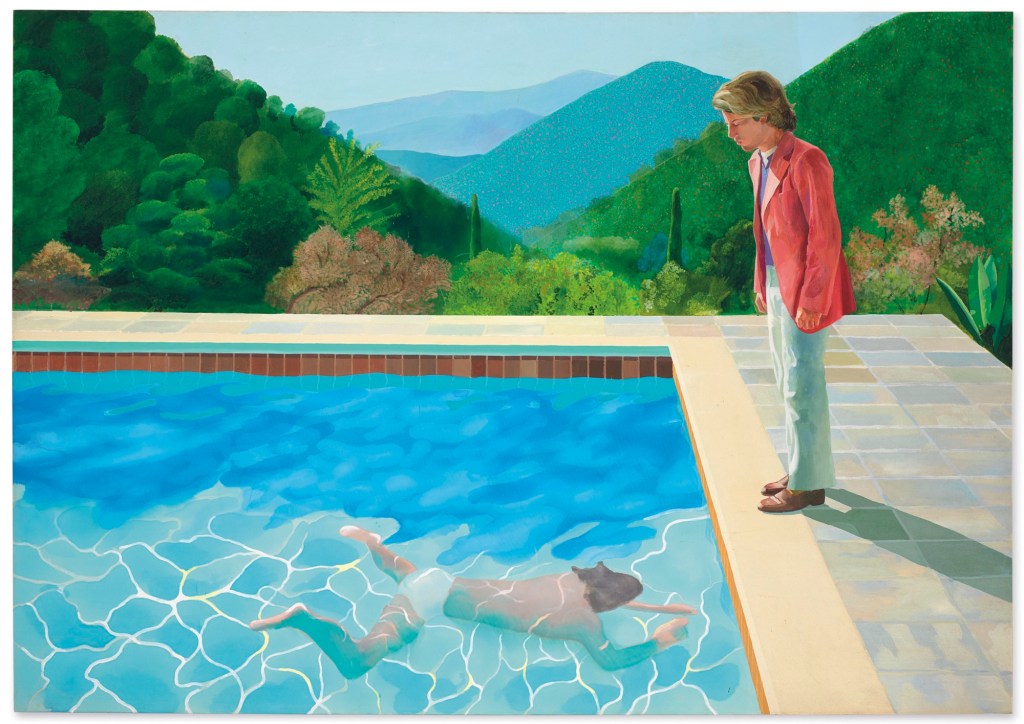
His work was noted for brilliant hues and flat perspective influenced by pop art. I knew nothing about his earlier work nor much about his work since 2000. I had read about pioneering use of Polaroid, iPhone and iPad and other technologies as tools and media for art and inspiration.
Louis Vuitton Foundation
We took an Uber to the Louis Vuitton Foundation sponsoring of David Hockney 25. The building, designed by Frank Gehry, is itself a monumental work of art.
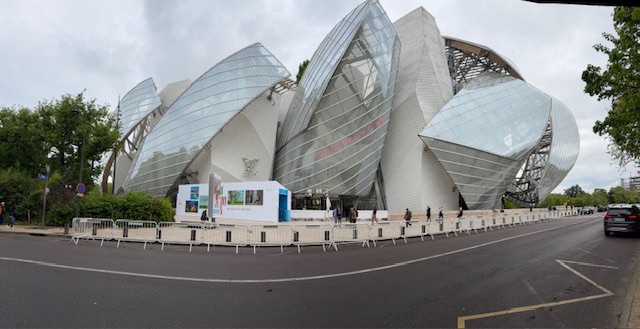
Concrete blocks stacked at weird angles are the core for the 4-level structure. The blocks are pierced with giant glass windows creating internal light.
Metal shields or sails looks like gossamer wings on every side. Perhaps it is a giant 3-masted schooner sitting high on the edge of Bois de Boulogne park. Or perhaps it’s a flutter of butterflies ready to take flight. We were stunned by its presence before getting out of the Uber.
David Hockney 25
With 11:00 tickets we were ushered into a reception hall bypassing the crowds standing on line hoping for the limited daily tickets. We got audio tour headphones and started through the exhibit.
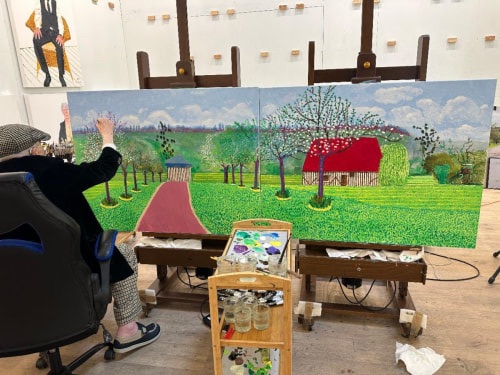
On a wall, we watched a video of David Hockney painting a canvas that we would see later in the show.
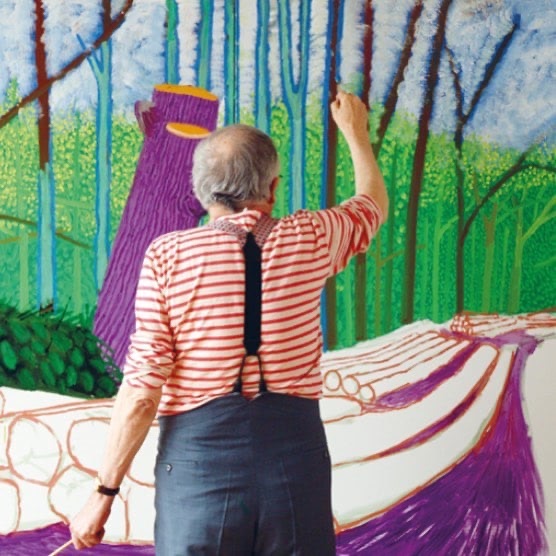
Look for the finished painting later in the blog.
Hockney walked or stalked back and forth with his brushes, bounding up to the canvas to add a stroke here or there, stepping back to consider, then changing colors and working on a different part. Here we could see him actually making dabs and splashes and strokes on canvas—a new and revealing use of technology.
The galleries were organized both chronologically and thematically.
- Abstract art declared he was openly gay during his early days at the Royal College of Art the when it was still illegal in England
- Moving to California and achieving fame for his painting that captured the cool hedonism of the time
- Touring the United States experiencing the vastness, openness, and beauty of mountains and canyons
- Moving back and forth between Los Angeles and Yorkshire to take care of his mother
- Moving to Yorkshire permanently and painting pastoral scenes in his style
- Moving to Normandy and more reflection on the surrounds
- A gallery of portraits
- A final video gallery of opera designs of the 1980s and 1990s which are among his most imaginative and fantastical works
Wherever Hockney lived he was inspired by what he saw and recorded it for himself and for the world to see differently.
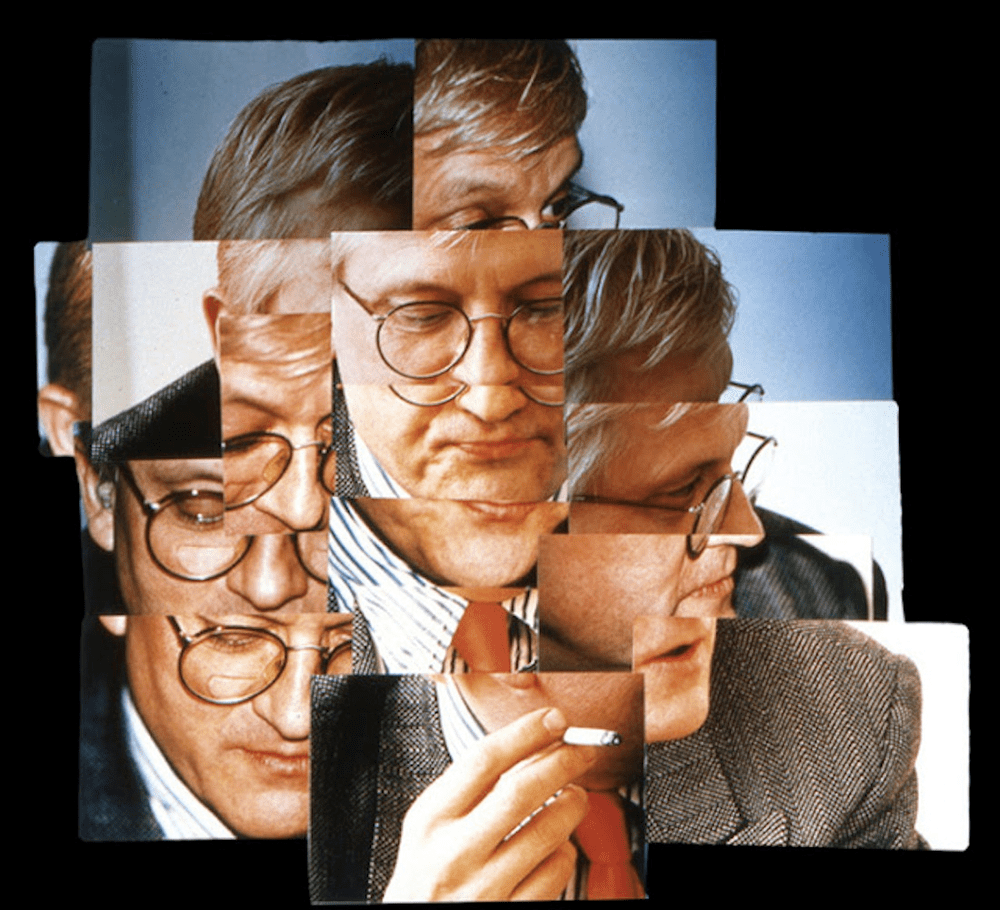
Over his career he worked in oil, acrylic, watercolor, and charcoal. He engaged in printmaking. He used photography for collages which then led him to thinking about collage in painting. He pioneered technology as a tool and as a medium itself. Still painting. In 2017, he was fit enough to work at his easel for 6 hours a day. Nearing 90, he is under care at his home in Normandy.
After 3 hours spent in 7 galleries, Becky and I were overwhelmed, elated, and exhausted. We were soaked in the art we saw.
We did not attempt photography because capturing what we saw was impossible, especially with the crowds everywhere. We knew we would buy the huge catalog but not until we were home.
A Life of Boundless Creativity
Hockney’s art was him and he was his art. He was intimate and monumental. He was plain but never simple. He was grand and granular.
He was famous and infamous. He was commercial and self-aware of history and legacy. He was humorous and self effacing. He was a curmudgeon and a Bon Vivant. He was open and private. He loved and lost and loved again.
He painted people. He painted himself, his pets, celebrities, and his friends and lovers. He honored those artists who inspired him and “recreated” their famous work in his own style
The images captured in his art are a unique vision. I could wax on and on and then on some more about what we saw and how we felt. Instead I am going to take you, friends and readers, on a my exhibition of his work because that is what he lived for.
California
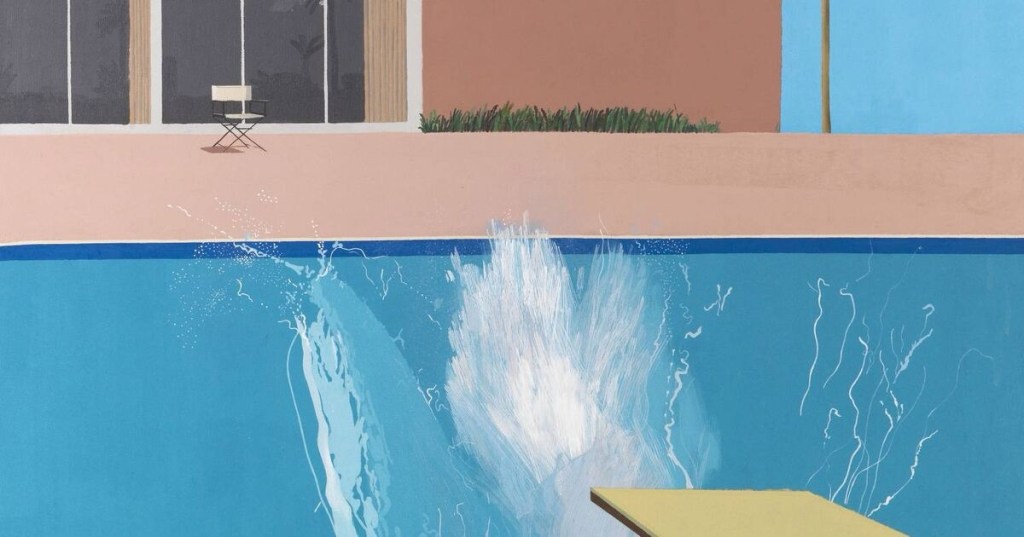
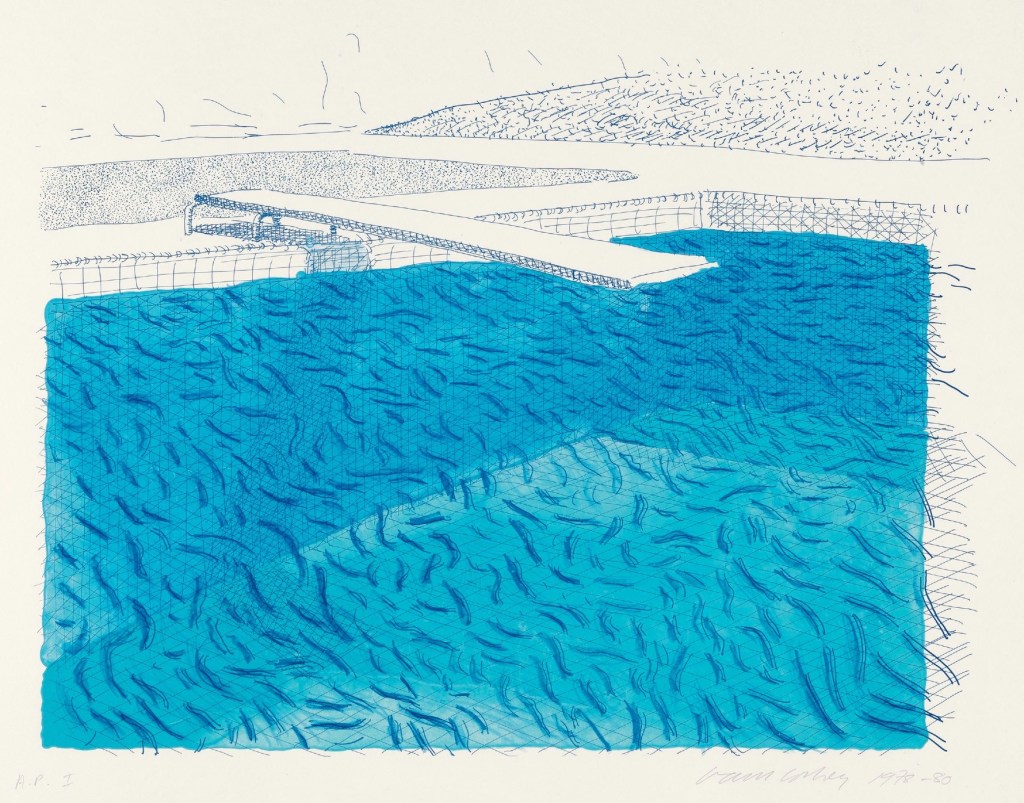
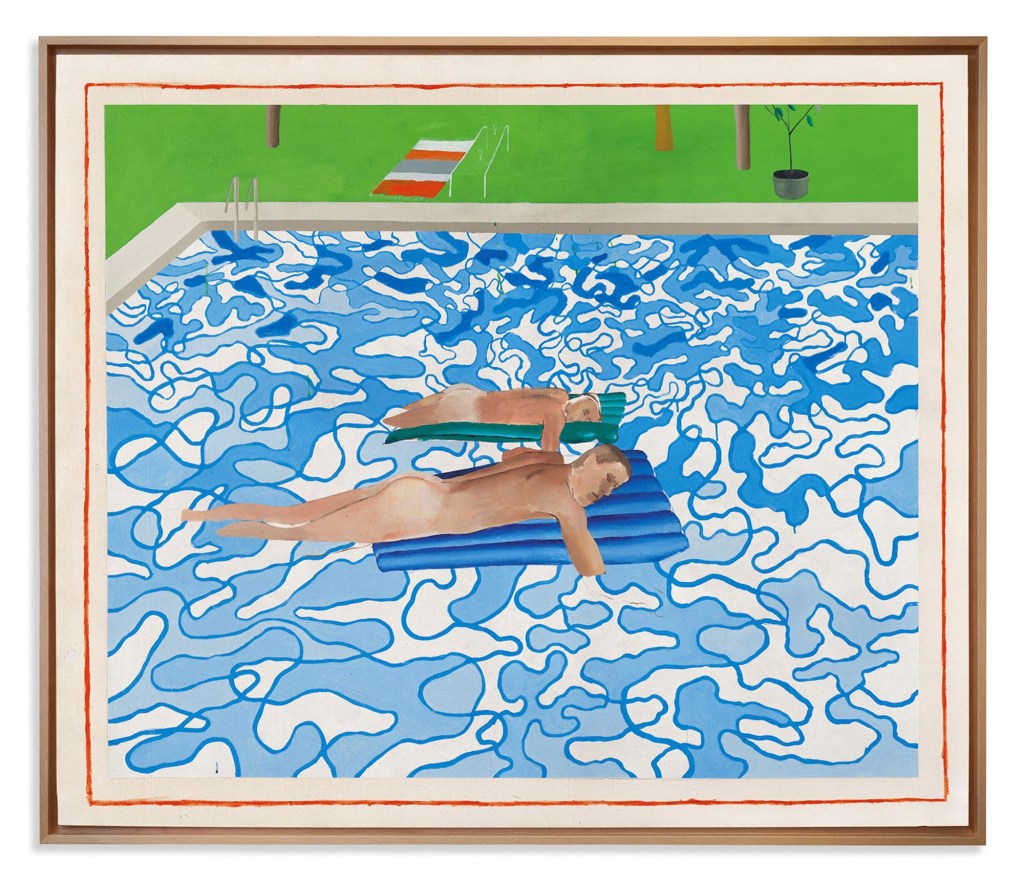
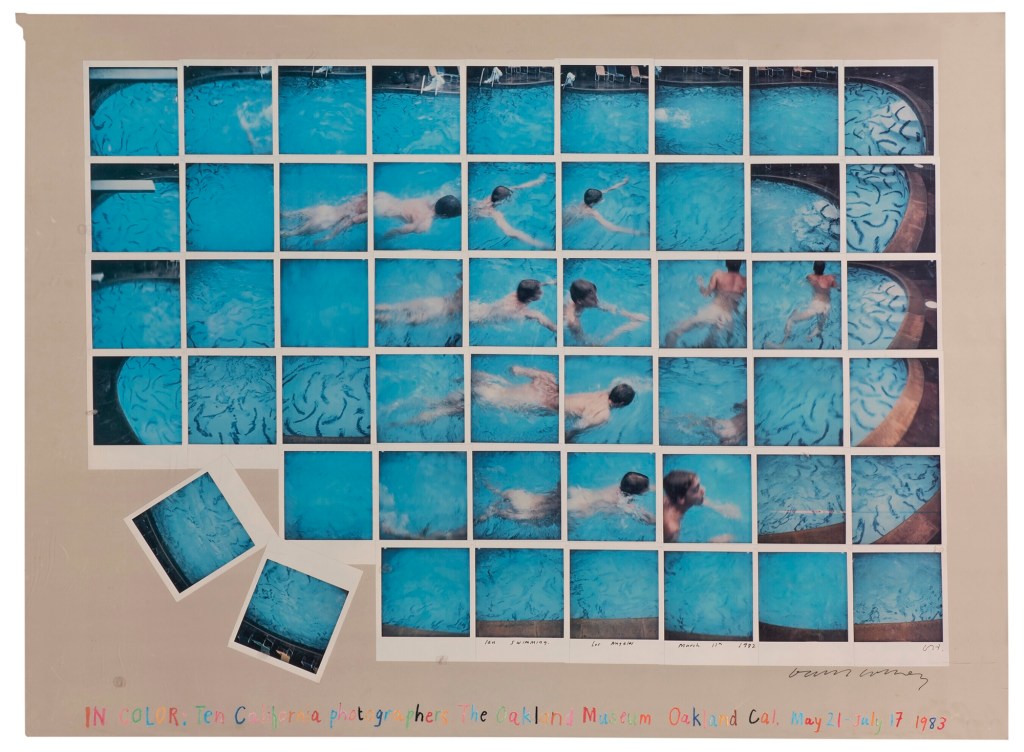

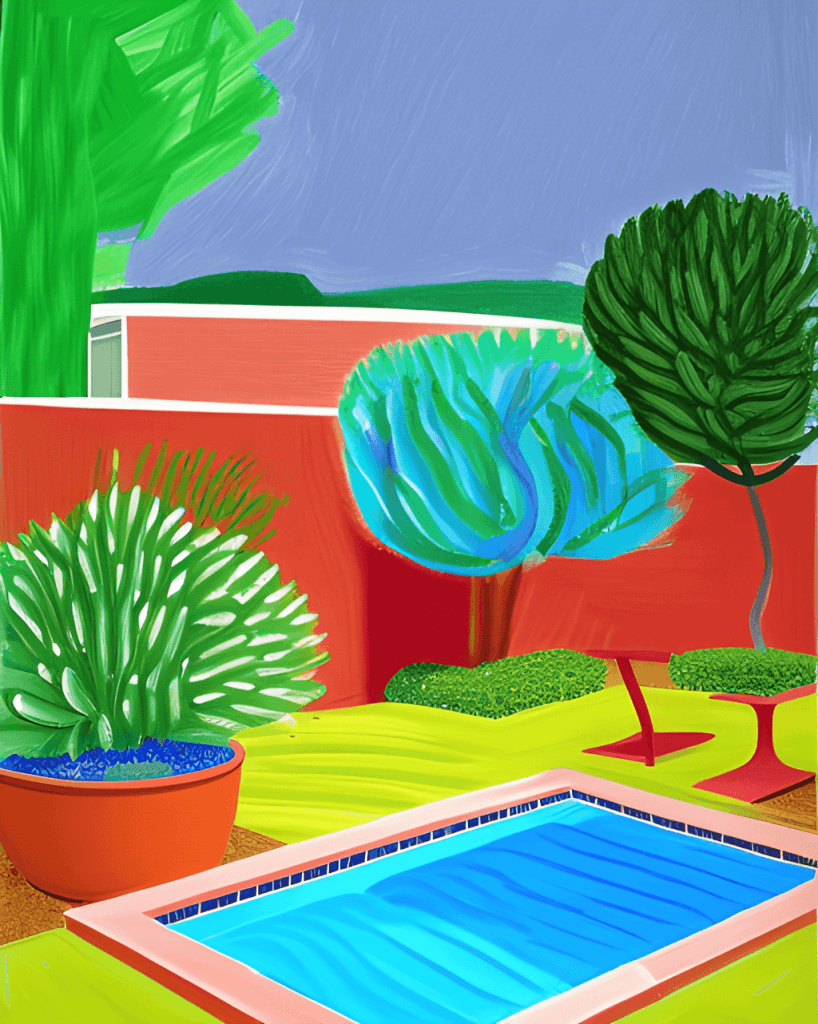

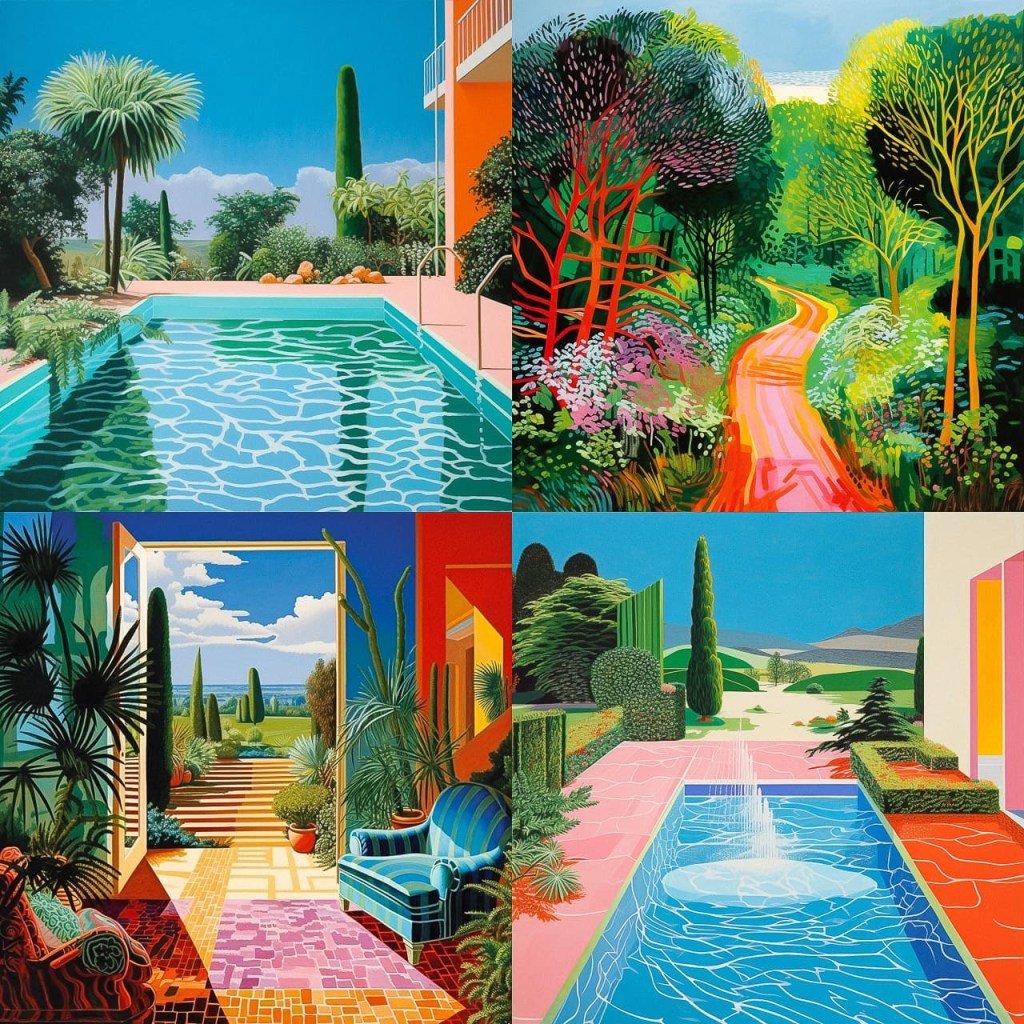


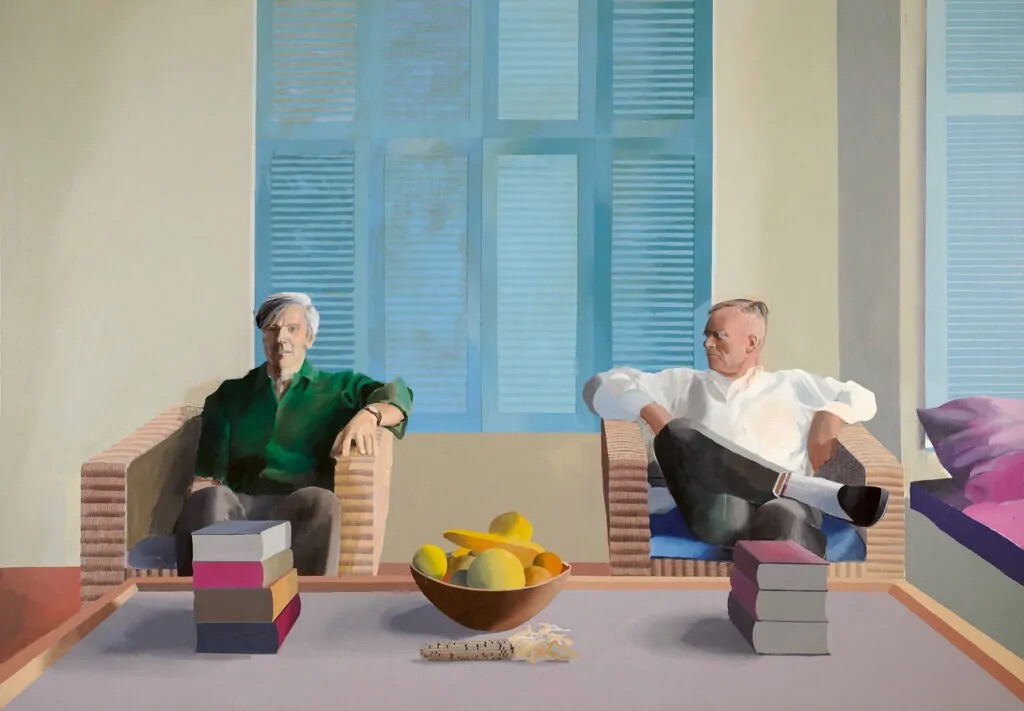
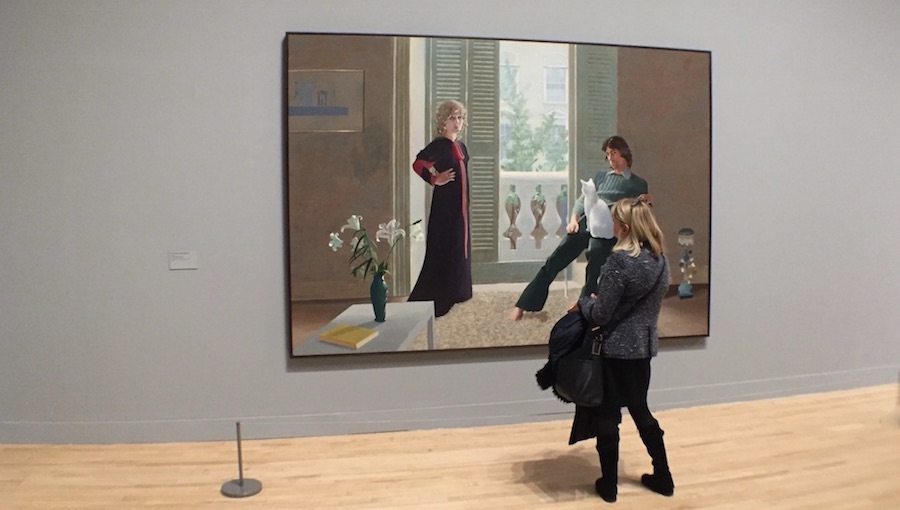
Hockney’s reputation grew immensely during his time in Los Angeles. He was cool and famous for painting cool and famous friends such as Christopher Isherwood and Don Bacardy and not so famous, his Dad and Mom.
He painted and photographed many scenes with swimming pools trying to capture the transparency and transience of moving water. “In November 2018, Hockney’s 1972 work Portrait of an Artist (Pool with Two Figures) sold at Christie’s auction house in New York City for $90 million (£70 million), becoming (at that time) the most expensive artwork by a living artist sold at auction.”
Reference and more about his life and art at
https://en.wikipedia.org/wiki/David_Hockney
Panorama
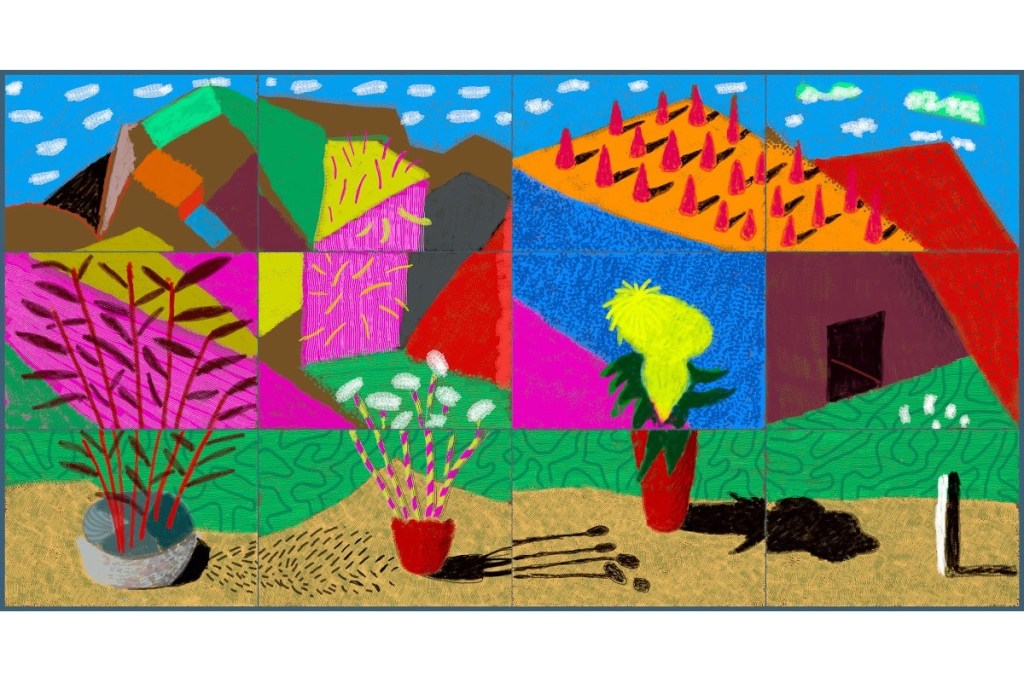
A driving trip across the United States took Hockney to places and vistas that changed his painting. He responded with grand landscapes: bigger, bolder scenes, representational and abstract, from unusual points of view.
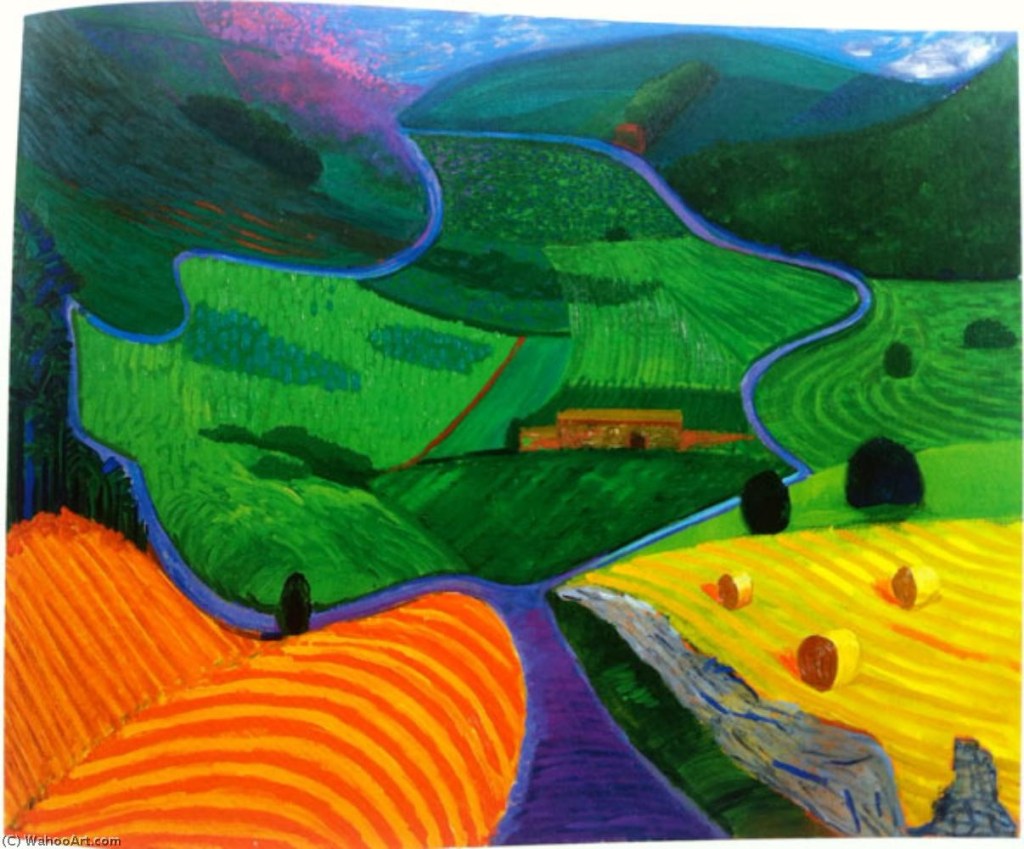

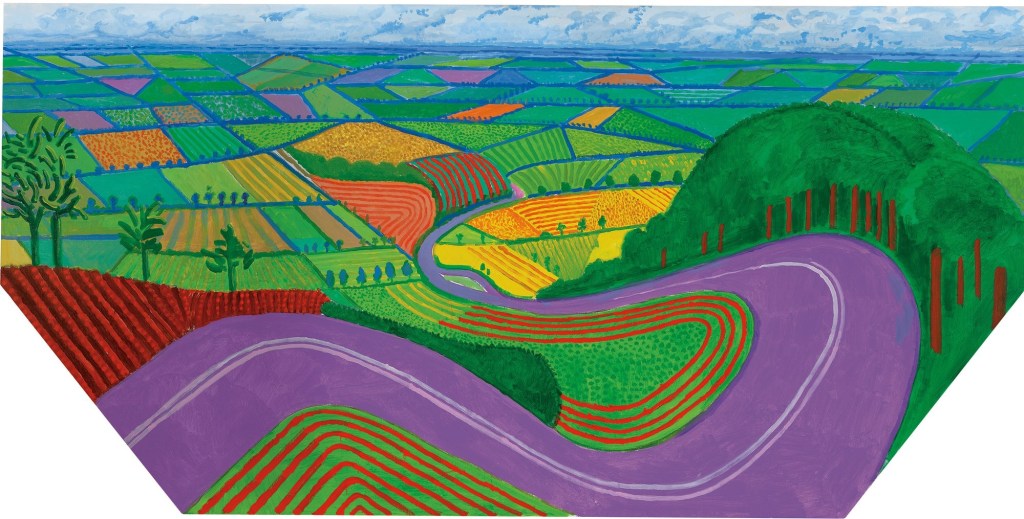
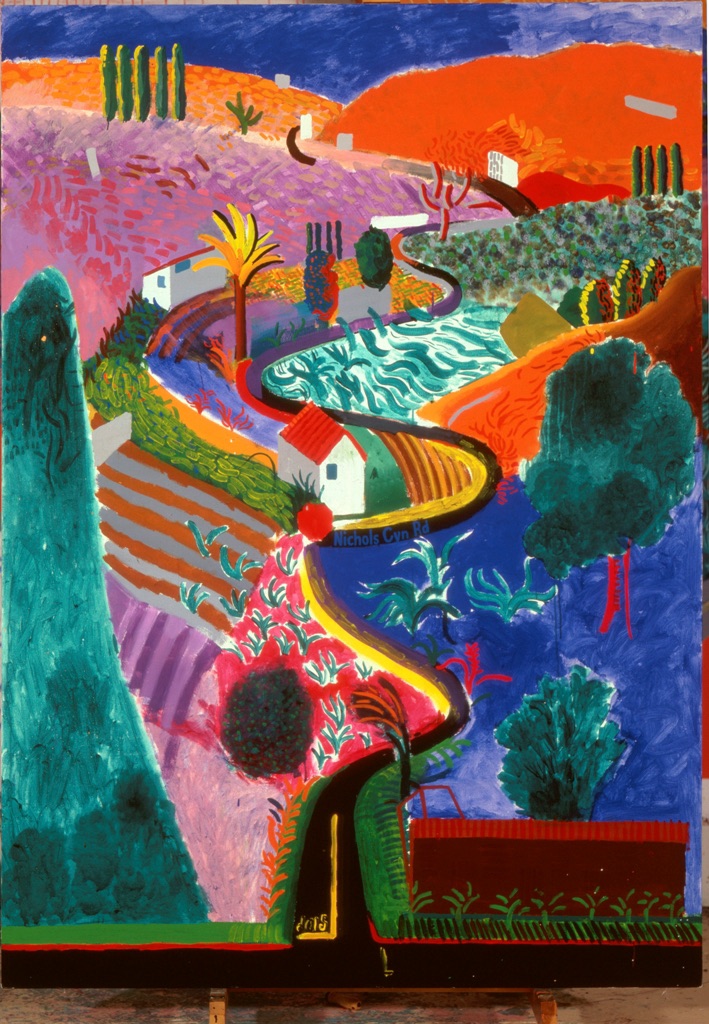
His work with Polaroids led him to paint on large canvases and put them together for an impact that was astounding. This collage technique was a major breakthrough for him. Now he could paint outside the limits of one canvas.
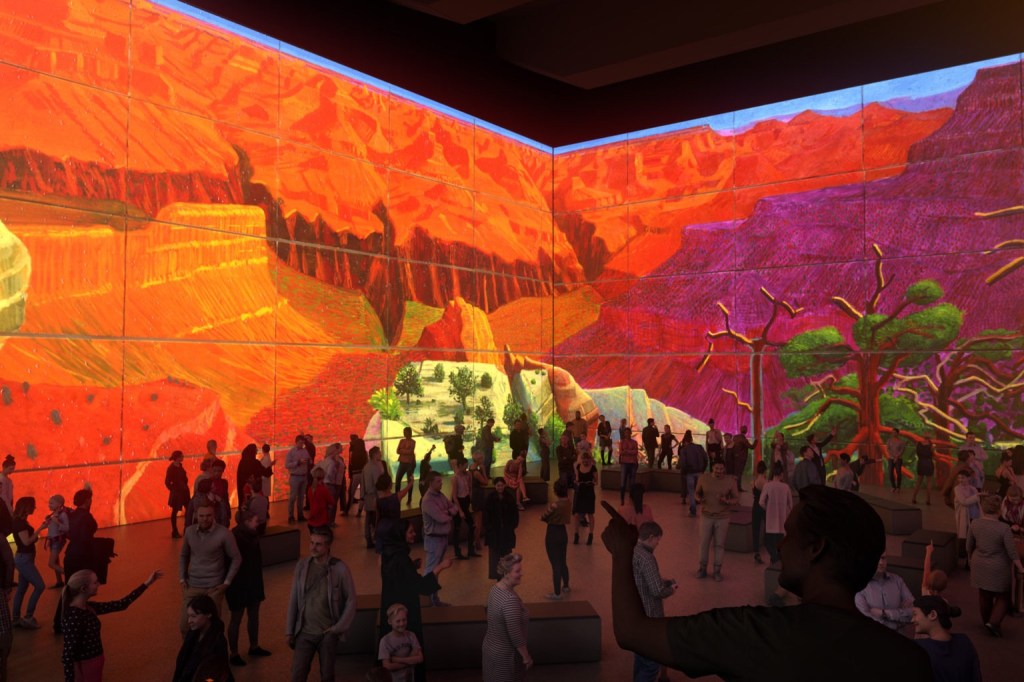
of many canvases collages together.
Yorkshire
Hockney began visiting his mother regularly and eventually moved permanently to Yorkshire where he had gone to school in Bradford. Although the content was more pastoral, his exuerberant technique created a new artistic language inspired by his home land. He painted similar scenes many times.
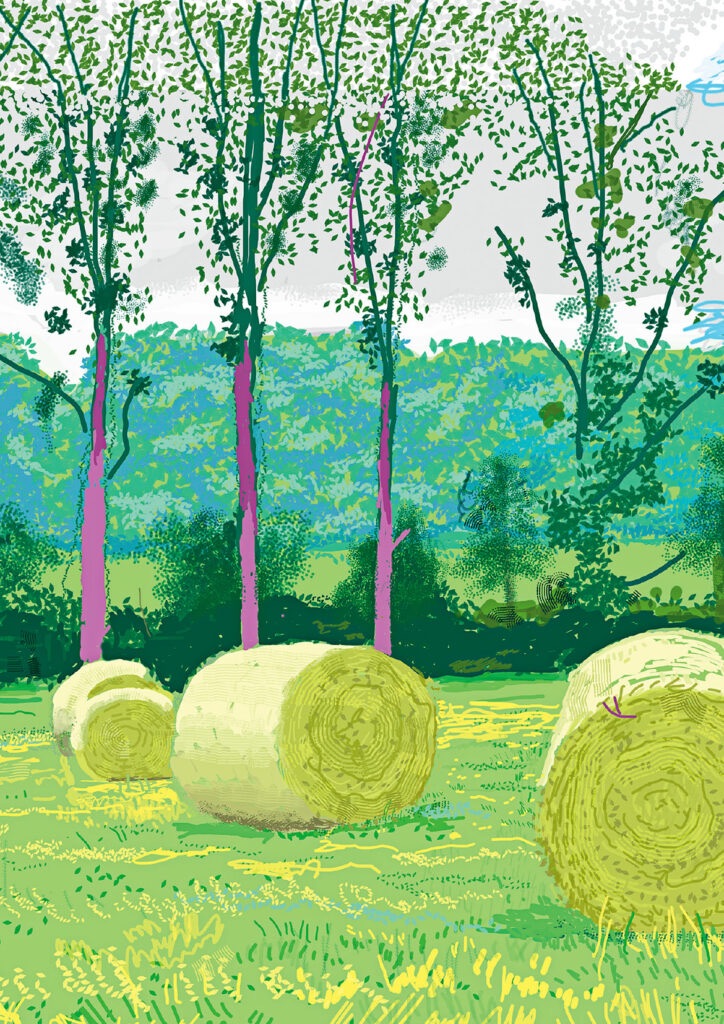
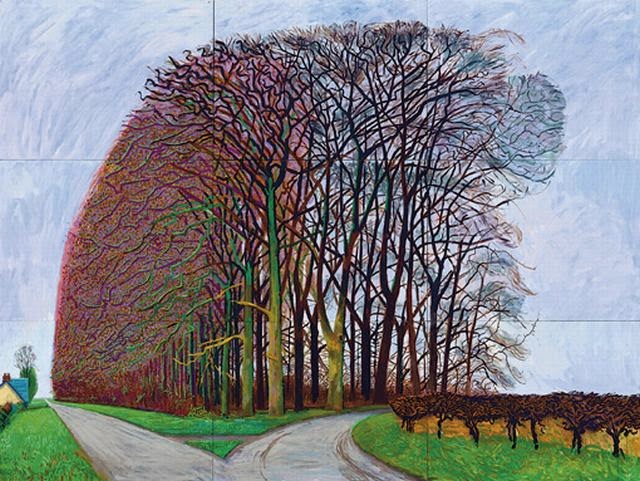
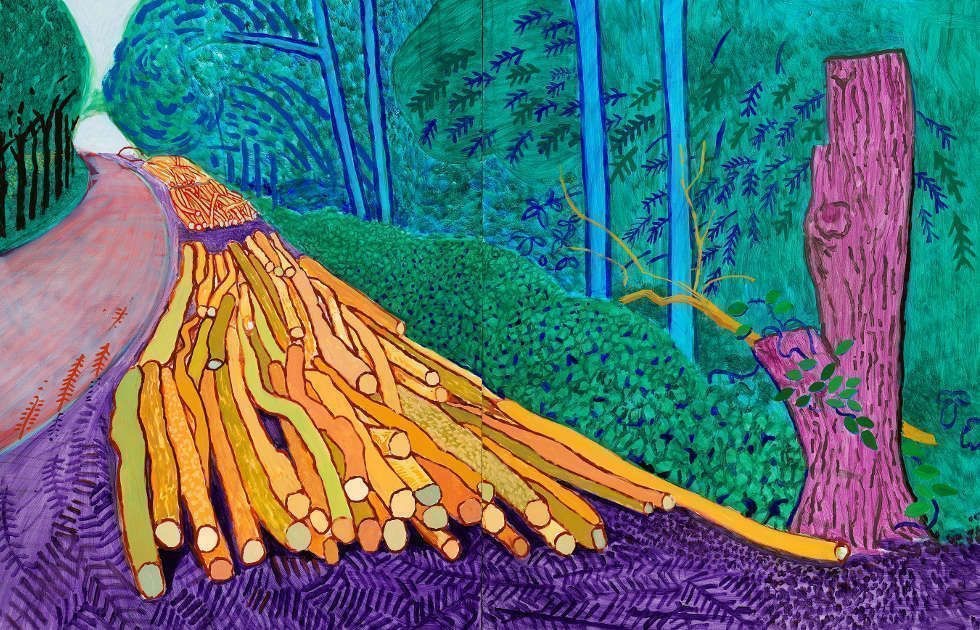
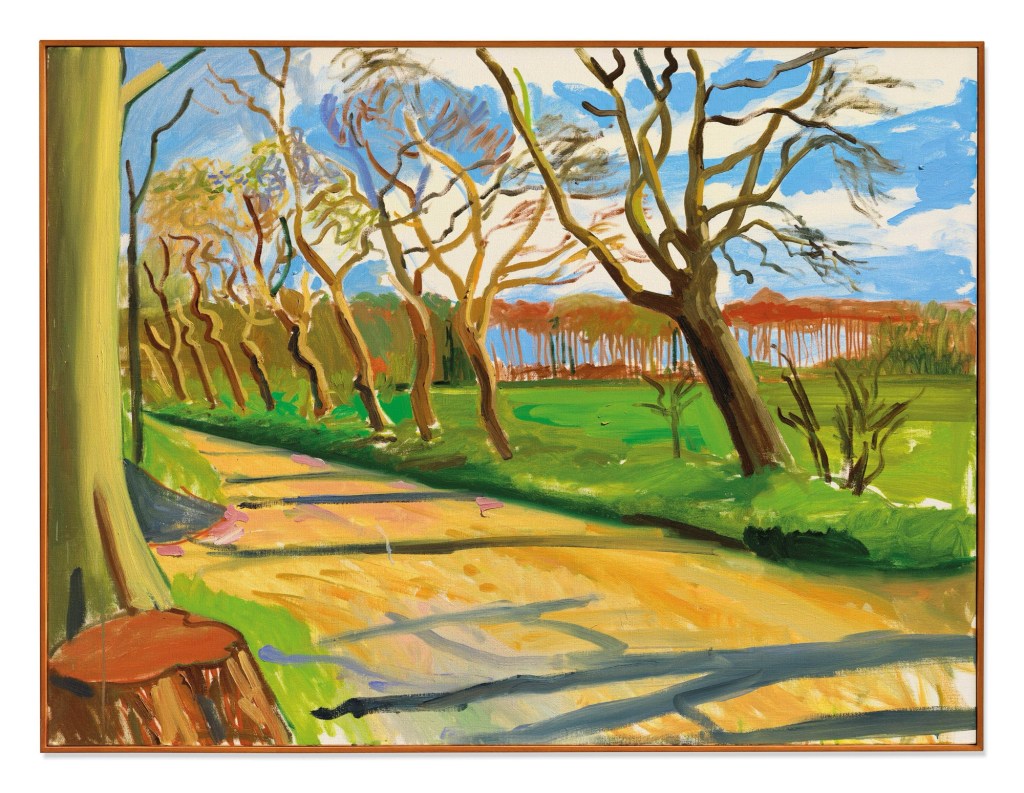
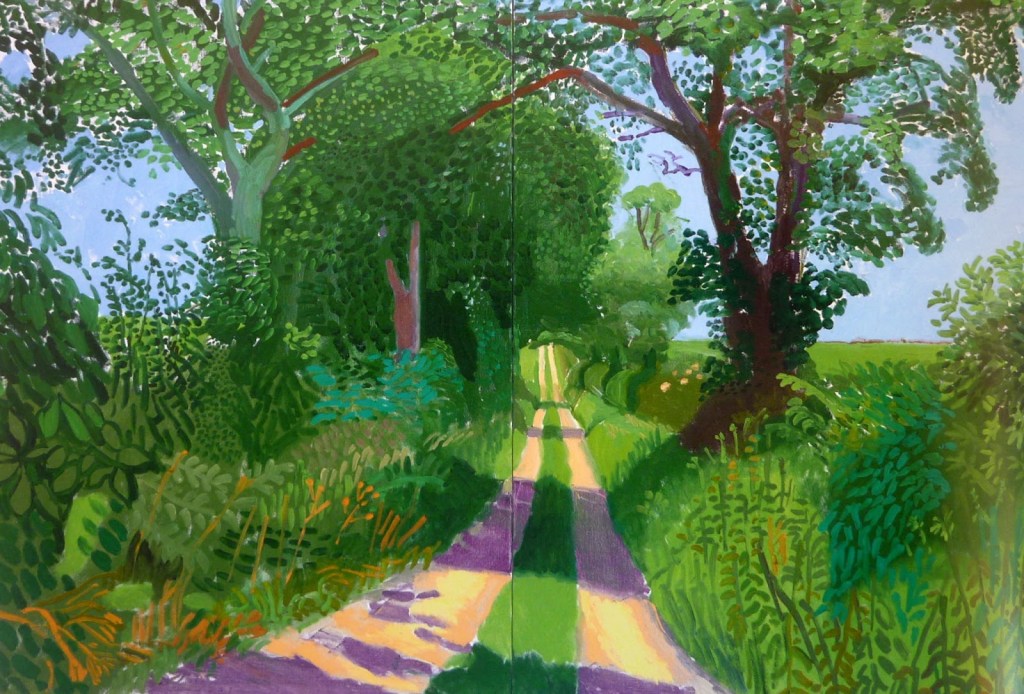
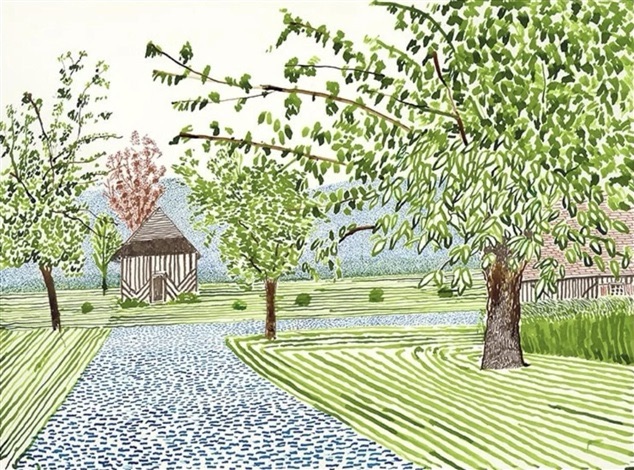
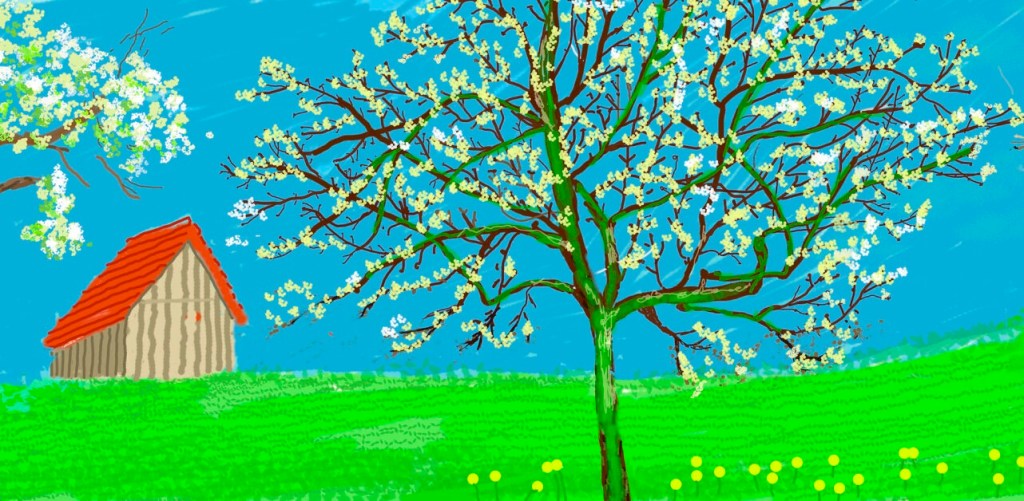
Hockney magnified his vision with interpretations of “simple” scenes on a grand scale.

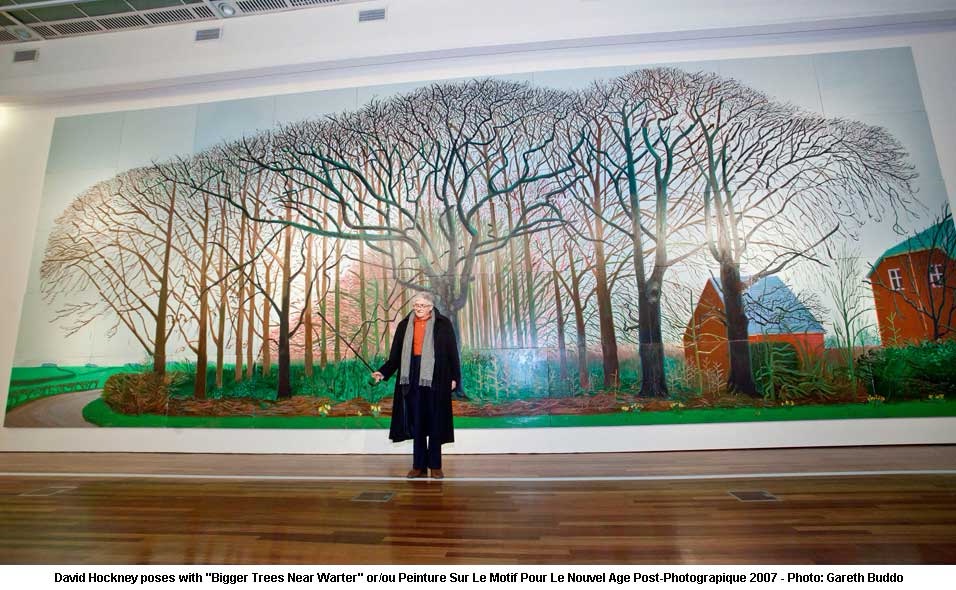
Normandy
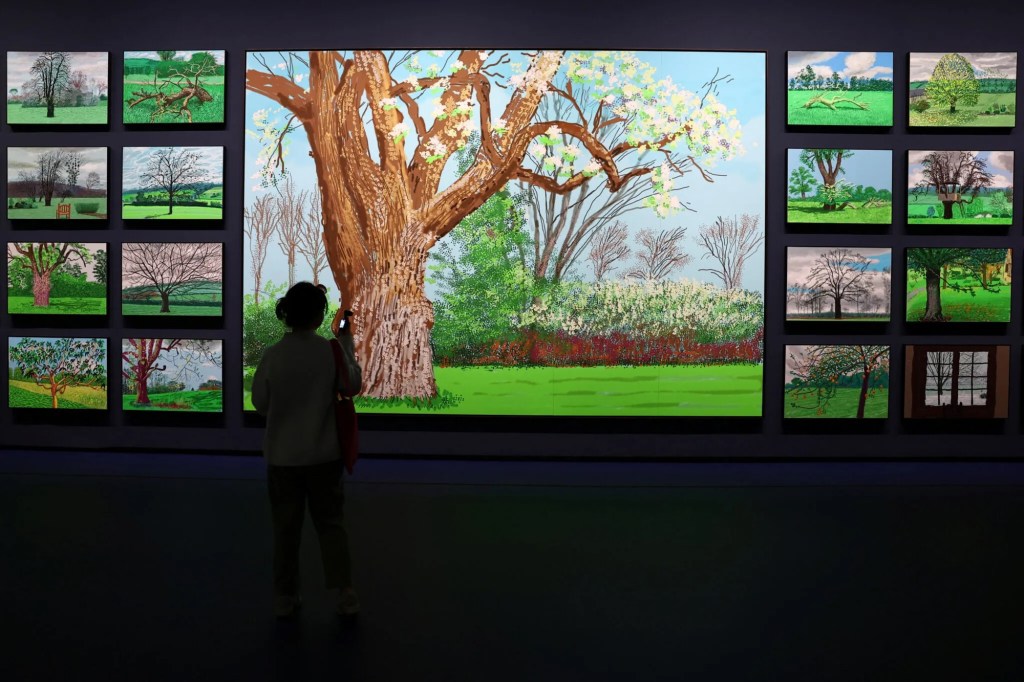
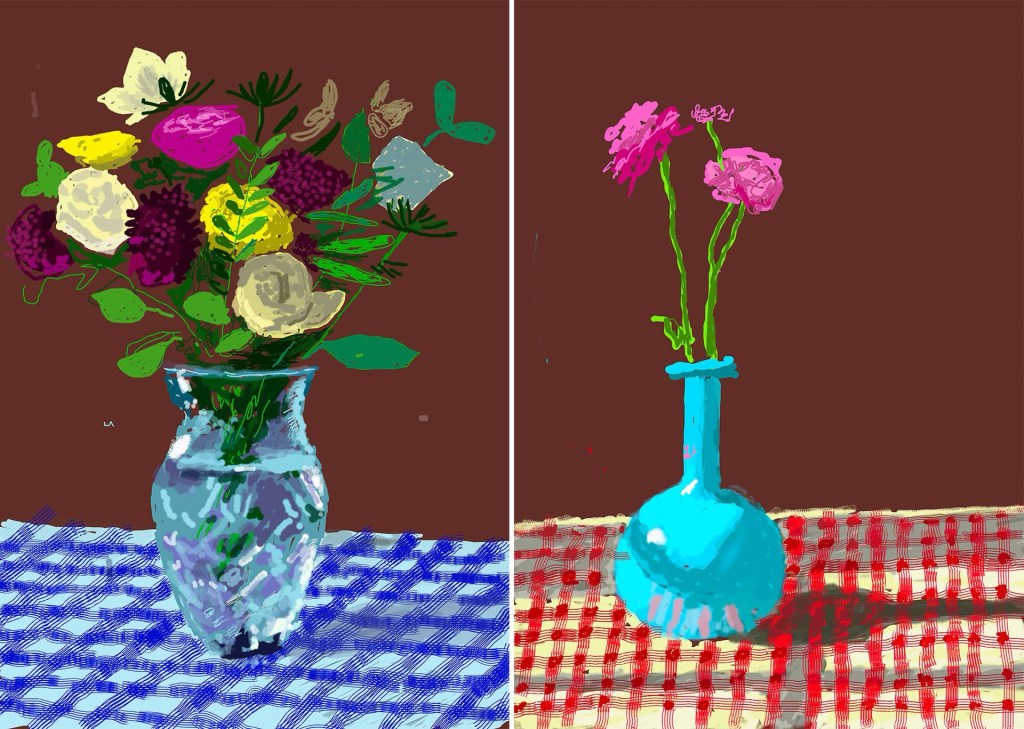
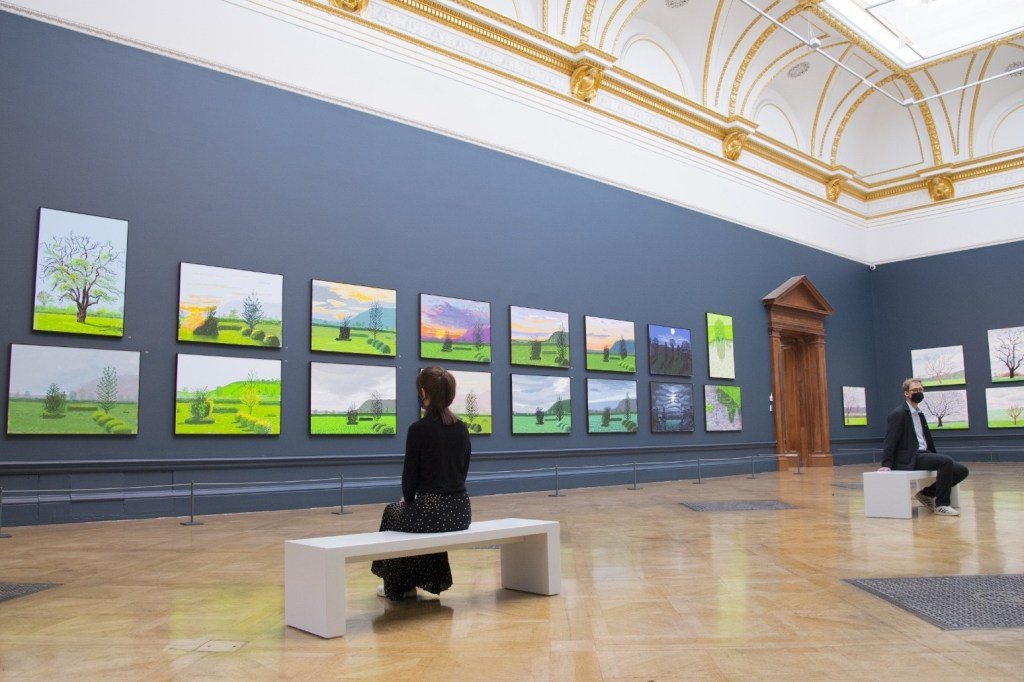
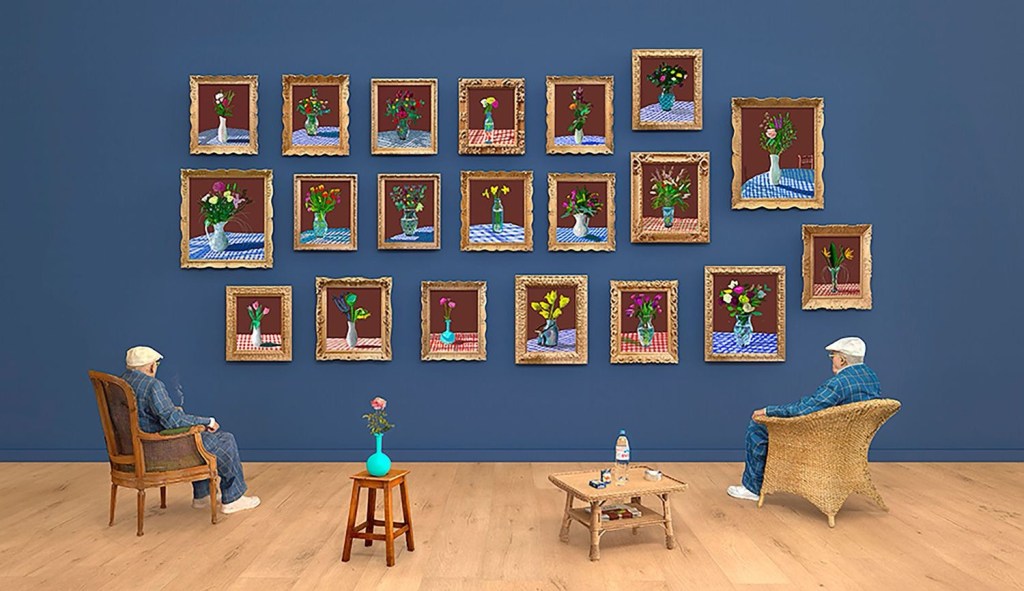
Normandy became a retreat, not from work or creativity, but from the demands of fame and the impact of age. Here he spent more time painting in small scale and similar subjects again and again—flowers in vases, pets, hawthorn blooms. Several galleries featured these themes. One panorama used a sequence for canvases to show what he could see from his house and garden. The Grand Cour, a panoramic view from his garden, was in a separate rounded gallery which reminded Becky and me of being surrounded by Monet’s water lilies in the Musée de l’Orangerie.
Portraits
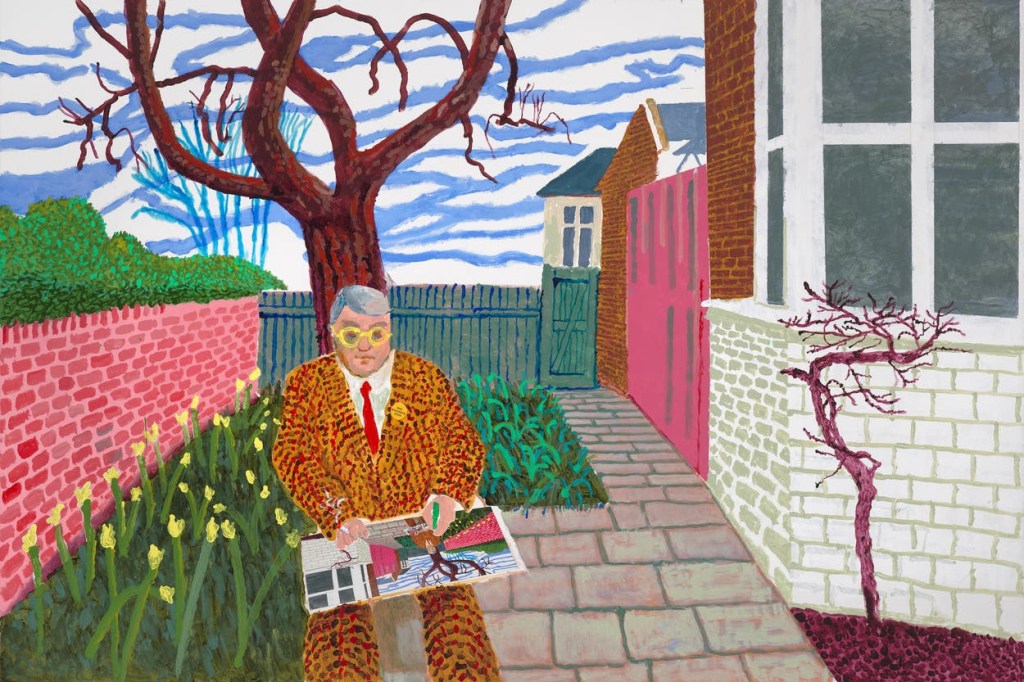
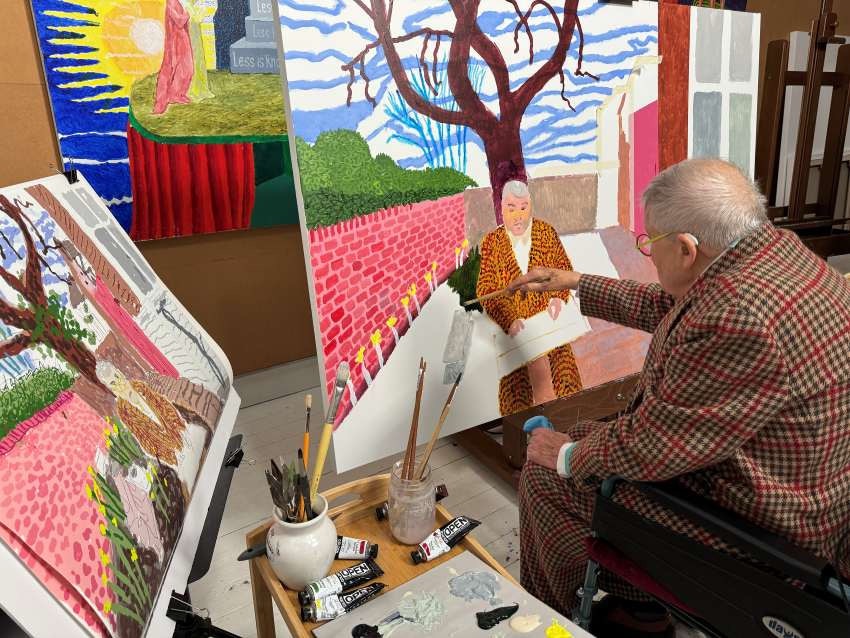
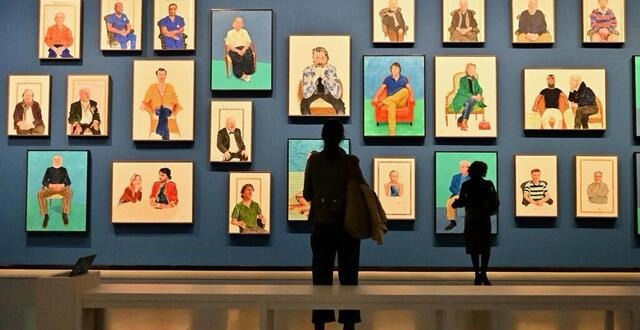
Hockney painted many portraits and self portraits over 60 years. He paints from life and from photos. While capturing the face and posture, he renders something more true than photographic accuracy.
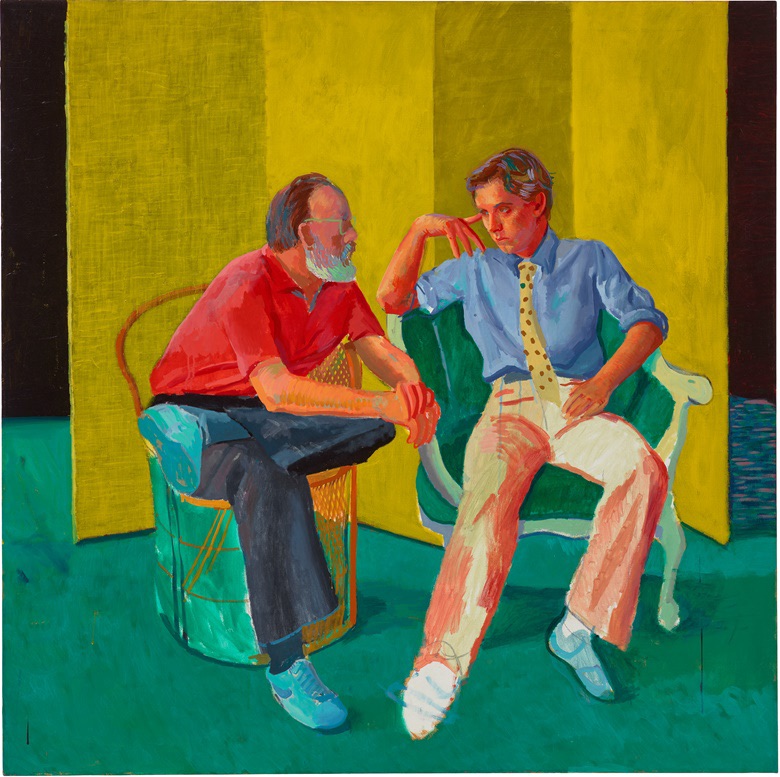
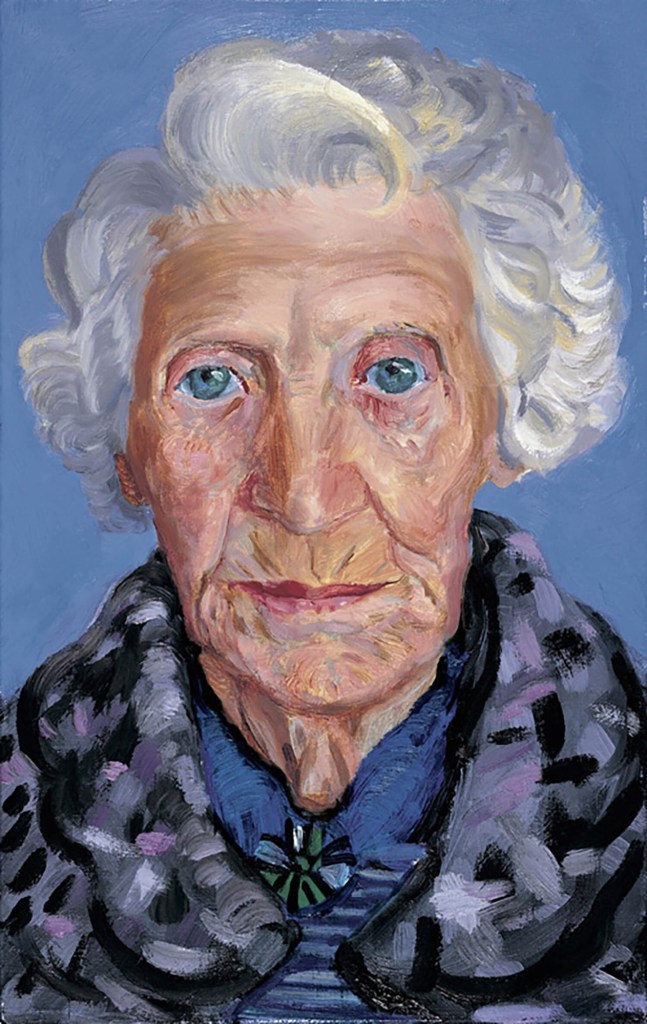
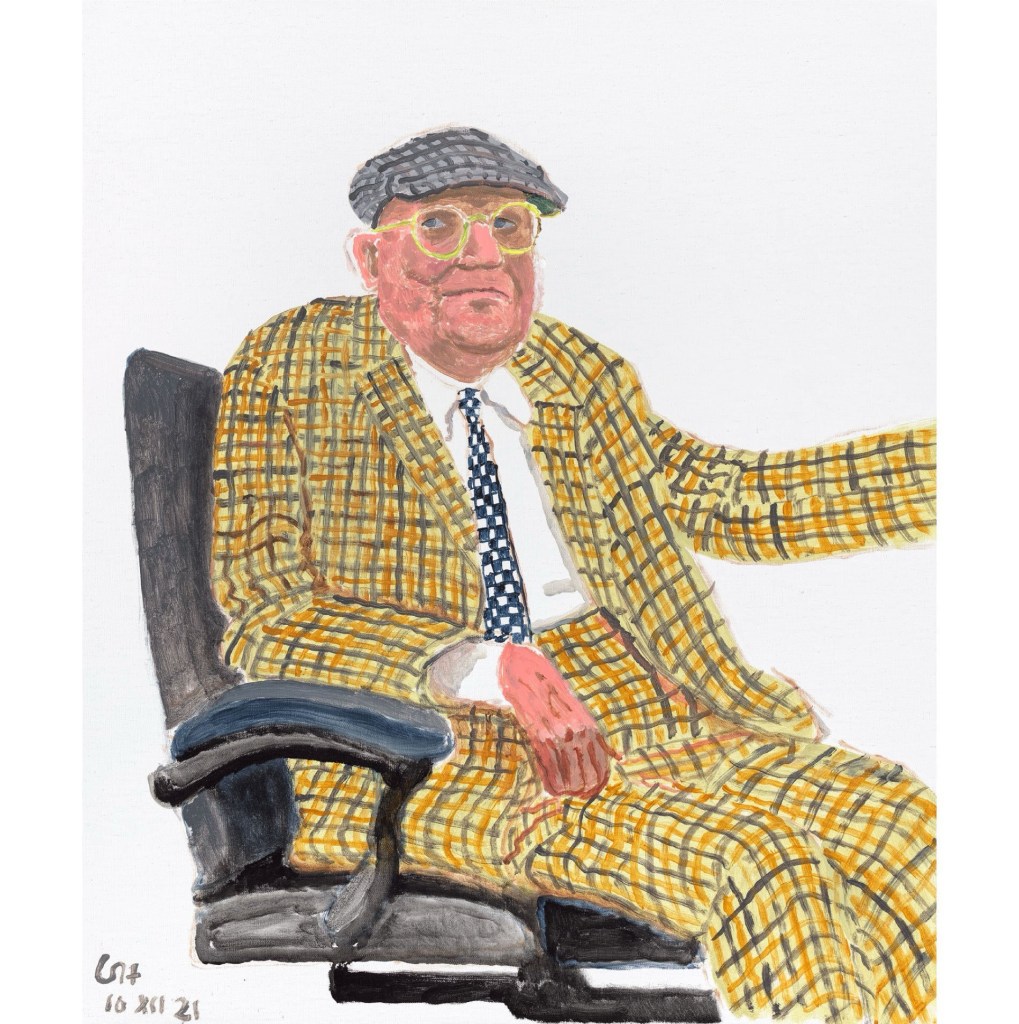
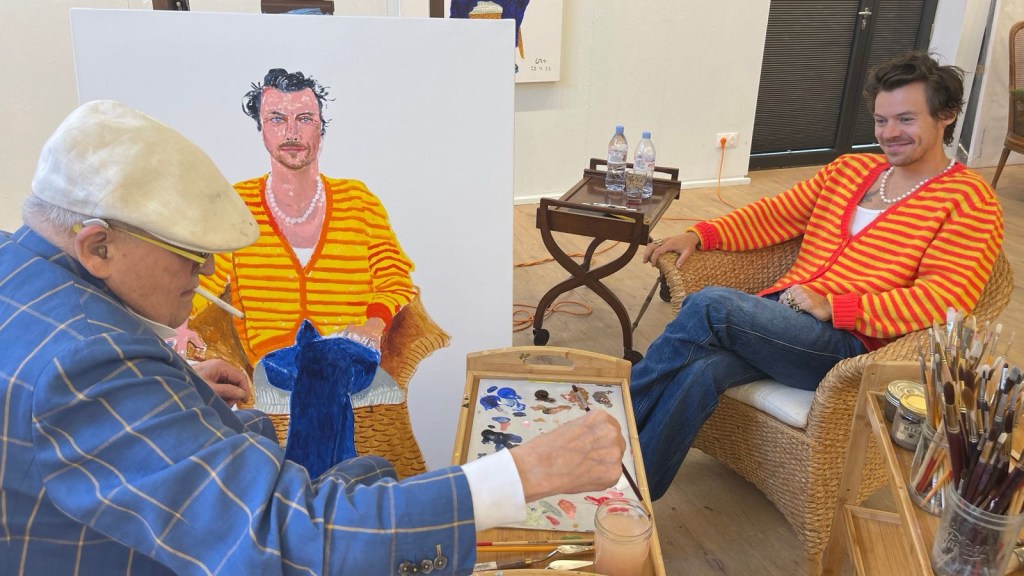

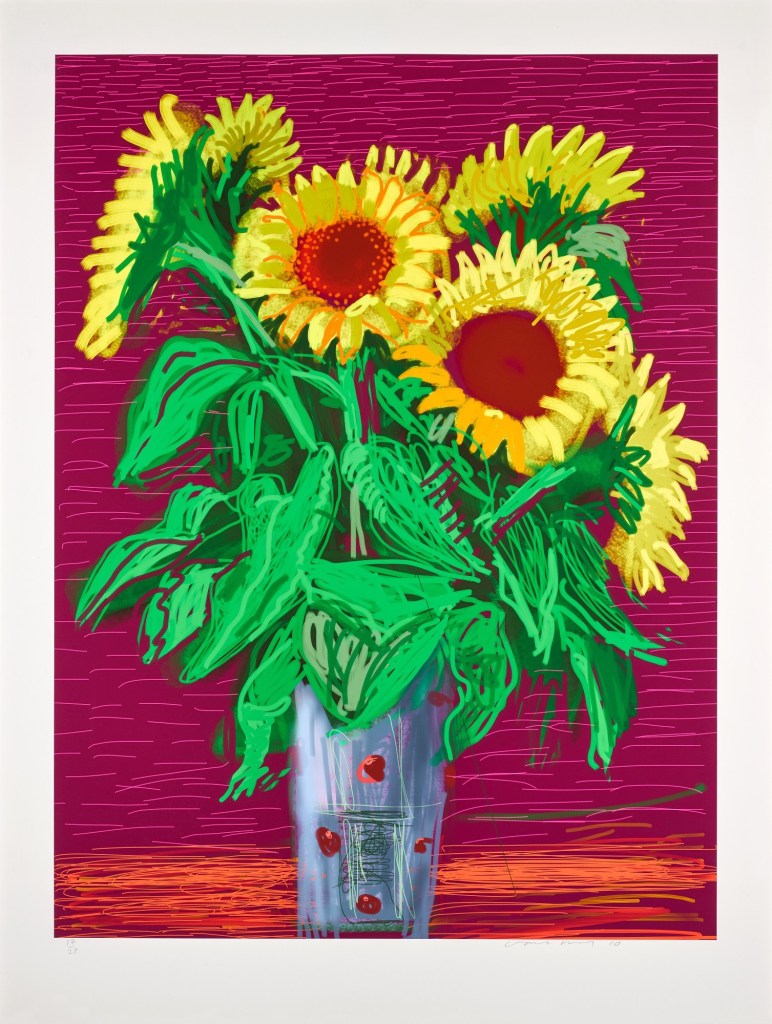
Another gallery held a dozen paintings inspired by famous paintings by other artists. His take honored the original art with distinctly Hockney attributes. This sunflower tribute is one example.
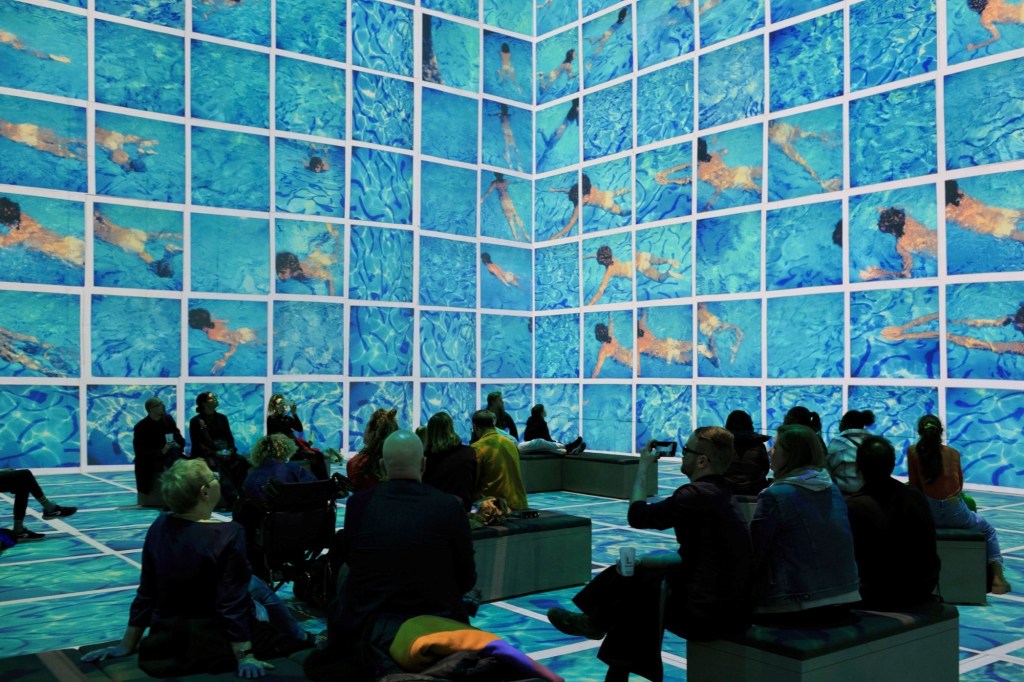
The final room held a video show of a dozen opera production designs. In an auditorium-size room without seating, production designs for a dozen operas were shown in rotation.
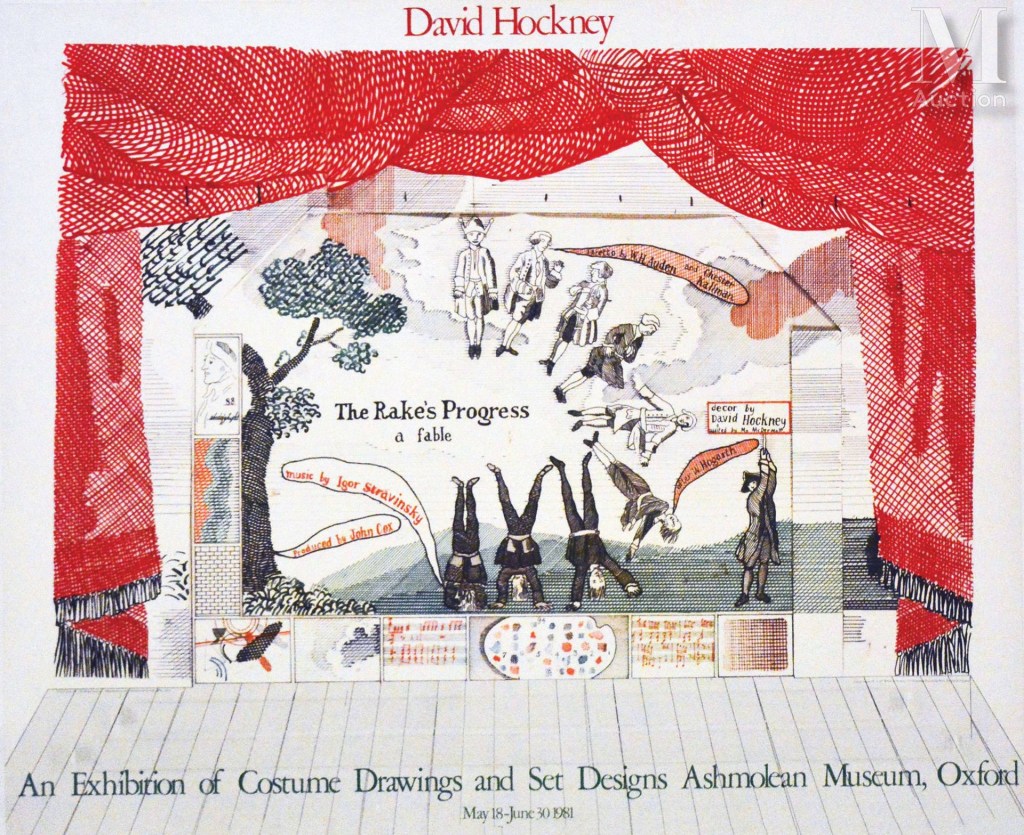
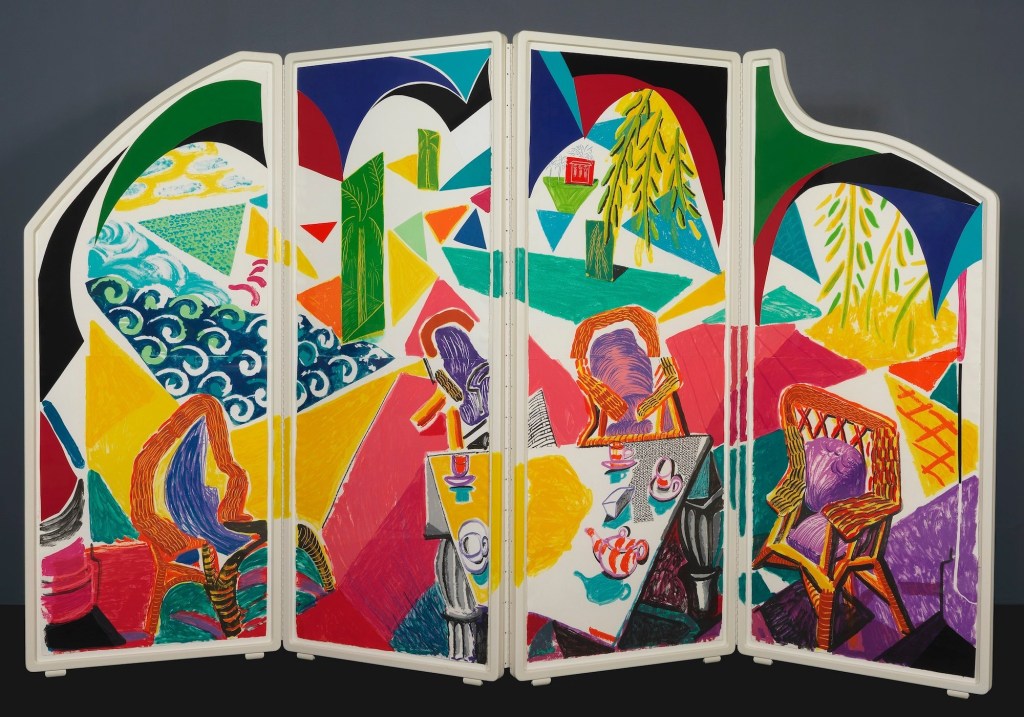
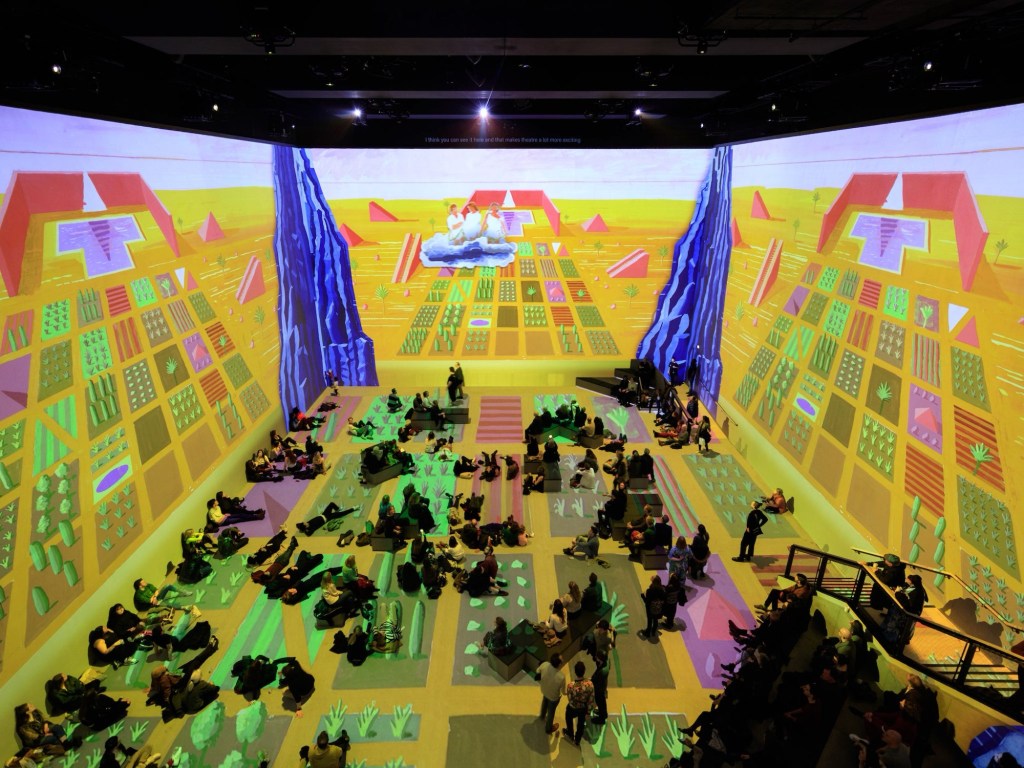

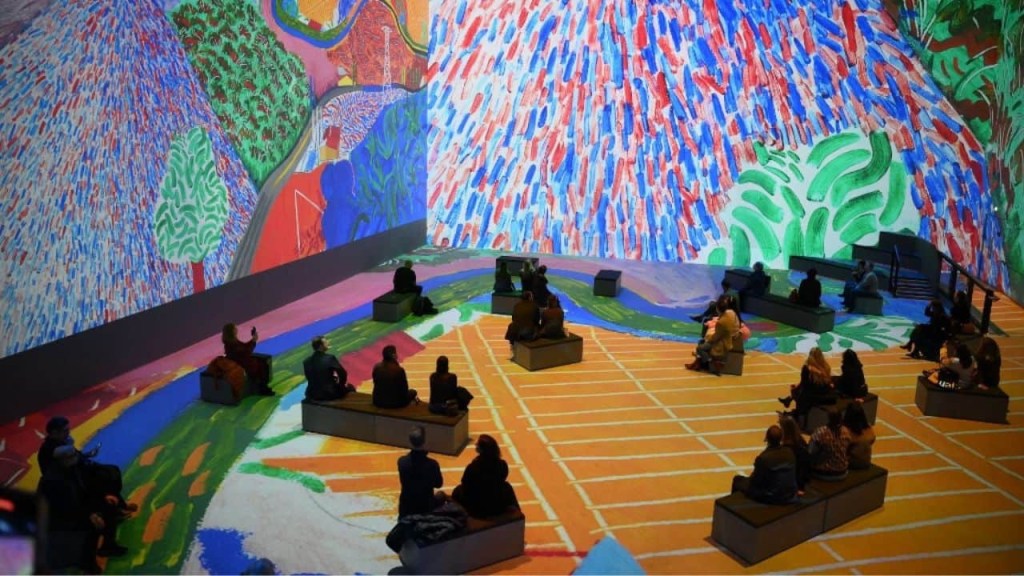
The images were shown on three walls, the ceiling, and the floor where many people were lounging on pillows. People standing along the rear wall were able to see all the surfaces. The images were accompanied by music from each operas. The effect was almost psychedelic.
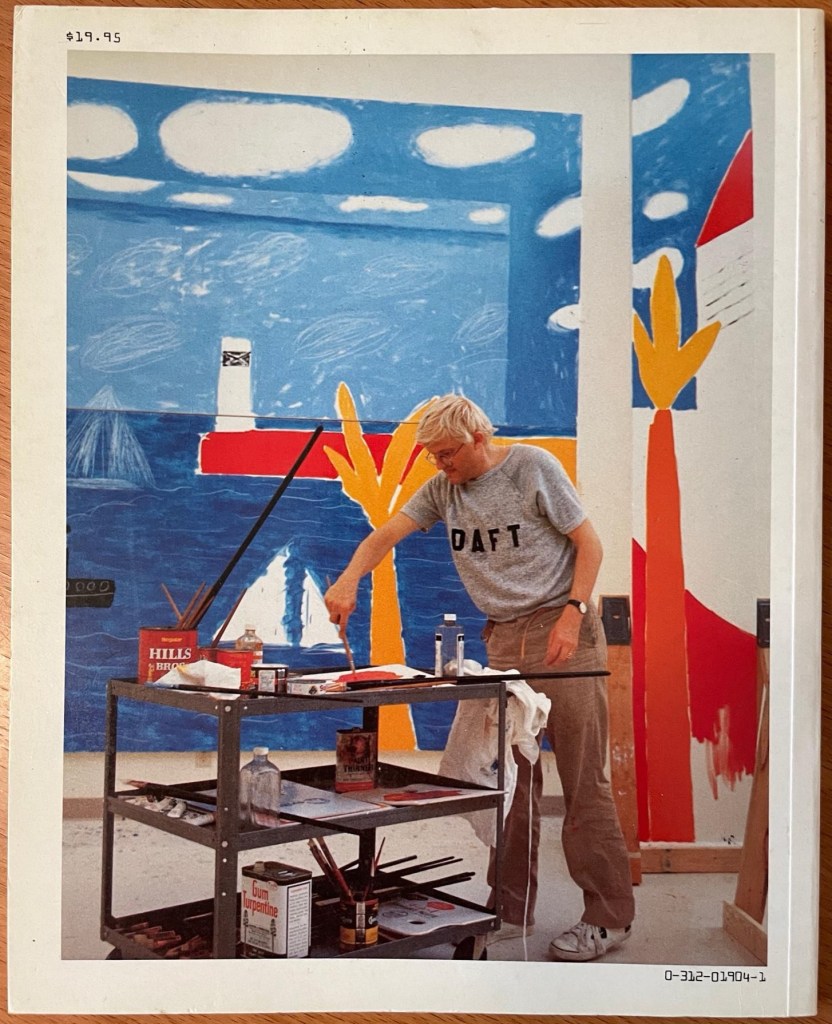
He has been honored many times with exhibitions focused on a single theme. David Hockney 25 is a comprehensive look at his work. This curated show honors his life of artistic creativity and brings his recent and less known work into focus.
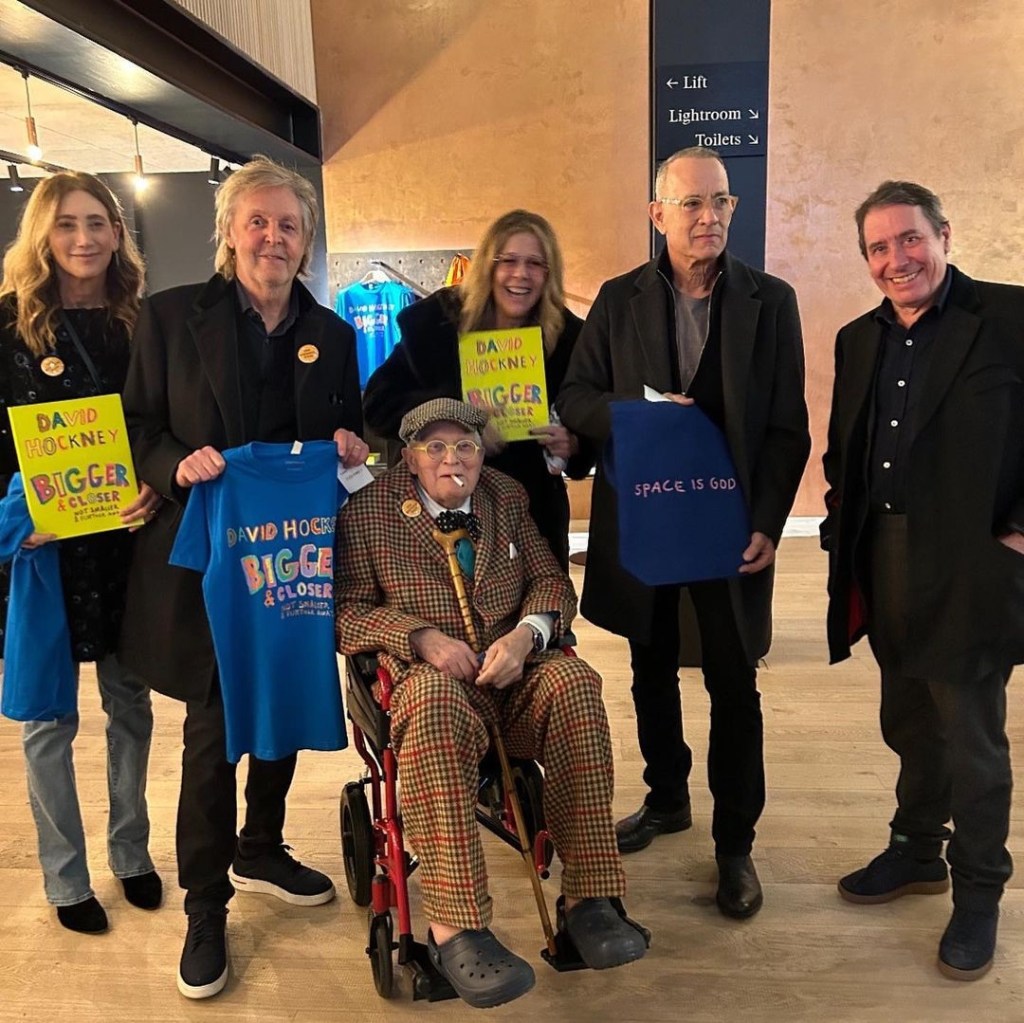
Never a shrinking violet, he enjoys celebrity but not necessarily the demands on him. Here he appears with a few friends with a book for a new exhibit.
I hope you enjoyed going on a tour of David Hockney with us. We saw many of the works here, but not all. I included some I found online that were not in the show. If you have time and interest you can find much more about David Hockney on Wikipedia and at the Louis Vuitton Foundation website.
 Tipps for Travel
3 responses to “Experiencing Hockney”
I loved the tour of David Hockney. Thank you! (By the way, this ema
LikeLike
Glad you took the tour with us. It was fun to reconstruct the tour for you.
LikeLike
Did you get the catalog yet?
LikeLike