We arrived in Copenhagen later than hoped, due to the train delay, then spent the first hours getting transport tickets, visiting the Tourist Info TI which was about to close at 4:00, and wandering around Radhaus (City Hall) square looking for a number 23 Bus. Bus 23, where are you? Recommended by the TI person as the best way to our hotel, it was a phantom.
Holding the map in one hand, orienting with Danish street signs, and asking several strangers for the Number 23 bus left us exhausted and frustrated. We finally flagged a taxi. The driver seemed surprised when we told him where we were going, but he delivered us to the Maritime Hotel in about 2 minutes for only DKK77 or $11. We had been close all along!
Brilliant tree near hotel
The Maritime is a very nice tourist hotel: clean, safe, inexpensive. Its major advantage is its location in the middle of Copenhagen. The hotel lies between the City Center and the Royal Quarter and three blocks from Nyhavn. These three areas hold many sightseeing spots, and we took advantage of their proximity.
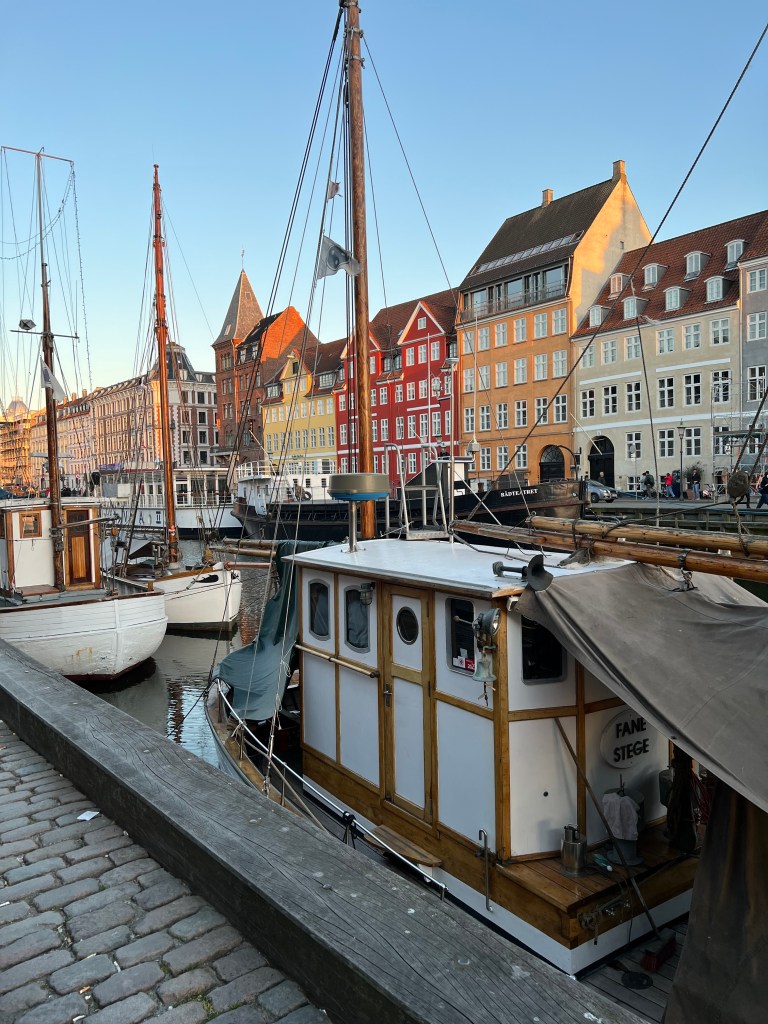
Colorful buildings on Nyhavn canal
Along the canal, Nyhavn boasts an historic area of brightly painted buildings frequently shown in photographs of Copenhagen. The Nyhavn (New Harbor) is actually the old harbor.
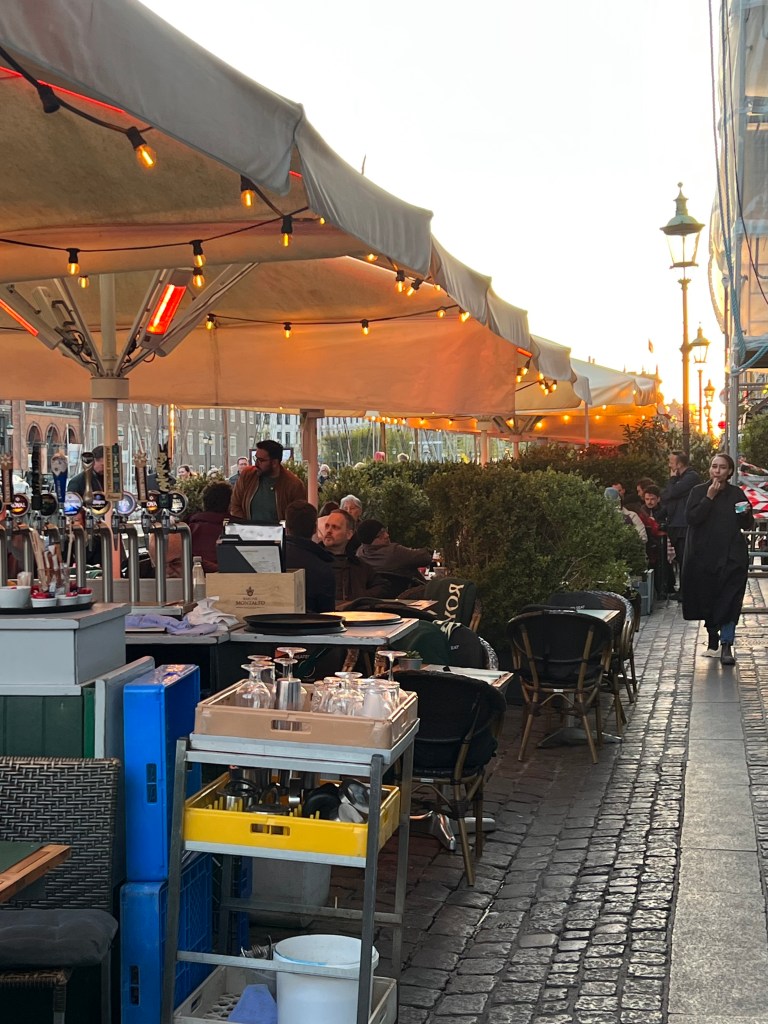
After a nap, we searched for food, having eaten only bananas and trail mix on the train. The colorful buildings in Nyhavn now house many restaurants with outdoor seating along the sidewalk. Many restaurants but they only offer four cuisines: smorrebrod and traditional Danish dinners, steak, fish, or pasta/pizza all with very similar menus. We randomly chose Hummer, and the choice turned into an amazing foodie meal.
Rikki, a woman we saw on the train, also stood with us in the transport office, so we had a nodding acquaintance. As we sat down at Hummer, Rikki walked past our table. Third time was the charm. I invited her to join us for dinner at Hummer.
Becky chatting with new friend Rikki at Hummer restaurant
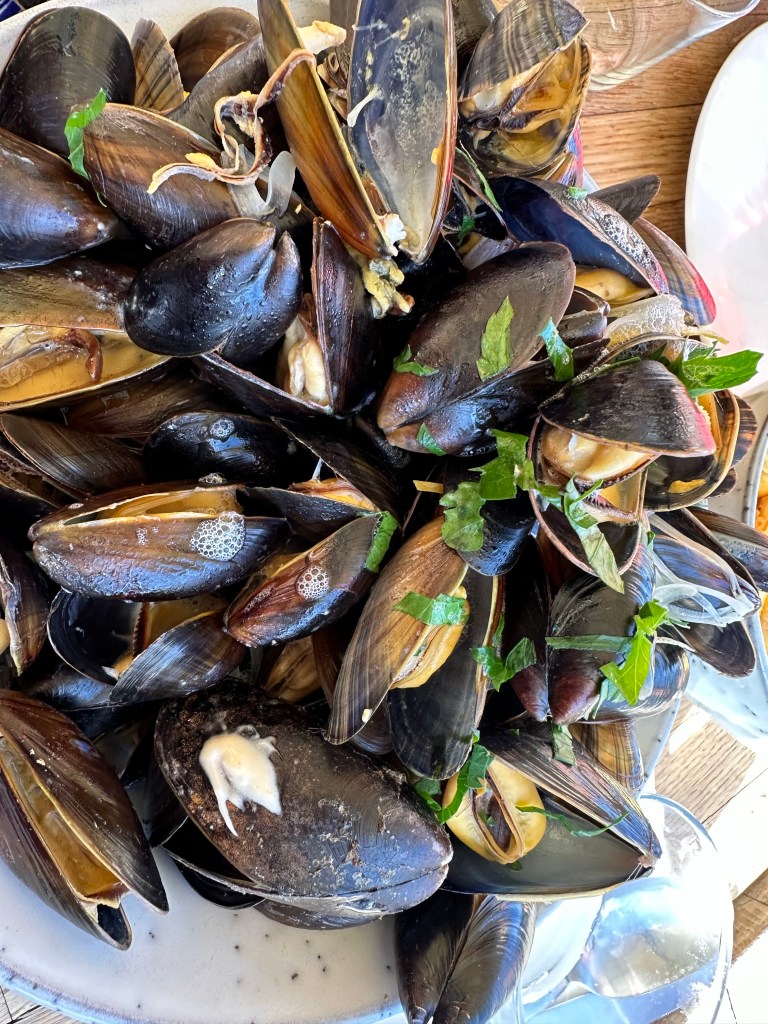
She accepted and we had company for the meal. After a starter of crab blini topped with roe, we ordered three different dishes: pan-fried cod in smoked butter, fish and chips, and moules (mussels) frites. All were simple, beautiful, and beyond delicious. I have never seen that many mussels in a serving.
Copenhagen is called the Nordic Foodie capital and proud of it. Copenhagen restaurants have more Michelin stars than all other Scandinavian cities together. Three days provide too little time to sample all the food in town, but we would certainly give Hummer 5 stars.
For breakfasts, we drank coffee with luxurious fresh croissants. We ate smorrebrod at the Magazin department store deli for lunch one day.
Smorrebrod at Magazin deli
The next day, we visited the Trovaldsen Food Court noted for its variety of temptations. We made healthy choices at Smag: a salad bowl with 4 picks from the 20 vegetable salads, 2 exotic dressings/toppings such as white bean purée or chili hummus, 3 sides of mushroom-balls, chicken satay, and corn falafel with fantastic bread. Two salad bowls were delicious but not cheap—about 300 DKK or $40.
Two salad lunches at Totvaldsen food court
On our last night, we went back to Nyhavn and randomly picked Venezia pasta/pizza restaurant. Actually we had randomly picked a different Italian restaurant, but after 10 minutes looking at menus and no sign of service, we decamped to Venezia. That turned out to be a wise move.
We ordered carbonara and gnocchi and burratta/tomato salad. The service was superb, the food was excellent. The gnocchi were so light they almost floated off the plate, but the rich cream sauce held them down. Carbonara was equally rich with the same cream sauce and a salty kick from the prosciutto. The creme de la crème sauce alone earned a 5 star rating.
In between those superb dinners, we had another non-so-healthy treat in Nyhavn. Warm mini-waffle topped with your choice of ice cream seems to be a popular delight (or maybe just popular for Copenhagen tourists). We decided to go with the flow. Admittedly, this is not our typical food choice, but when in Copenhagen…..
The Royal Quarter
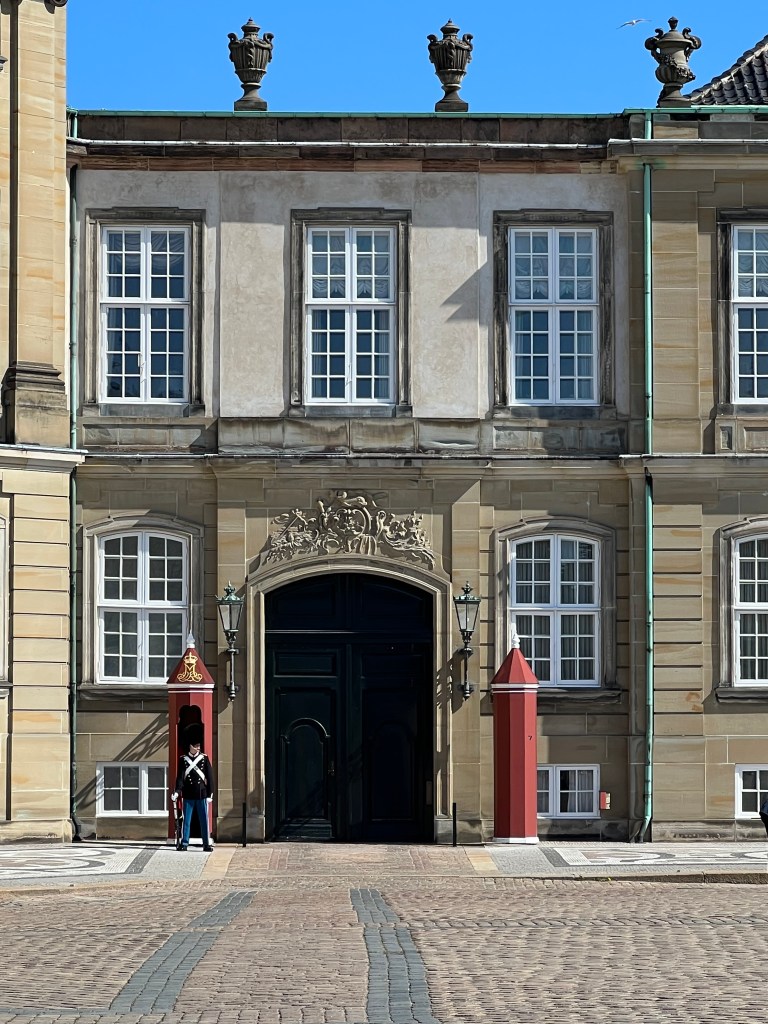
We had two full days of sightseeing in Copenhagen. On Saturday, in the Royal Quarter area, our first stop was at the Amalienborg Castle, the official residence of Queen Margrethe II. A small museum is mostly about the royal family life. The Castle is laid out around a large paved courtyard and contains the royal residence and some related government offices.
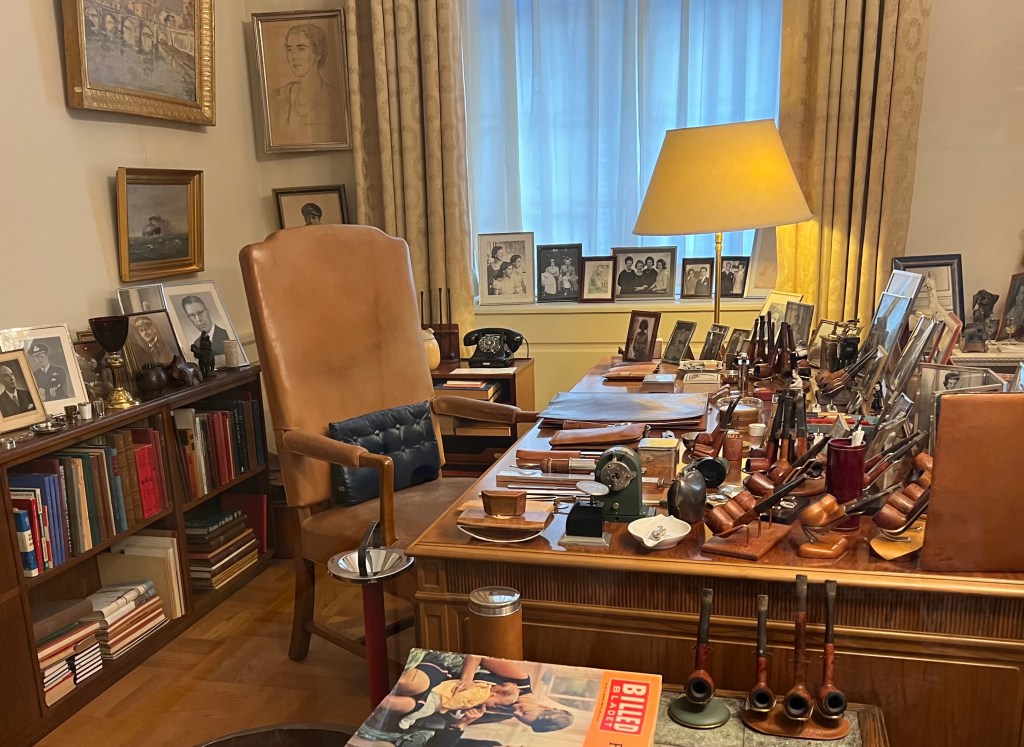
Amalienborg Palace EntranceKing Frederick’s Study and Pipe CollectionNOTE: Thumbnail pictures should enlarge if you tap on them for more detail.
VIDEO of Amalienborg Castle
We were slightly disappointed that the Queen was not serving afternoon tea for us, but perhaps she had royal duties attending the coronation of Cousin King Charles III in London.
In the afternoon, about half a mile away, we entered the Rosenborg castle and 10-acre garden.
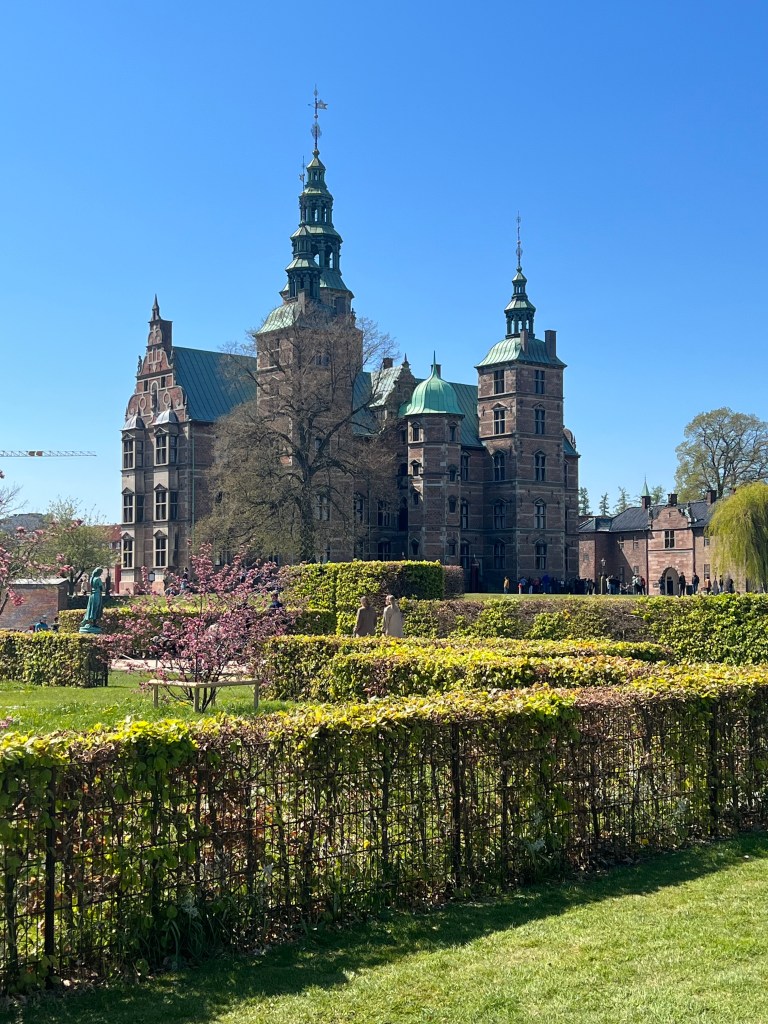
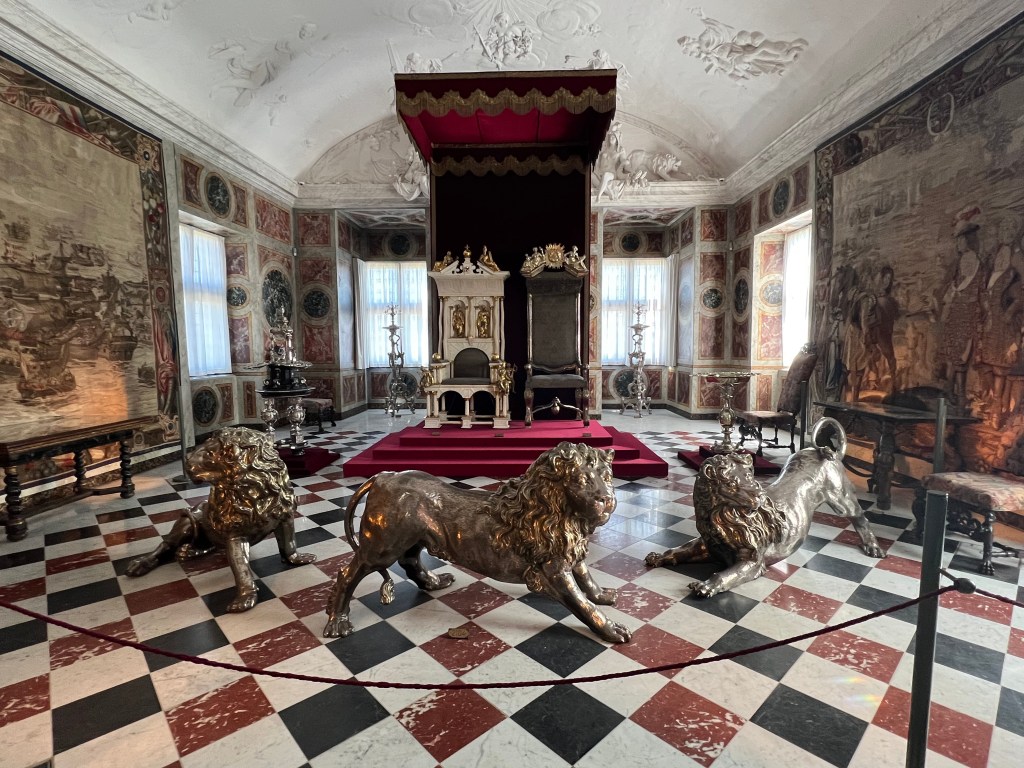
Rosenborg Castle and groundsThrone room for King and Queen in Rosenborg Castle
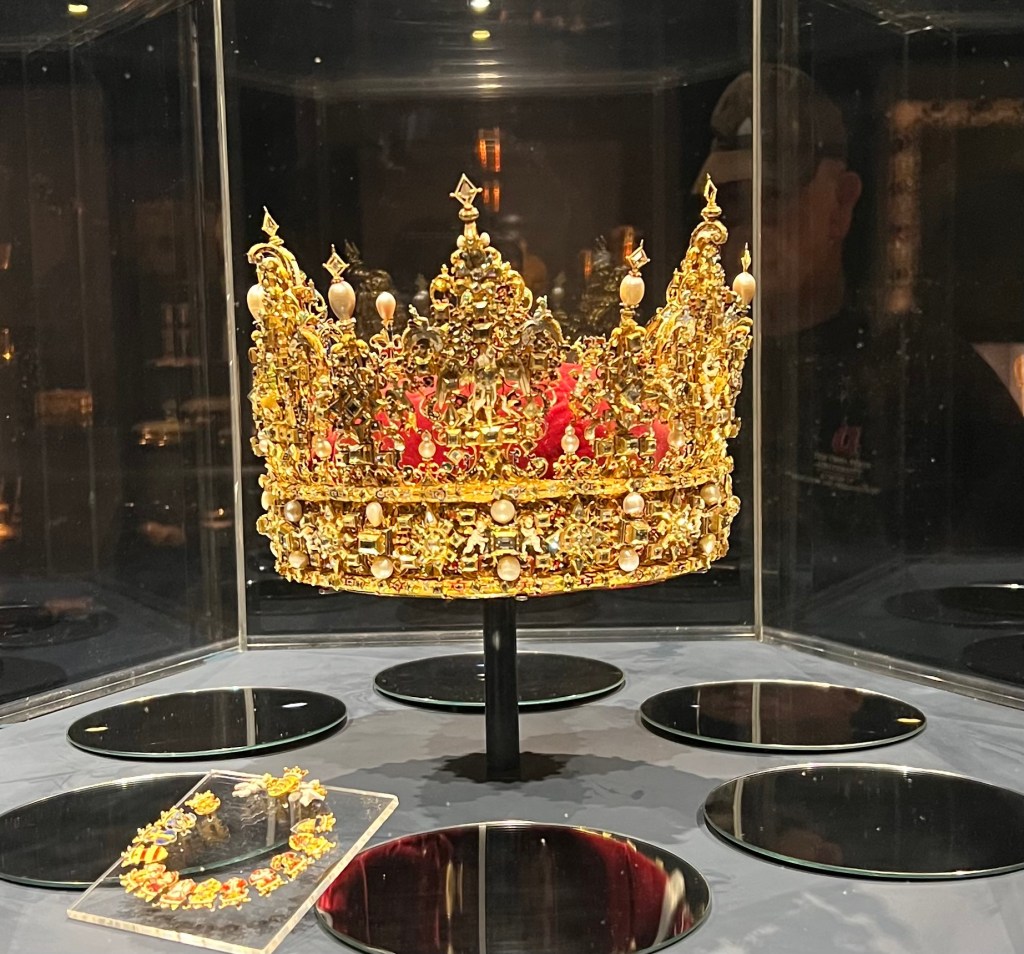
The exterior, interior, and grounds have been maintained and turned into a museum with original furnishings and amazing displays: silver and gold serving pieces and jewelry, ivory carvings, porcelain, coins, swords, and gifts to the royal family from around the world. In the basement was the treasury which holds and displays the royal crowns, jewels, and other gold royal possessions. “Ostentatious” comes to mind—17th and 18th century feudal privilege and vanity are on display. All this wealth came from Denmark being a leader in world trade.
Royal crown of Denmark
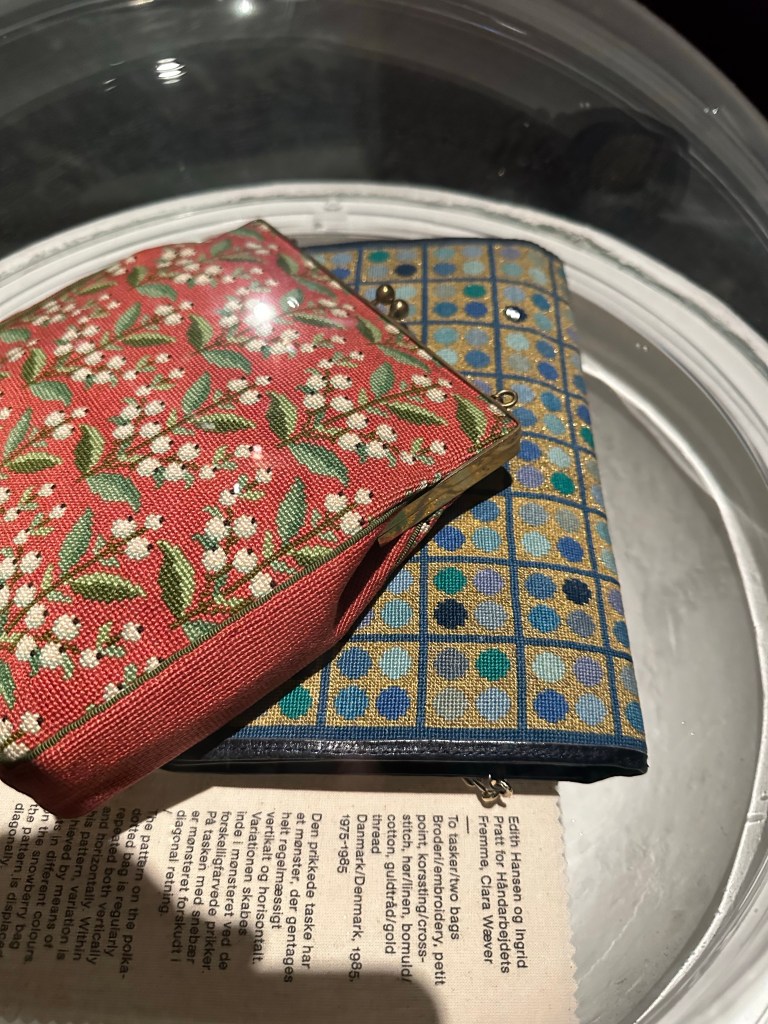
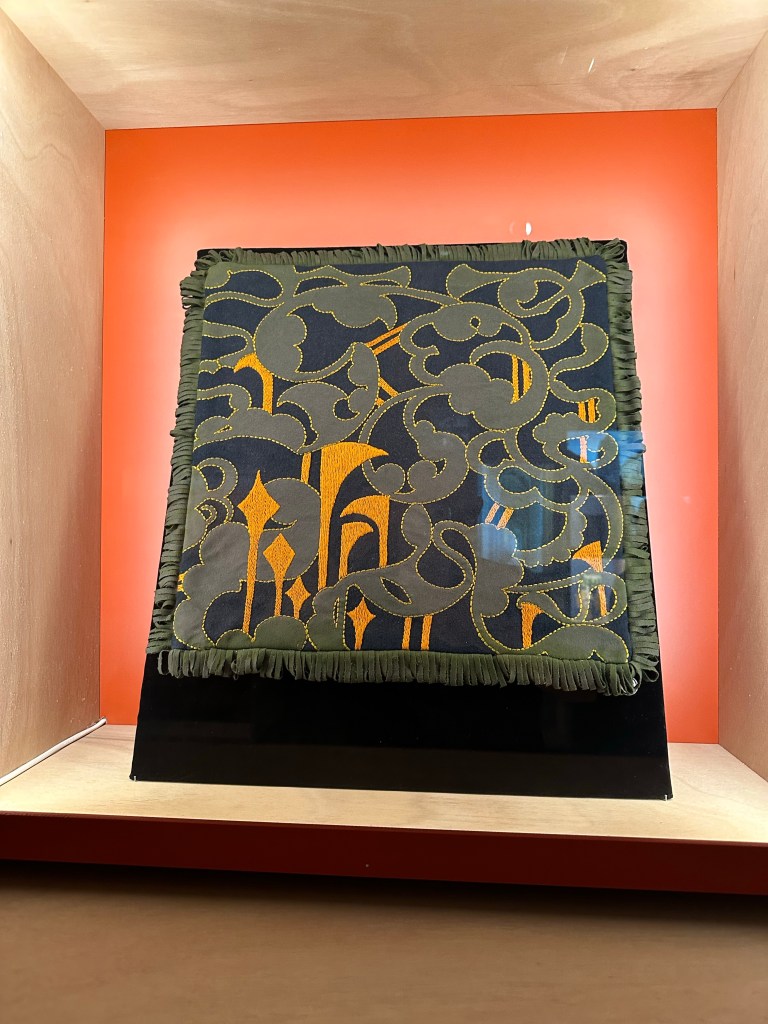
Between the Amalienborg Castle and the Rosenborg Castle, a design museum was shown on the map. This was the highlight of the day. Danish Modern design has inspired and still influences architecture, graphics, fabric, printing, and art. The museum displays the historical aspect of 20th century design and the direction of design in the 21st, emphasizing ecological adaptations.
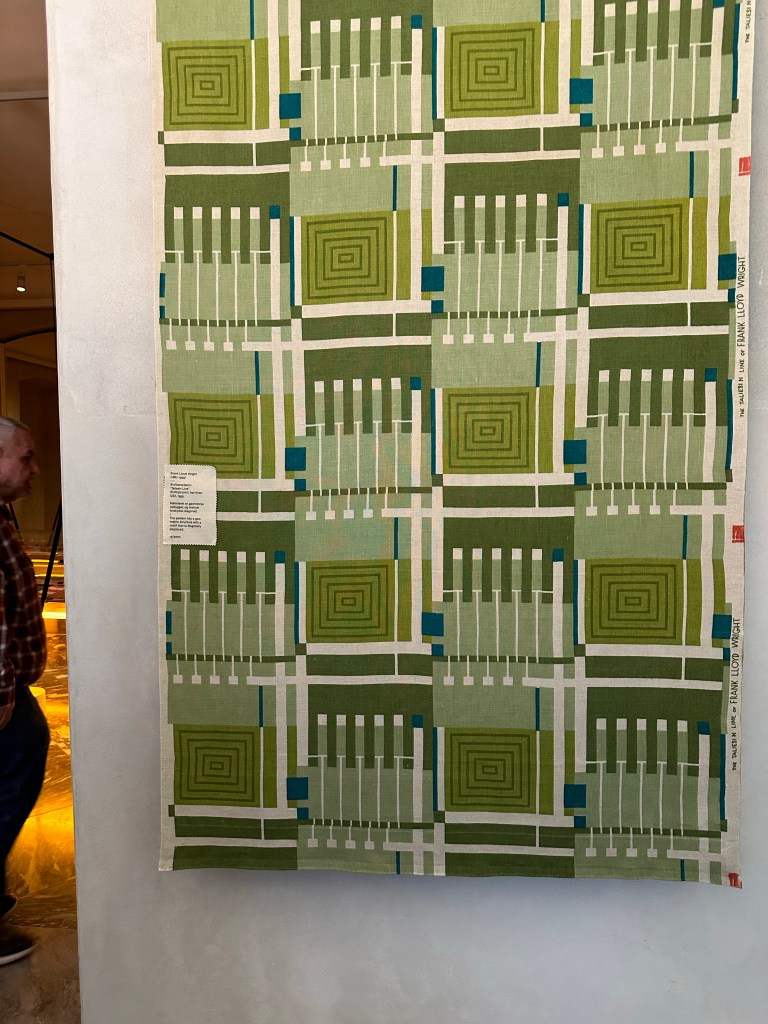
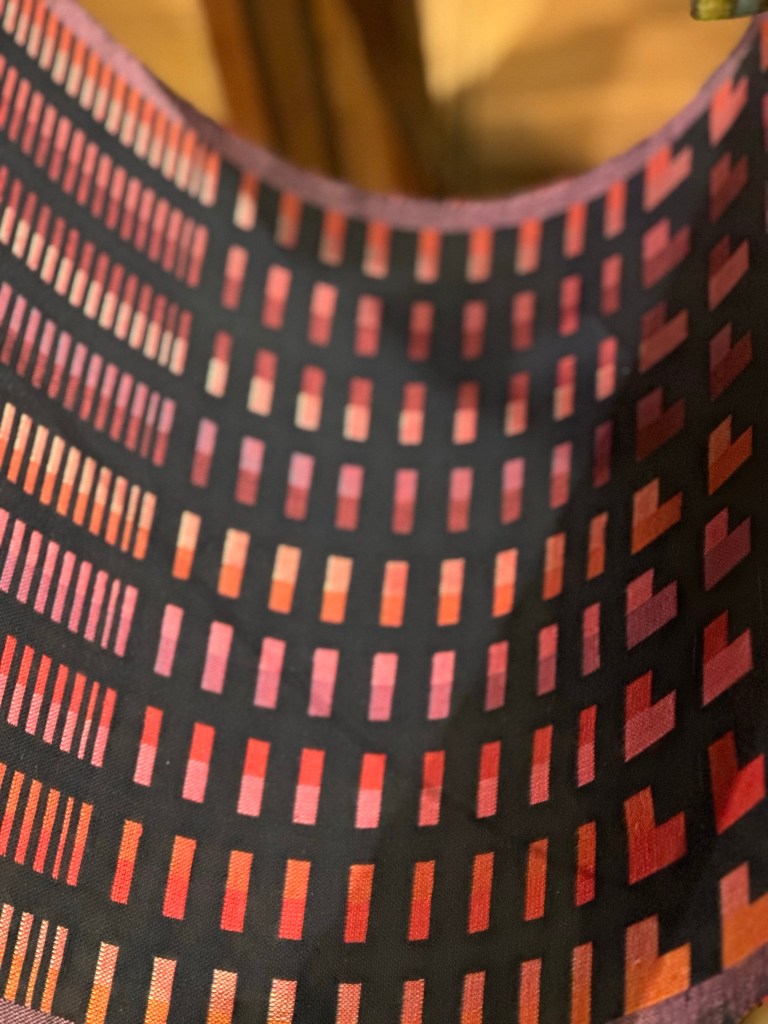
Many exhibit inspired our quilting and woodcut printing hobbies. Simplify, simplify, and repeat are the guiding principles.
Inspirational designs from the Design Museum
Chairs have been a mainstay of Danish Modern design. At an estate sale in 1990, we bought a Finn Juhl Chieftain chair and 6 Finn Juhl dining chairs. The Chieftain chair is a classic featured in many modern design publications. But its wing span made it hard to fit into any room. Eight years ago, I donated the chair to the Dallas Museum of Art for their 20th Century design collection. Someday, I would love to see it on display.
Finn Juhl chieftain chair
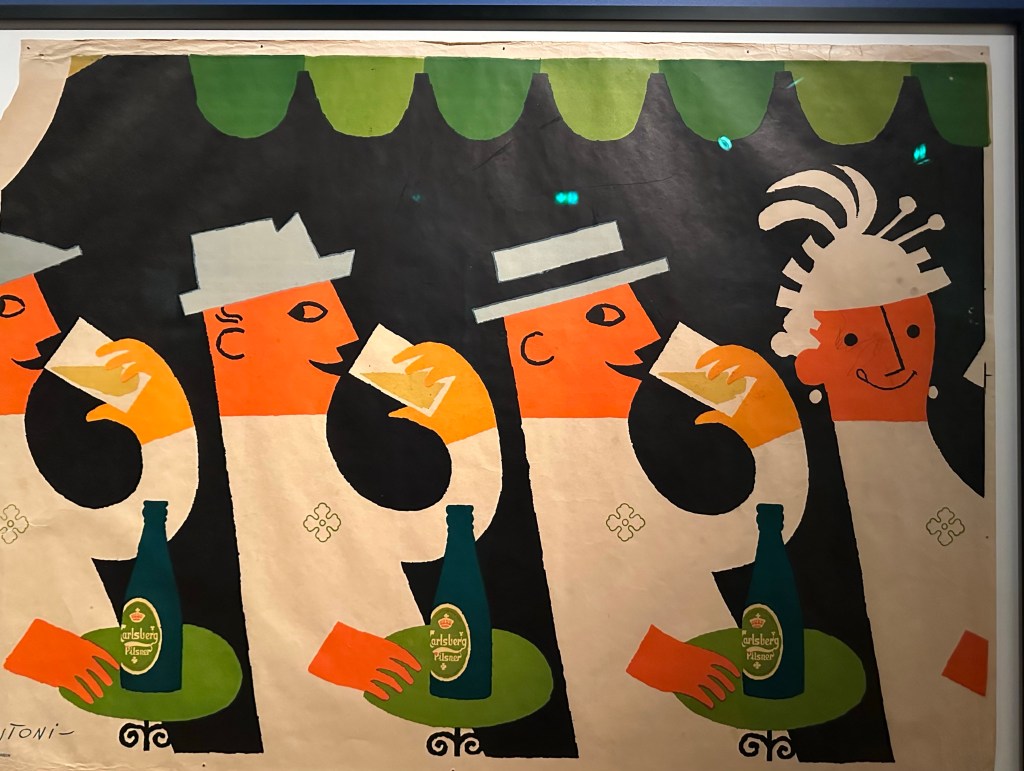
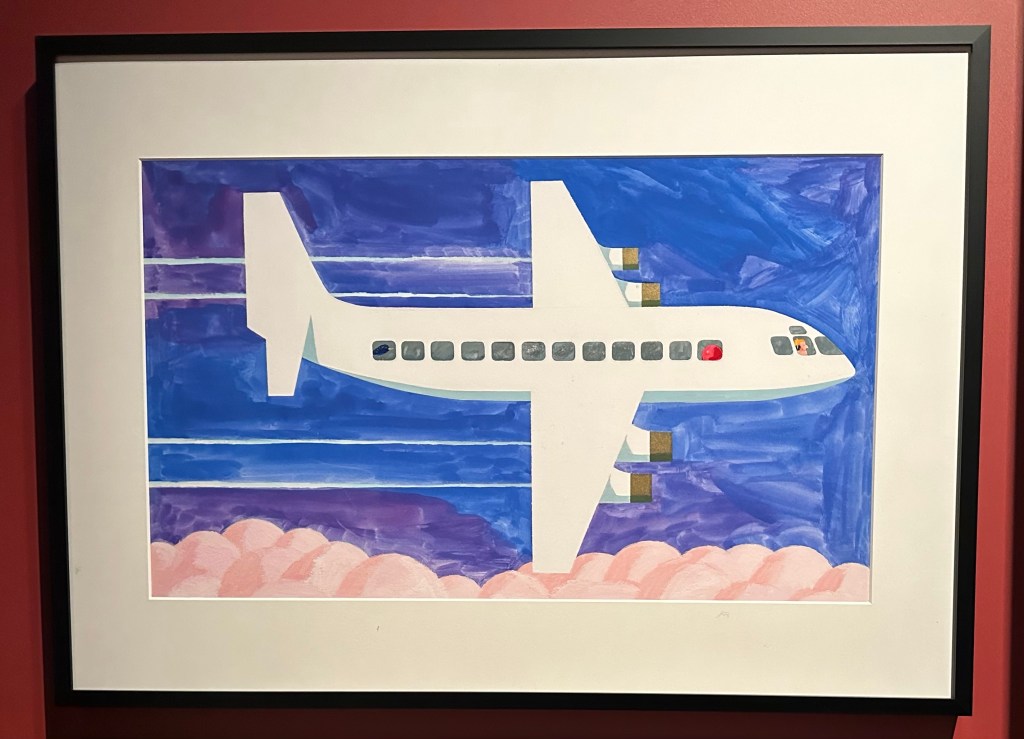
We had a short visit to the Museum of Copenhagen which tells the history of the city, important people, and important facts about the city. One exhibit featured the Danish graphic artist Antoni whose simple, sharp, colorful cartoons influenced graphic arts for more than 50 years.
We know that we could not see everything worth seeing even if we stayed a full week or month. However, the list of things we did not see in Copenhagen seems particularly long: Louisiana Art Complex an hour away; Freetown Christiania, an independently governed community within Copenhagen; the modern art SYMK Museum; the Danish Resistance Museum; the Museum of Denmark; the Architectural Design Center; Tivoli Gardens; day trips to three or four places outside Copenhagen . . . and the list goes on. More time and more energy were needed.
The final morning a taxi carried us to the Station an hour early without looking for Bus 23. Actually Bus 26 was the bus that went close to our hotel and was designed the “sightseeing” route bus. The cab was 10 minutes late, there was road construction, and it was morning rush hour. We still got to the station in plenty of time to find the correct ramp, locate the train car, and claim our seats. A successful exit from Copenhagen moved us toward our next stop in Goteborg (Gothenburg), Sweden.
Extra photographs
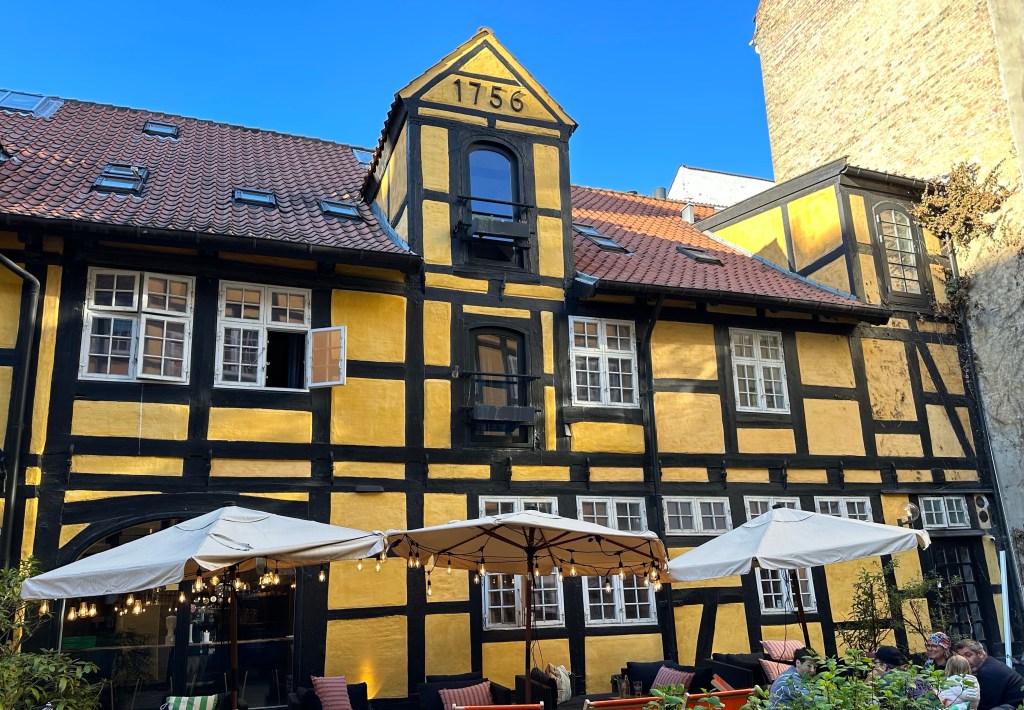
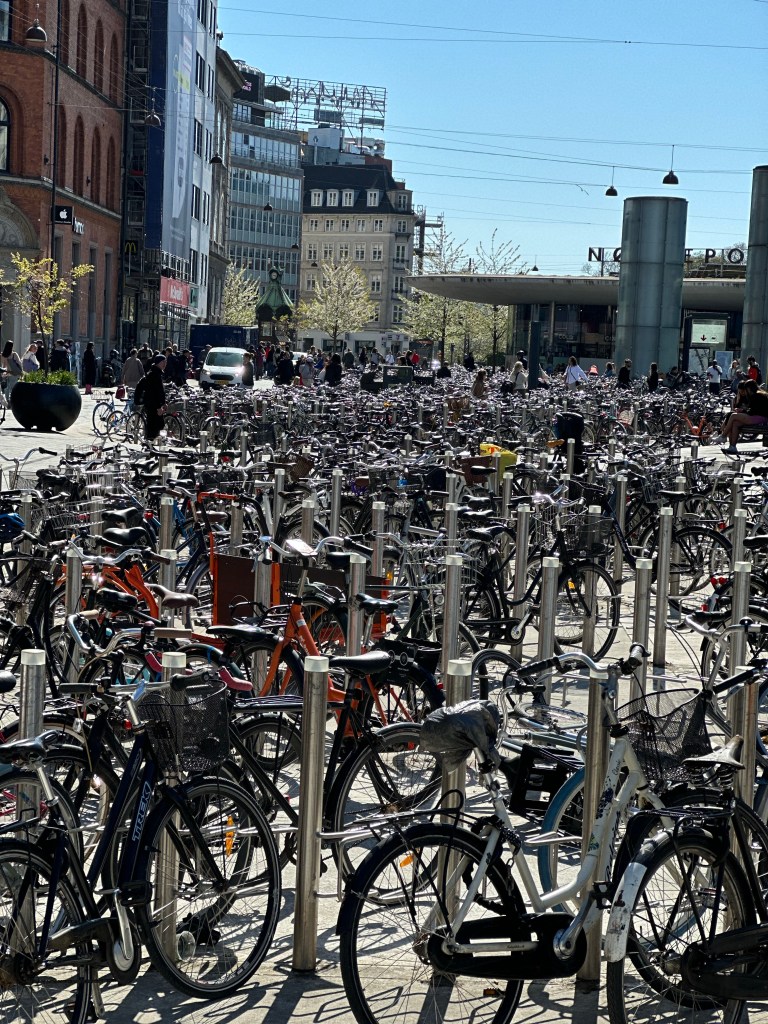
Nyhavn hostel set back in alcove from streetTiled room is a royal privy around the cornerSentry at Amelianborg CastleFrom the Design museumAnother Antoni commercial art designWow! A bowl overflowing with musselsBicycles at the Norreport travel center
Our trip to Copenhagen began with a tram to Amsterdam Centraal Station where we caught a train to Hamburg. The distances from Amsterdam to Hamburg to Copenhagen appear short on the map, but they are not—by rail are almost 12 hours with Hamburg only half way.
Boarding the train in Amsterdam Centraal Station
The start of the trip was a little hectic. We had reserved seats but somebody was sitting in them, Everybody was just sitting anywhere. Since the train was not crowded, nobody seem to care.
We changed trains at Hanover, a major junction where many people were waiting for connections. Apparently a previous train to Hamburg had been canceled, leaving a train-load of all people anxious to be on our scheduled train. The Hamburg arrived late, a rush ensued. People were crowding anywhere they could get on. Luggage was stacked everywhere it should not be. It was equal opportunity train mashup.
Since we were unable to get to our reserved seats, so we stood up most of the final leg of the trip. A chatty woman going to Hamburg to visit her ailing partner found a seat for Becky for a part of the trip.
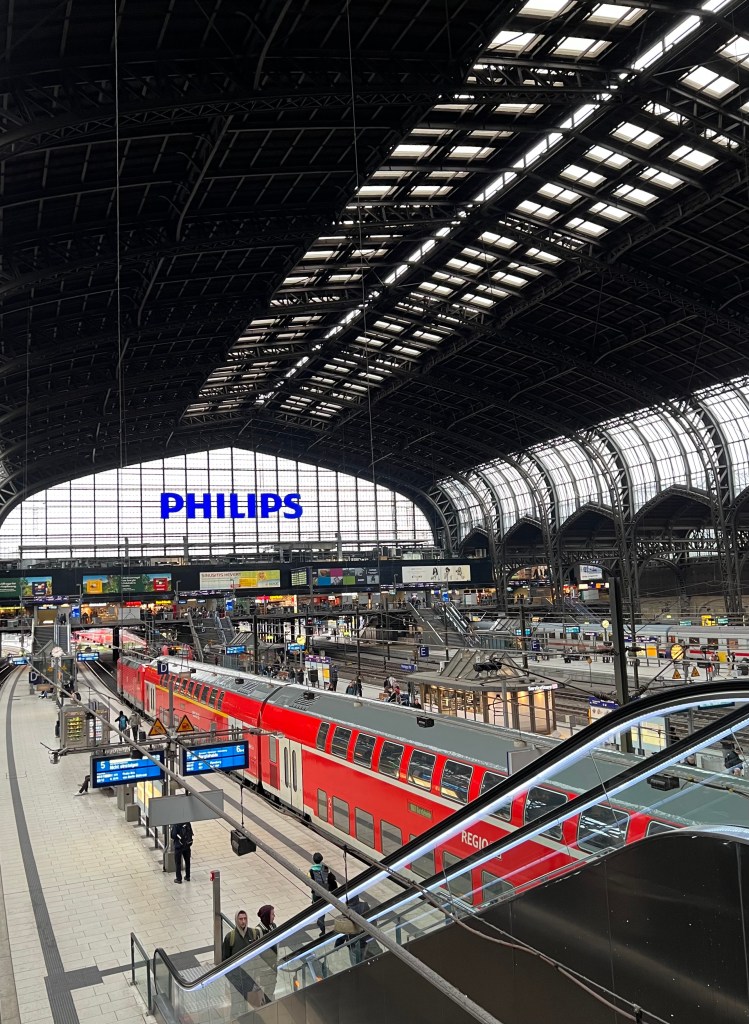
Hamburg HBF station
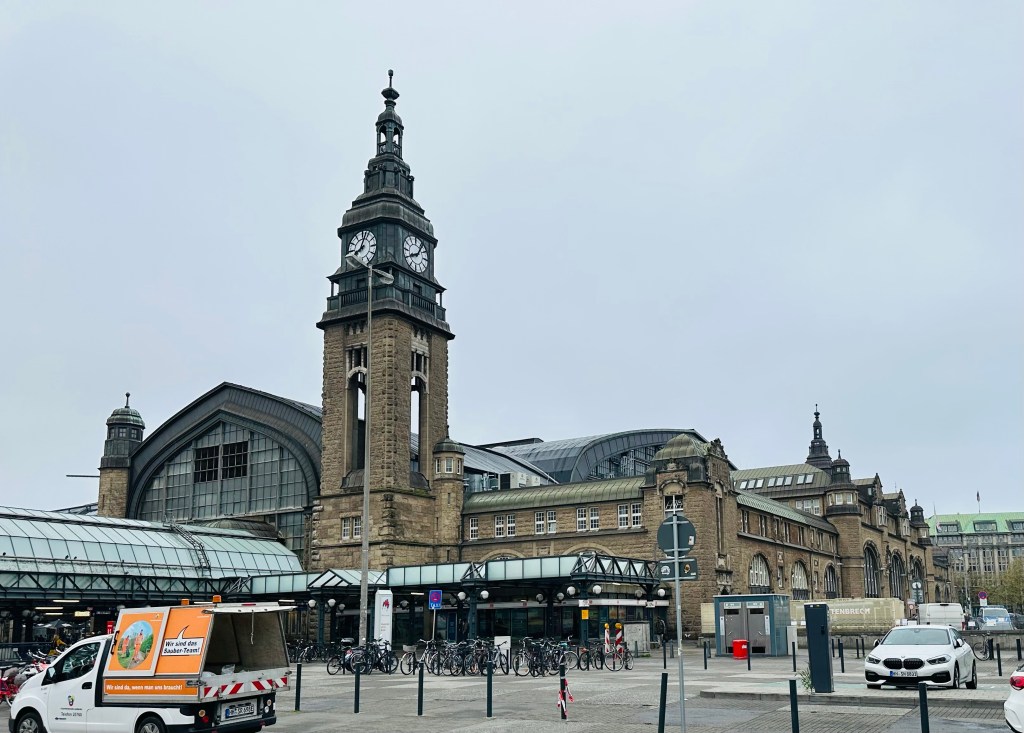
Hamburg Hauptbahnhof is an impressive edifice and example of gigantic train stations across Europe. All 12 tracks handle trains coming and going from early to midnight. I thought maybe 20,000 people traveled through Hamburg per day. Becky looked the number up; I missed it a little. Approximately 720 trains move up to 450,000 travelers per day, making Hamburg one of the most frequented passenger railway stations in Germany.
Continental Hotel Across from Hamburg HBF
The Continental Hotel was across the street from the station. We asked for directions because we had exited the wrong door from the station which was two city blocks long . The hotel is in the photographs—not the large fancy one— but the small one labeled Continental to its right. Our room was on the 6th floor which had a separate elevator—penthouse at last. Not really, but the room was clean with a good bed, hot water, and a balcony.
After standing for most of two hours, our legs and backs were exhausted. As soon as we checked into the hotel, we checked out for 4 hours of deep sleep. I woke at 7:30 pm and went foraging in the Wanderhallen food court that serves thousands of train travelers. Subway is there, Dunkin Donuts is there—along with every possible ethnic food choice. The Middle Eastern cafe had the freshest looking food and best prices: a vegetarian plate with halloumi for Becky and a chicken shawarma (like a gyro) for me.
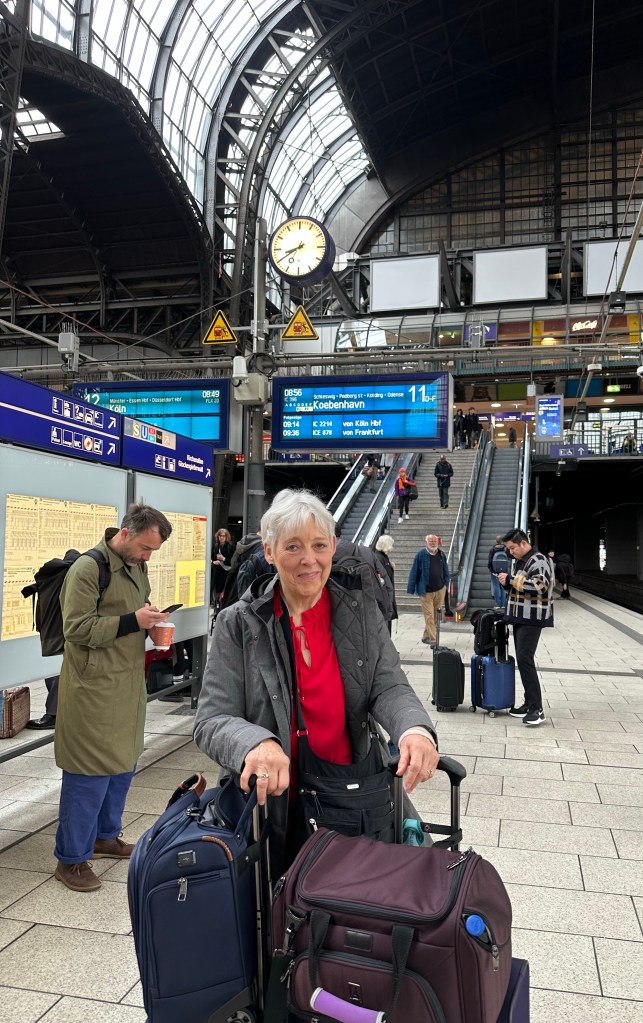
Repacking for the journey to Copenhagen was the evening’s task. We were up at 6:00, buffet breakfast, 7:00 in the hotel, and at the station by 8:00. We were determined to claim our reserved seats for this five hour trip: 104 and 107 in Coach 8.
Waiting for the train in Hamburg and ready to claim our seats.
If you do not claim seats, people sit in them, and you have to convince them that they are in your seats. After standing yesterday, we were willing to make people move so we could have seats. Standing up from Hamburg to Copenhagen would not be fun.
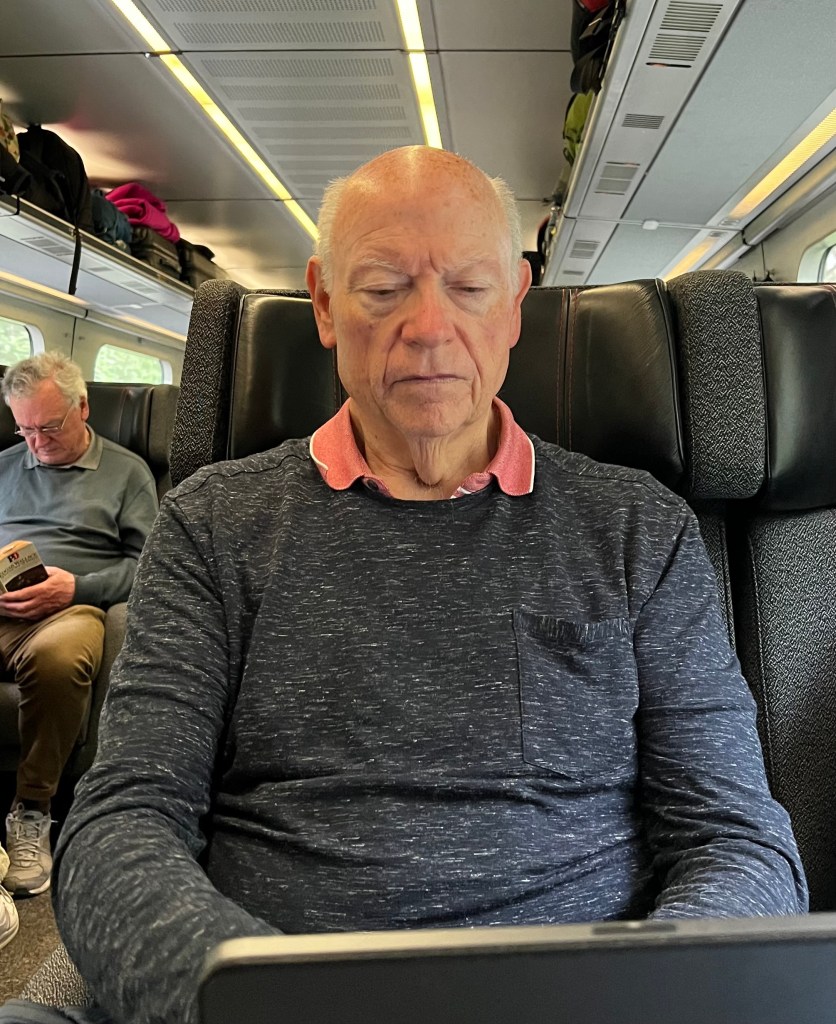
Blogging on train to Copenhagen
The train was on time, there was not a crush of people. We found our correct seats and settled down for 5 scheduled hours to Copenhagen, which turned into 6 due to track maintenance work and some other problems with train schedules. The train arrived in København, and we were ready to enjoy Danish wonders.
Tulips set off the tourist season in Amsterdam with an amazing patchwork of colorful fields around Keukenhof. The world-renowned Vermeer exhibit brought tourists a little early this year. It’s a busy spring for Amsterdam and the Netherlands! Every venue comes with the warning that it will likely sell out.
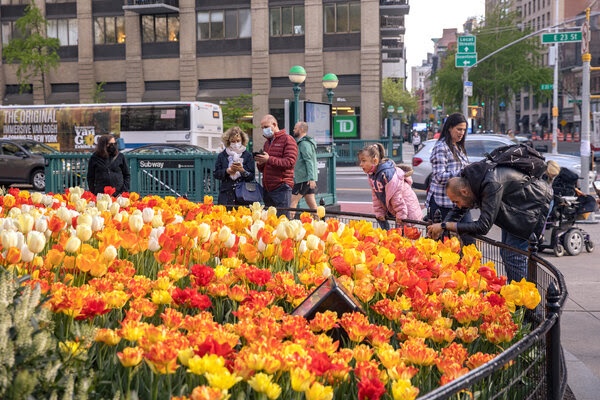
Tulips on display near Museumplein
We visited Keukenhof in 2017 and there were plenty of tourists then—often standing in front of tulips that we wanted to photograph. We did not get tickets for the Vermeer because all tickets were gone by the time we decided to travel. We found one tour that included Vermeer tickets for $150 a head. Tempting but no!
Rijkmuseum was sold out due to the Vermeer exhibit
We had reservations for both the RijksMuseum and Van Gogh Museum. The RijkMuseum features the grand masters of Dutch art. The skillful painting of realistic domestic and historic scenes with such grandeur and portraits with such emotional depth is amazing. We just don’t really enjoy them very much. We walked quickly through the central galleries where several hundred people viewed Rembrandt’s monumental work “Night Watch” from behind a protective screen.
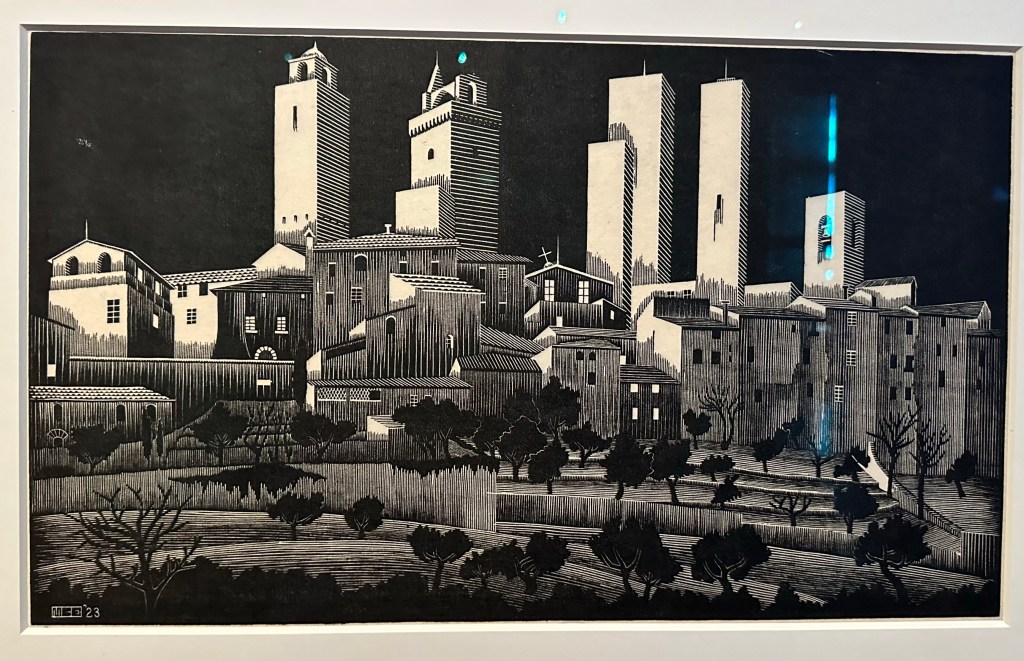
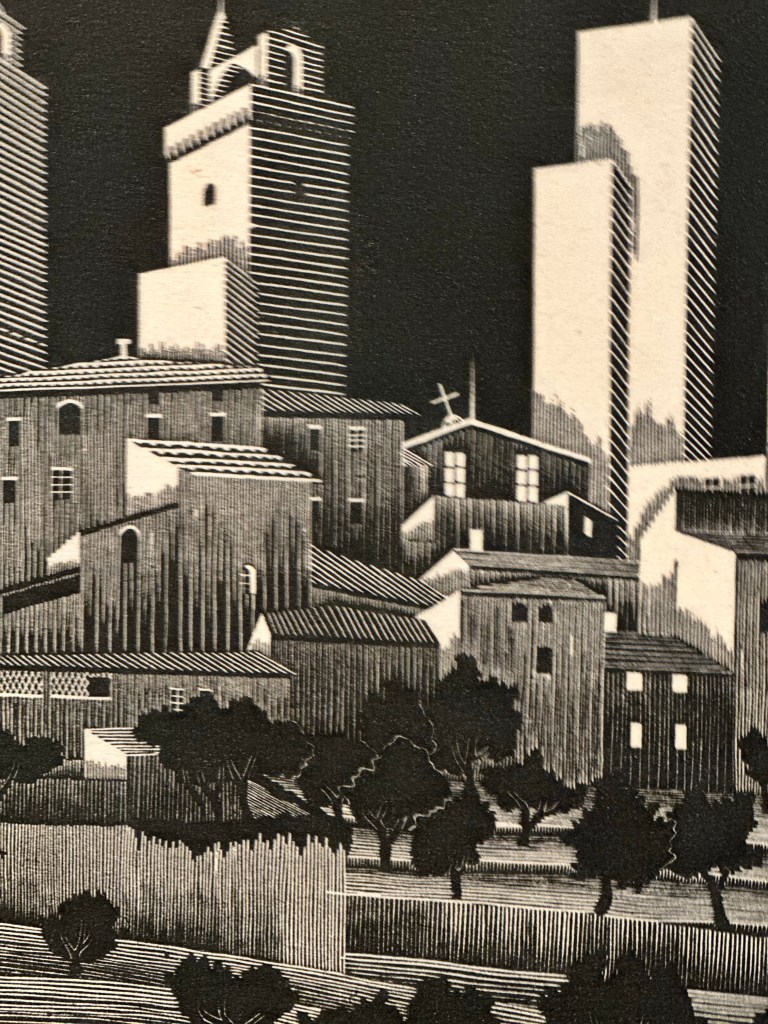
Other galleries offered some glorious and unexpected gems. For example, in an out-of-the-way gallery on the third floor, we found an exciting exhibit of 20th century art and artifacts, spanning Arts and Crafts, deco, moderne, industrial, and art nouveau design. In addition to a display of modern chairs and a sleek complete single-engine airplane, we were surprised at works by Escher which were realistic, but stylized, woodcut prints and lithographs— very different from the tessellations and mind bending graphic puzzles he developed later and is famous for .
Escher wood cut printDetail from Escher print
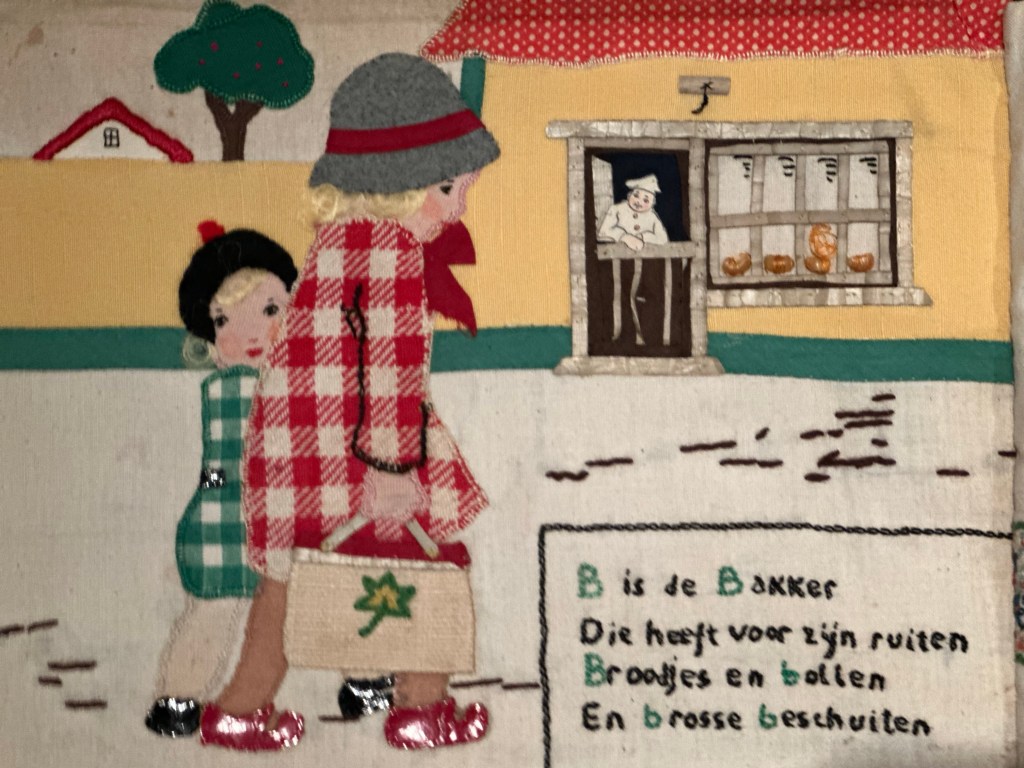
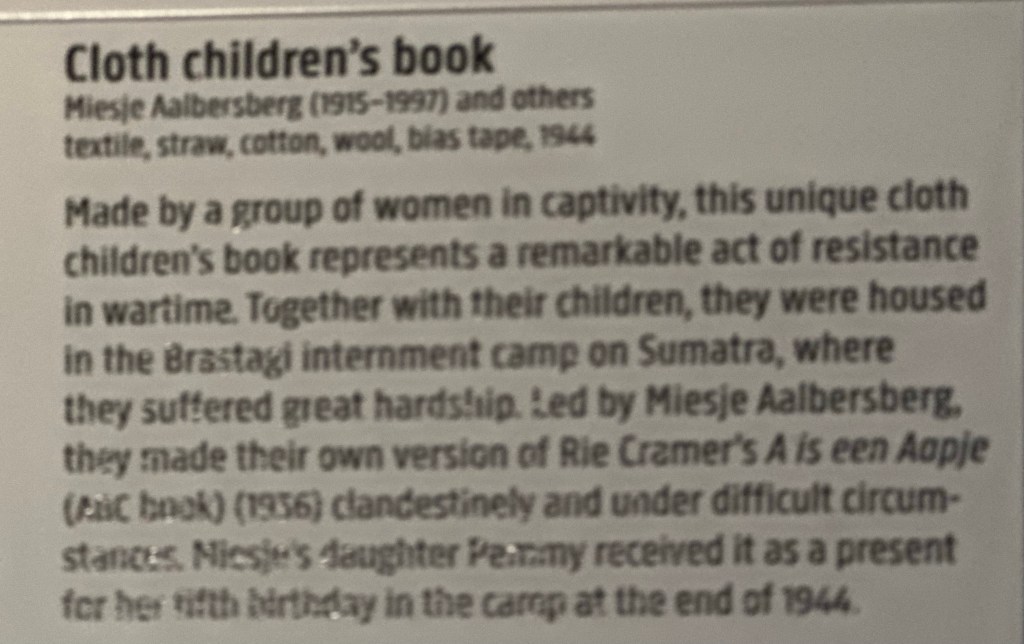
Another exhibit focused on World War II art and artifacts related to the resistance movement and people’s lives. One of the most touching was an alphabet book created for children by women who were in a concentration camp.
We got into the Van Gogh only by joining a tour. Tour guide Jo was very knowledgeable about Van Gogh’s life and art, his financial and emotional struggles, his often cantankerous relationships with other artists, and his death steeped in controversy. What really happened those last two days of his life? The official record and the unofficial reports from those who knew him reveal gaps and inconsistencies. His brother Theo died about a year later of “a broken heart.” The task of preserving and promoting his art was left to his sister-in-law and nephew, also named Theo.
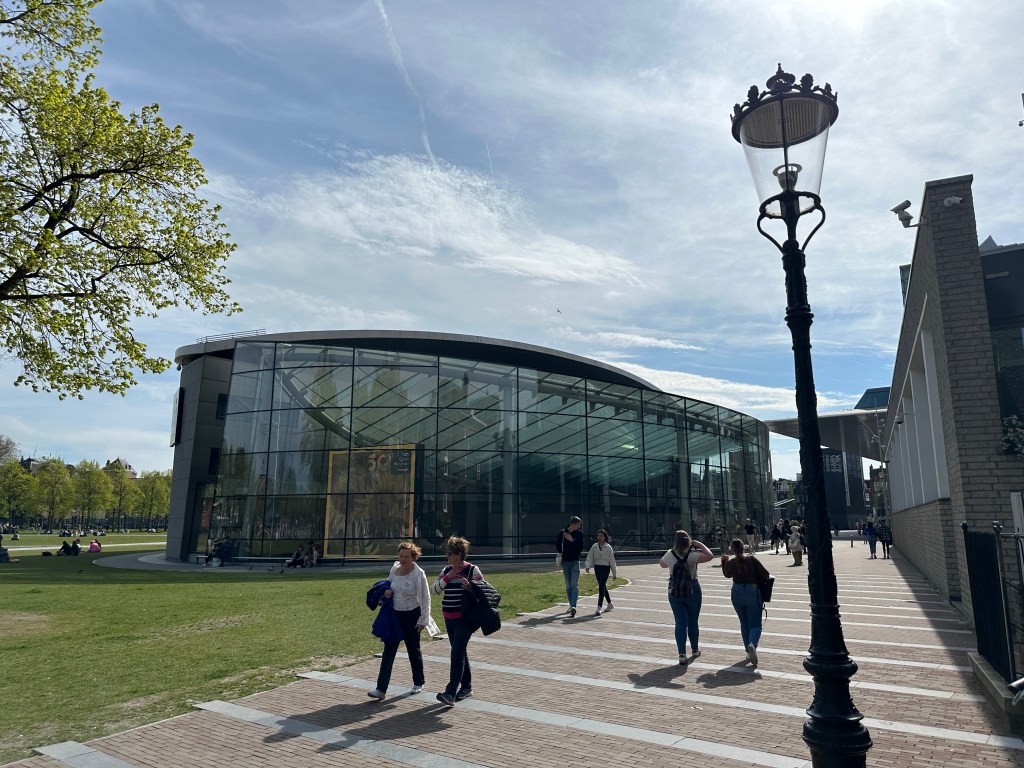
New Van Gogh museum on left, older Van Gogh museum on right
Van Gogh began painting in the accepted style of the day, but soon was experimenting with other approaches to subject and technique. In Paris he met many French impressionists who showed him their work and encouraged his efforts. But his work was moving toward a style so radical in composition and color that he was not able to sell it. He traded paintings with Gaugin and others resulting in an impressive personal collection.
The dozen self portraits which opened the exhibit served Van Gogh as exercises in composition, painting techniques, and color combinations. The exhibit ended with works of artists who influenced him and of the many who were influenced by him, including Vuillard, Bernard, and Kees Van Dongen. After a long museum day, we ate poke bowls at Umami restaurant next to the hotel and turned into logs, having logged almost 20,000 steps.
On the third day, we took a stroll across the canal to an area called the “nine streets” with many shops, boutiques, cafes, and coffee shops (code for marijuana). We encountered many fragrances but did not inhale.
A canal tour for the afternoon took us past many of the important sites in Amsterdam. The audio system was not so good, but the boat glide was relaxing.
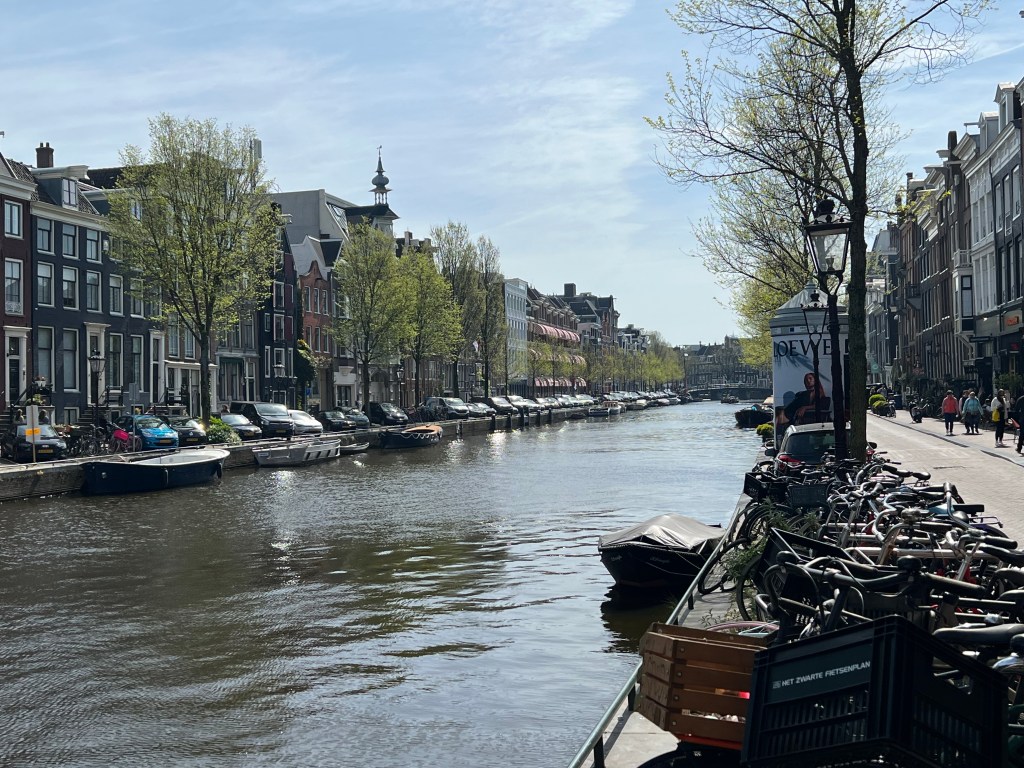
What we saw along the canals
Late lunch was at Zorba the Greek restaurant where we had fantastic main dishes of Moussaka and Vegetable Forno, Greek salad, and two waters totaling 55 Euros (about $62). If that seems expensive, it was actually relatively inexpensive for a sit down lunch in a nice restaurant.
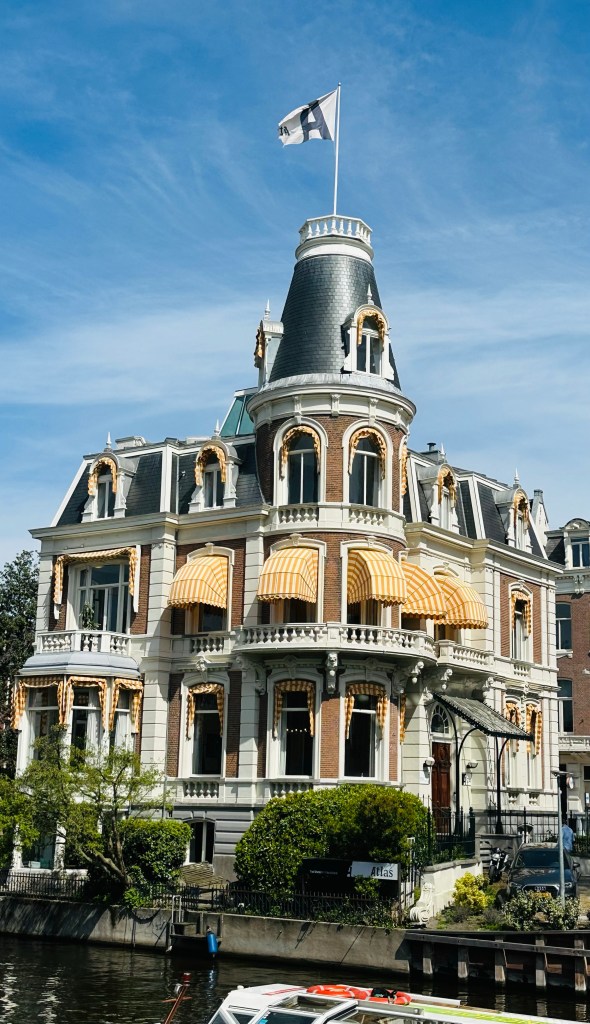
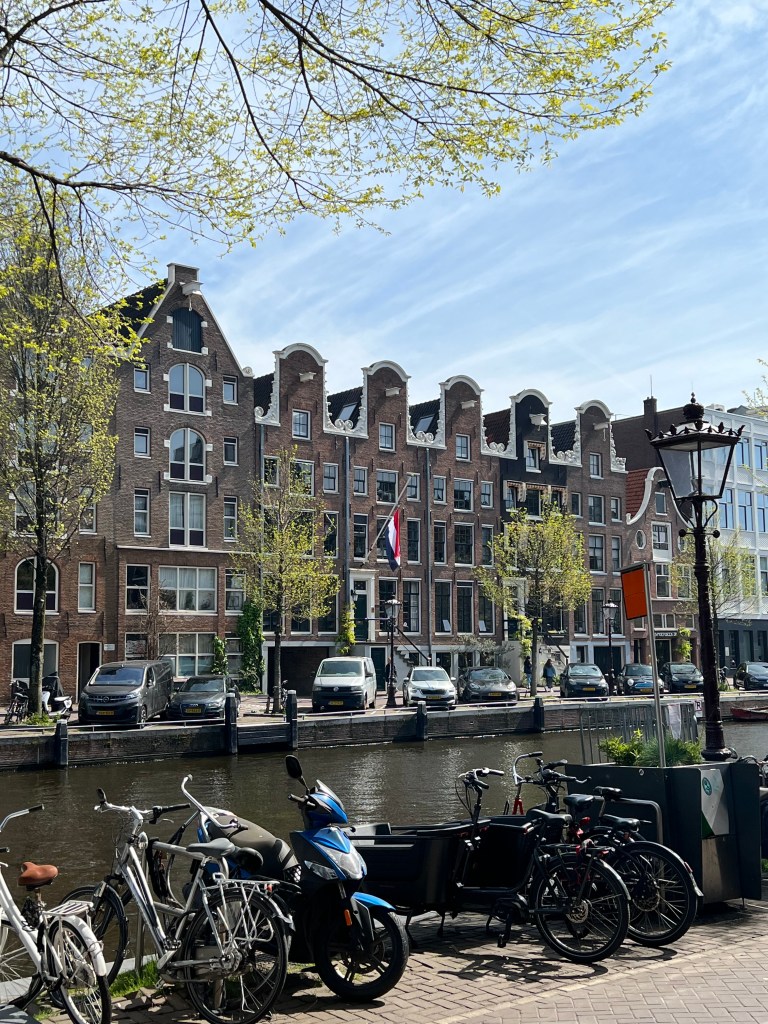
We also enjoyed looking at buildings on the street and along the canals. Amsterdam, an old city, has striking examples of architecture from many periods: Neogothic, Victorian, and modern.
Interesting house and apartment buildings
In the afternoon, we had two hours at the Stedjik Museum which contains 20th century art primarily from Dutch artists. Warhol used a photograph which he silk screened the photograph about 30 times. The photograph is of an assault and but the horror of the scene almost disappears with the repetition. Becky appreciated the design and techniques of a huge fabric woven with packaging wrappers from different products.
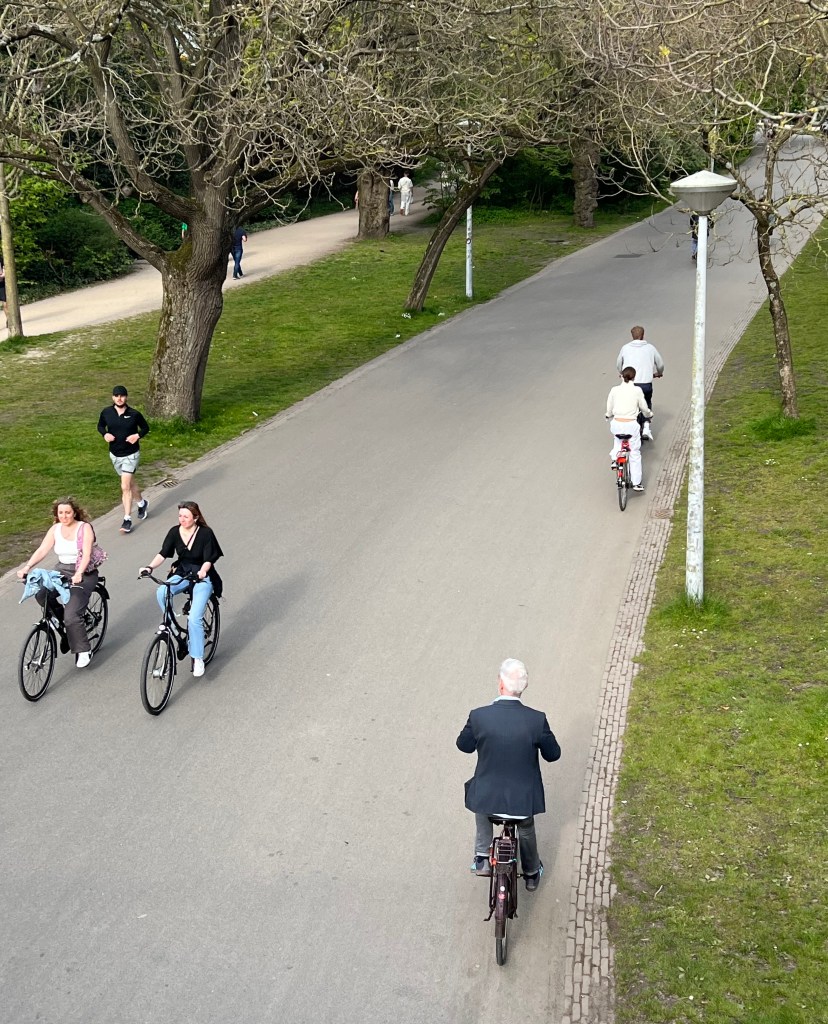
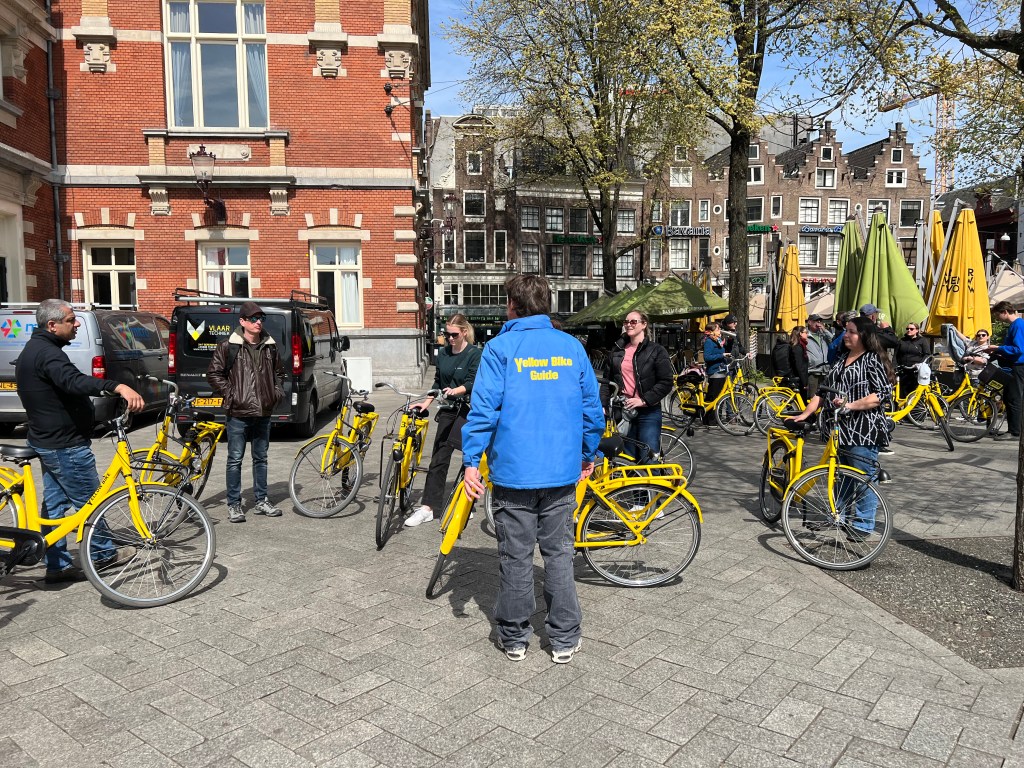
Bike paths were everywhereYellow bike tour getting organized.
As we walked around Amsterdam, we were amazed at the number, variety, and speed of bicycles and bicyclers. If you accidentally or absent-mindedly stand in the bike lane, you risk limb and life. We soon learned to look left, right, left before crossing the bike lanes. I was unconvinced that tourists should be pedaling with Amsterdam traffic and speedsters.
We spent the week getting clothes washed, errands run, prescriptions filled, and everything eventually packed. Becky coordinated the Girls EMpowered (GEM) celebration at Upward on Thursday—a fine time for all the girls, teachers, and United Way representatives. Then we could concentrate on finishing reservations and stuffing our bags.
Our aim was to minimize luggage weight and number. We packed only one suitcase for clothes and shoes and one carry-on for medicine, glasses, technology, a book, and travel materials. We reduced weight about 10 lbs each: Becky’s suitcase weighed less than 30 lbs, and mine less than 40 lbs after some serious debate and deletions.
Interrailing, our travel provider, customizes train-based vacations in UK and Europe and makes all the train, ferry, and hotel reservations for the places you want to visit. They also offer links to packages for day trips, local buses and trams, and sights/sites based on your itinerary. All the arrangements are set up so that we can concentrate on the fun parts.
The plane trip was Asheville AVL to Charlotte CLT to Philadelphia PHL to Amsterdam Schiphol AMS lasted from 2:30 pm Monday to 11:00 am Tuesday —total of about 24 hours in transit.
All planes were full, full, full. Amsterdam arrival was a couple of hours late because the pilot and copilot were delayed getting to Philadelphia. The flights were uneventful if flying across the Atlantic Ocean at 590 mph and 40,000 feet can be counted as uneventful.
From where I was sitting, I had a view of the toilets on the A320; many people were baffled by the inward folding door. Some people pounded on the door until they accidentally managed to hit the push here sign marked with an up arrow. A few stepped back, studied the door, and hit the arrow. A few asked an attendant. The attendants or travelers just opened the door for some. Others gave up—which seemed like a bad idea.
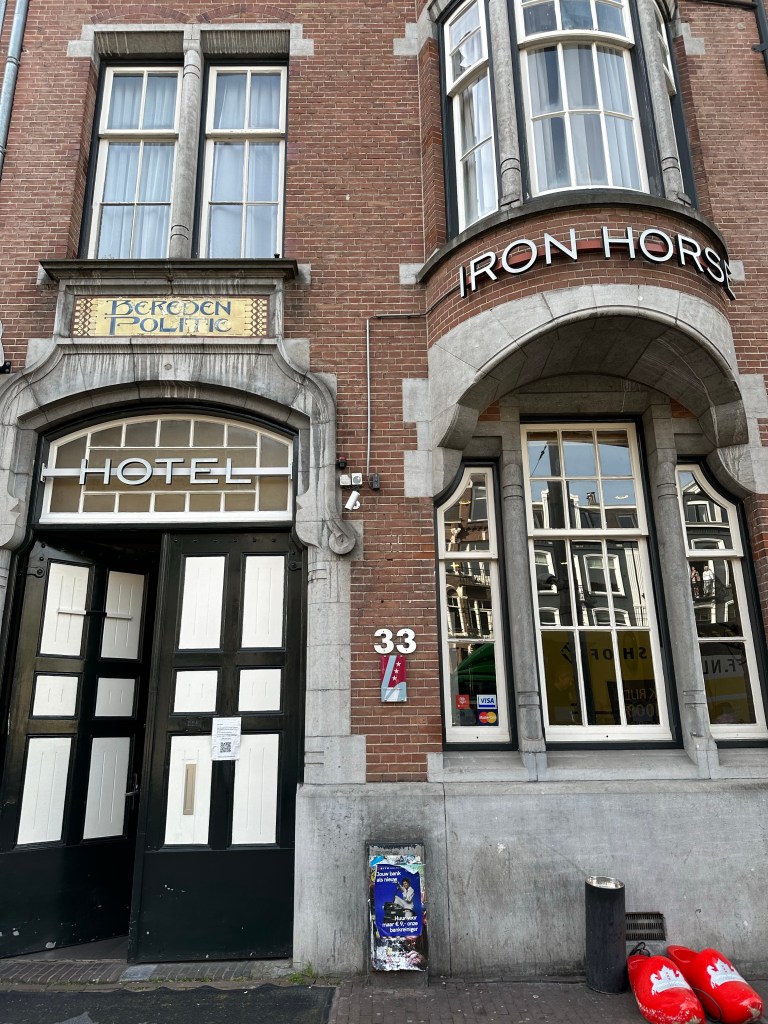
Upon arrival in AMS, we took the train from Schiphol to Amsterdam Centraal, the transport hub of the Netherlands and Amsterdam. We stood in line to get our GVB tram/bus passes, jumped on a tram, and rode to Leidensplein junction near our 3-star tourist hotel—clean, safe, spartan, and well located to the Museum Quarter which is our focus in Amsterdam.
Iron Horse Hotel was an historical building.
After check-in, we scouted the neighborhood for food and drink. Cafe and restaurant food is very expensive so we plan to picnic from grocery stores with an occasional sit down meal.
Will you be my friend and feed me lunch?
A small grocery was just a few yards from the hotel; we bought deli sandwiches for lunch in the park on a canal. Two copper-feathered ducks became very friendly, faintly quacking, edging closer, hoping that some morsels would find their way toward them. The closer they got the more demanding they became. Oh the dilemma! Should we feed the ducks or not? What do you do?
After 24 hours of travel by plane, train, and tram, exhaustion overwhelmed us. As a result we plopped ourselves down to read for a while and go to sleep. Very deep and long sleep was important in anticipation of a busy day on the Museumplein tomorrow.
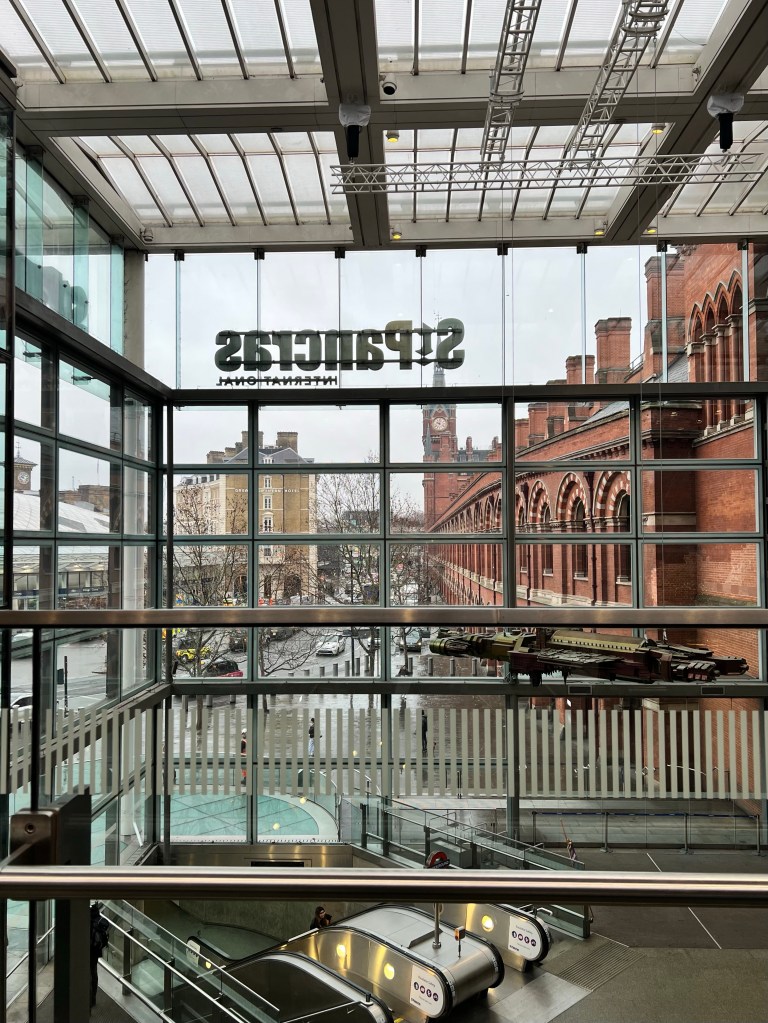
MS Maud arrived early to Dover on the morning of December 22nd. The excitement of a new adventure made it easier to say goodbye. We were very happy not to face the whole journey to the US right away. A taxi delivered us to the station by 9:00 for a 9:48 train into London. At St. Pancras station we changed trains for St. Albans, 20 minutes northwest of London.
We had more issues with our electronic M-Pass, but the train agents opened the gates for us in Dover. The pass finally activated in London. Six people from the ship were on the London train with us. We formed a fire brigade to get everyone’s luggage off because incoming passengers stormed onto the train, not waiting to enter until we got off. Rush, rush, and bustle.
St Pancras Train Station—the old and the new
As we changed trains, we observed a sad Christmas event. A nattily dressed young man, probably headed home for the holidays, huddled in the middle of the platform attempting to corral his luggage and too many shopping bags. Gift bags holding bottles of wine had crashed, causing the contents to pour out across the train platform. The bouquet added a festive aroma to the morning and perfumed his problematic situation. Rush, rush…..
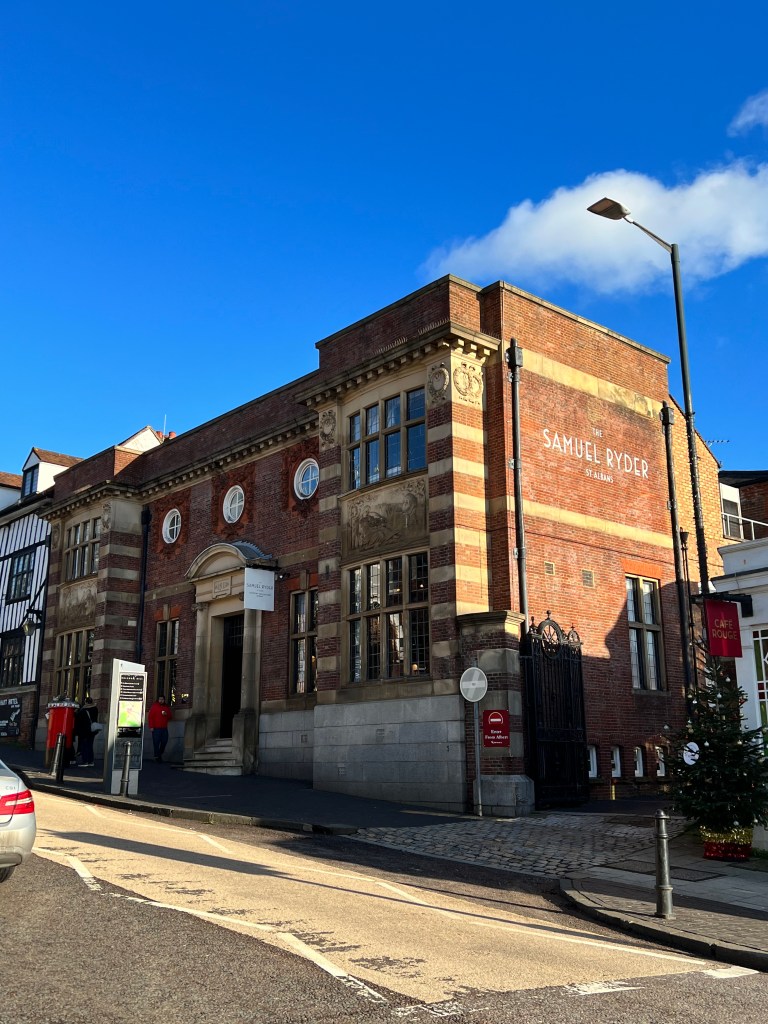
From the St. Albans station, a taxi took us to the century-old Samuel Ryder Hotel in the city center.
It was a wise decision as an inch on the map was at least a mile up and down hilly streets. The first floor of the historic building, once Ryder’s business office, was renovated for reception, lounge, and breakfast seating.
Modern, comfortable, cozy rooms are attached behind the facade. The updated hotel is decorated with a variety of abstract and contemporary graphics which we enjoyed such as this golf-themed one.
Samuel Ryder, an English entrepreneur and golf enthusiast, founded the Ryder Cup between top American and British golfers. The hotel is located next door to what was once his seed business but is now the Café Rouge. (For the rest of the story, search “Samuel Ryder” not “Sam Ryder” who is an American golfer.)
More importantly, the hotel in the city center is convenient for walking around and exploring a beautiful, historic, and archaeologically rich area. After settling in the room, we walked four blocks up a 20 degree incline to the aptly named High Street. In those four blocks, our street had three different names: Holywell Hill, Checkers, and St. Peter’s. The streets and sidewalks are centuries-old with an uneven mix of brick, cobblestone, rock, cement, cracked cement, with patches and loose materials. Uncertain footing made us very careful.
Why St. Albans? We were asked several times, even by residents. The simple answer was that we had never been there. Actually we picked St. Albans because of its fascinating role in English history. Neolithic and Roman settlements, the Norman Conquest, the Cathedral and Abbey Church of St. Alban, the Wars of the Roses, and Elizabethan intrigue put St. Albans at the center of many political and historic upheavals. (Search “History of St. Albans” for the whole story.)
The Samuel Ryder hotel serves a wonderful breakfast starting with fresh pastries, fruit and yogurt, and 8 choices at a huge self-service coffee maker with the touch of a finger—Americano for Becky and Café Latte for Steve. Then, we ordered from a variety of cooked breakfasts: full English, poached egg on avocado toast, eggs Benedict, or four pancake choices. Becky declared that the eggs were poached perfectly, so she ordered them without the avocado smear every morning.
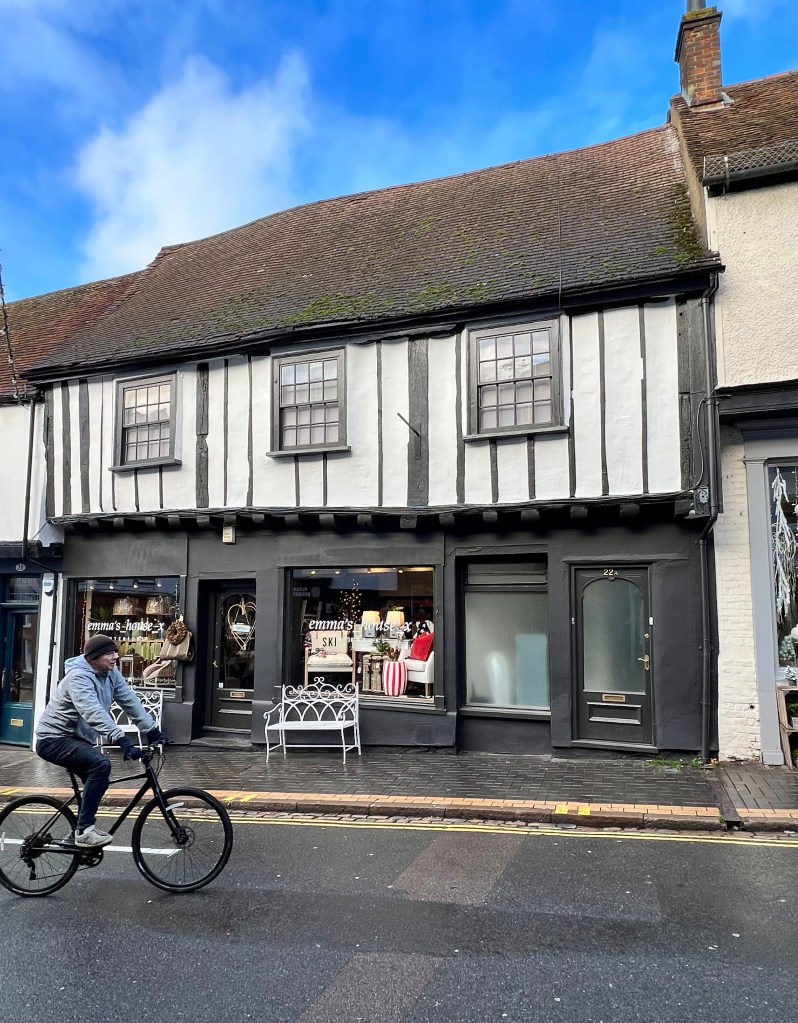
Half timber house on St. Alban Street
Many restaurants in England serve festive holiday lunch and dinner parties and do not accept walk-ins. Groups of family, friends, and business associates plan celebrations in December and through the New Year. We expected this and observed many such parties in progress; other places had signs that declared “Bookings Only.” Little Marrakech, a small mezze restaurant, was open and offered a menu of steaming tagines, spicy lamb or vegetable—perfect lunch on a chilly day. We wandered for another hour, then returned to hotel for a nap because we had 5:00 tickets for a pantomime, not Marcel Marceau pantomime, instead British pantomime also known as “panto.”
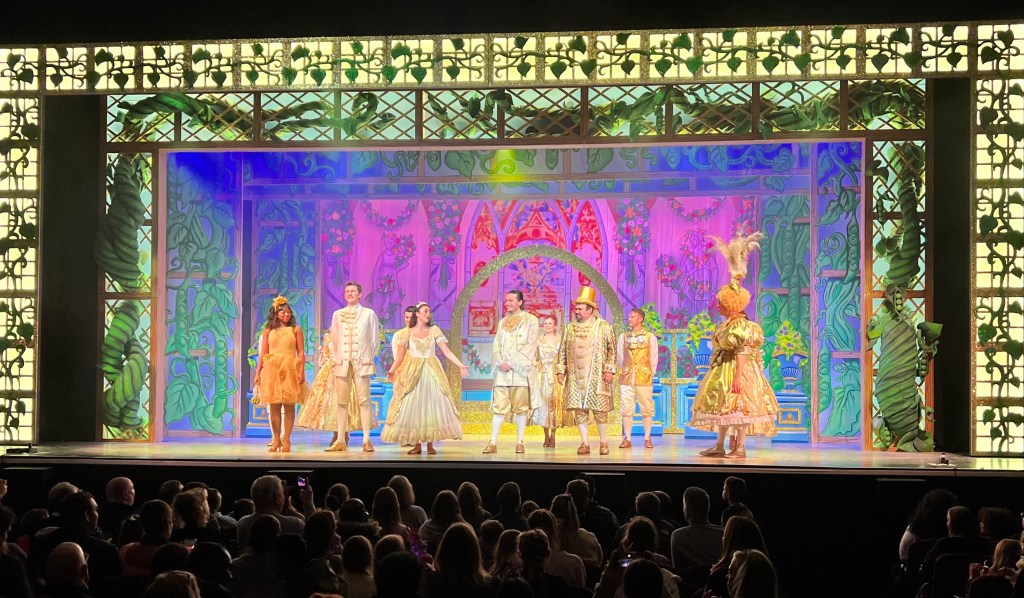
Panto, a traditional Christmas entertainment in England, is a hilarious, family-oriented stage production very loosely based on a classic children’s story such as Cinderella, Sleeping Beauty, or Puss in Boots. Hilarious and loosely are the operative descriptors. Certain stock characters appear in panto: the Dame played by a large man in outrageous bosomy costumes; a dancing horse played head and rear by two people; a hero and his love; a nefarious villain up to no good; and an interlocutor, or emcee, who talks to the audience, sometimes interprets what is going on onstage, and acts the clown. The entire show demands audience participation—especially booing and hissing the villain’s every appearance. The entire performance is riotous. Think “Shrek the Musical” colliding with midnight performances of “Rocky Horror Picture Show.”
“Jack and the Beanstalk” was everything we could hope—wildly elaborate sets and costumes, exuberant dancing, double entendre jokes, and audience singalong to modern (ABBA, Neil Diamond) and traditional songs (Grand Old Duke of York). The characters included hesitant Jack Trott, his best friend Billy as emcee, his encouraging girlfriend, his boisterous mother Dame Trott who picked out a gentleman in the audience to woo with mildly salacious greetings throughout the show, and Caroline Trott—a two-person dancing cow of course, instead of a horse. The villain named “Backinanger” was played by a semi-famous TV actor; many taunts and jokes referred to his 10-year stint as a character on “East Enders” whose only ambition was to be in boy band. The ludicrous plot revolved around whether Jack would sell Caroline to save the world from the villain’s Climatron machine.
Tickets were held at the Alban Arena box office, but they had trouble finding our reservations so we were a few minutes tardy, and the usher took us to empty seats which were better than our assigned seats. The audience of parents, grandparents, and excited children were greeted by Billy and warmed up by repeatedly screaming “Hello, Billy.” Many excited children required sudden trips to the loo during the performance. There was a constant stream so to speak. At interval we struck up a conversation with a family sitting behind us. Becca, the mother, is an elementary school teacher so we had a nice chat.
We began day two in the St. Albans City museum. St. Albans was at one time a center of print-making and book-printing. One exhibit showed dozens of fine print illustrations by local resident Frederic Kitton for original editions of Charles Dickens books.
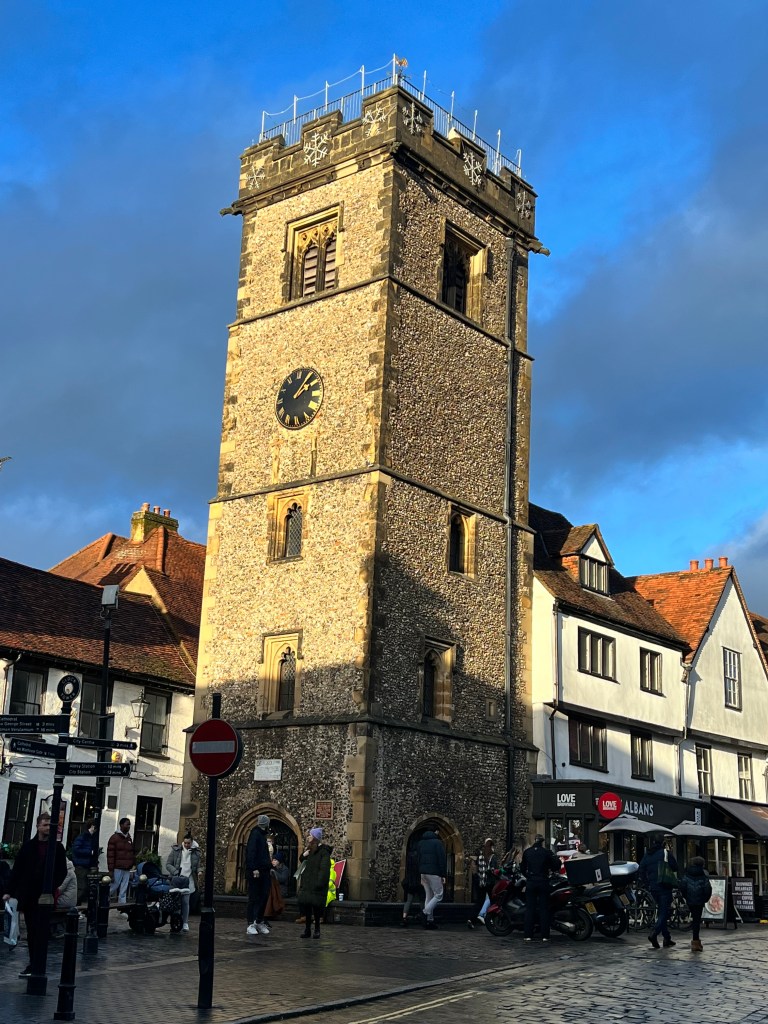
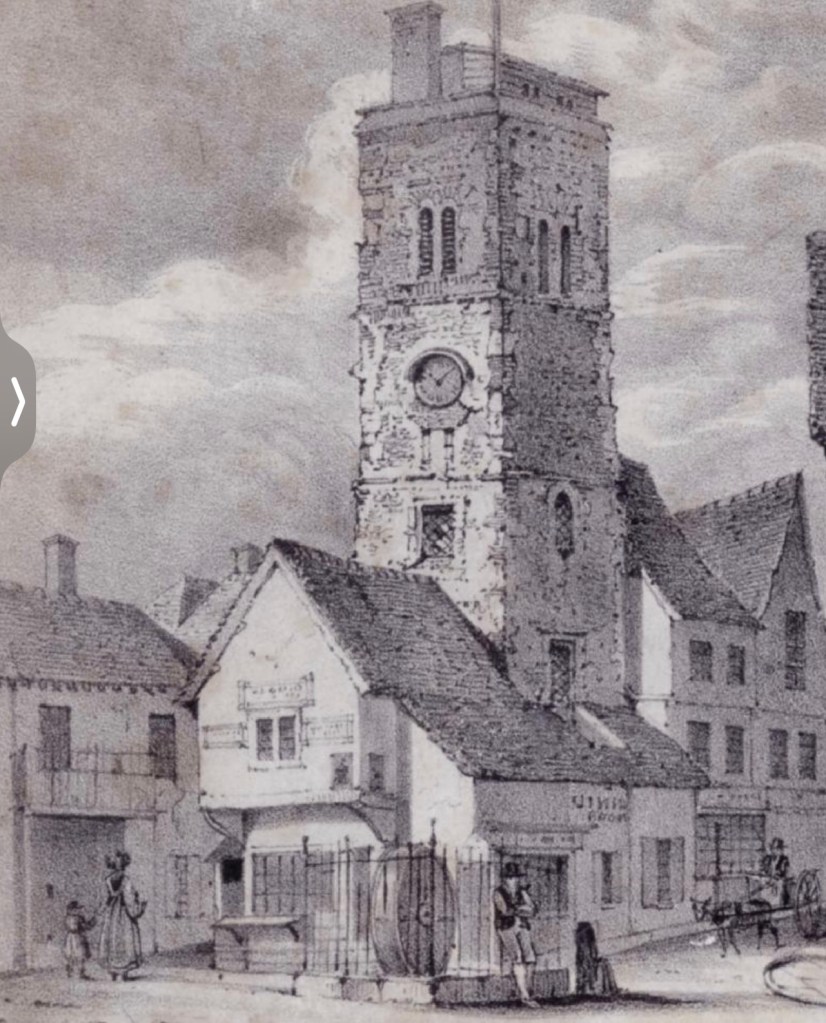
Frederic Kisson Illustration of St. Alban City Tower
The other exhibit featured Henry Moore’s sketches of coal miners in cramped spaces underground. “In the Dark” is an apt name for charcoal and pencil drawings he drew as inspiration for sculptures.
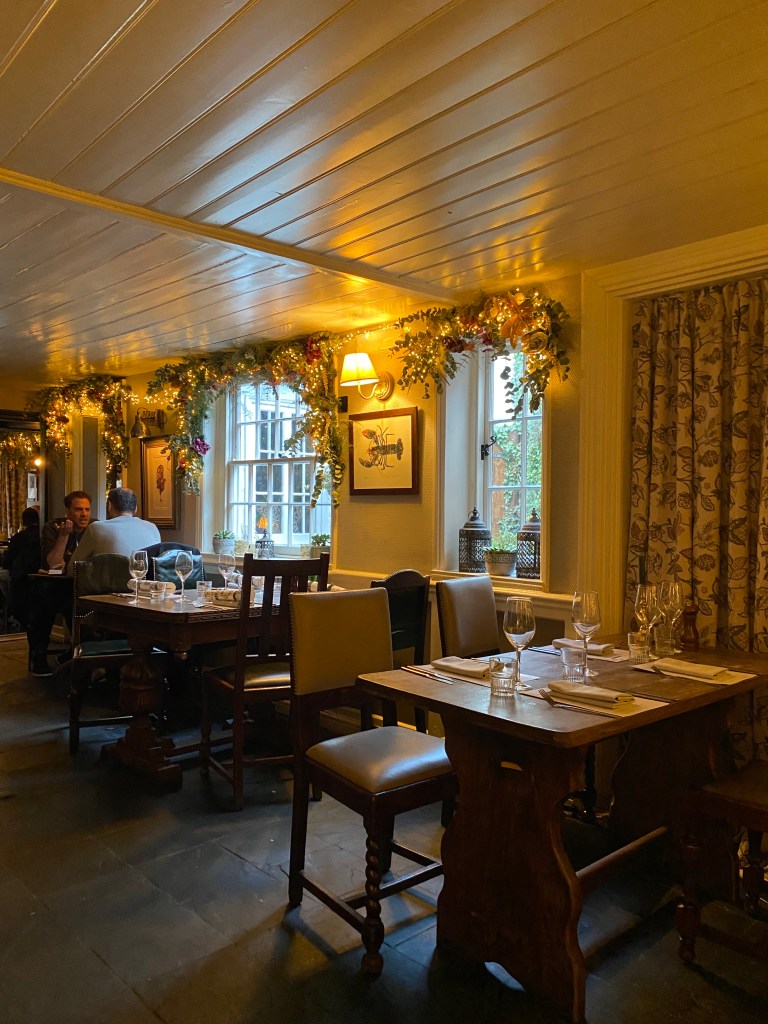
Dylans Pub at King Arms Inn
Knowing we needed to “book” a nice meal at Christmastime, we had made reservations for 2:30 at Dylan’s in the Kings Arms pub halfway down St. George’s street, a three block pedestrian walkway between High Street and Fishpool Road.
We enjoyed a fine three-course meal with a mushroom pastry for entree and custard for dessert. The food and service were great in the historical setting, and a cacophonous party of 10 added a festive touch. They had a head start nurturing their spirits.
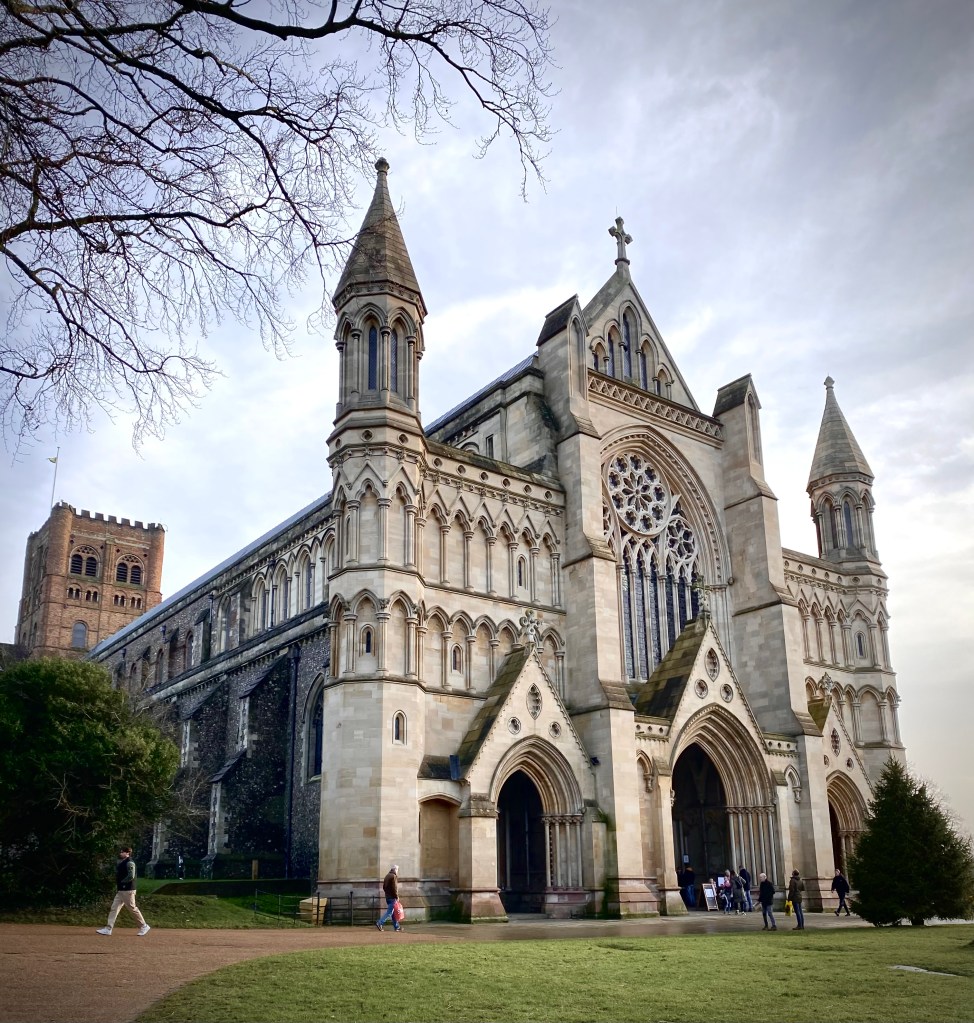
After the meal, we walked around the gigantic St. Albans Cathedral. The church site goes back to Roman times when a resident named Alban was hanged for harboring a Christian monk from the Roman authorities. (This was before Rome sent Christian missionaries across its empire.) Alban was the first English saint, so the site became a place of pilgrimage and successive churches were built there. His crypt stands in a special section of the Cathedral near an altar honoring the monk.
A Norman church with tower, beautiful arches, and 64 hand painted columns still serves at the core of the Cathedral. An Abbey was attached for hundreds of years until Henry VIII split with Rome and dissolved, destroyed, and rent asunder the abbeys throughout the kingdom. The town of St. Albans saved the Cathedral by buying it from the crown to serve as the parish church.
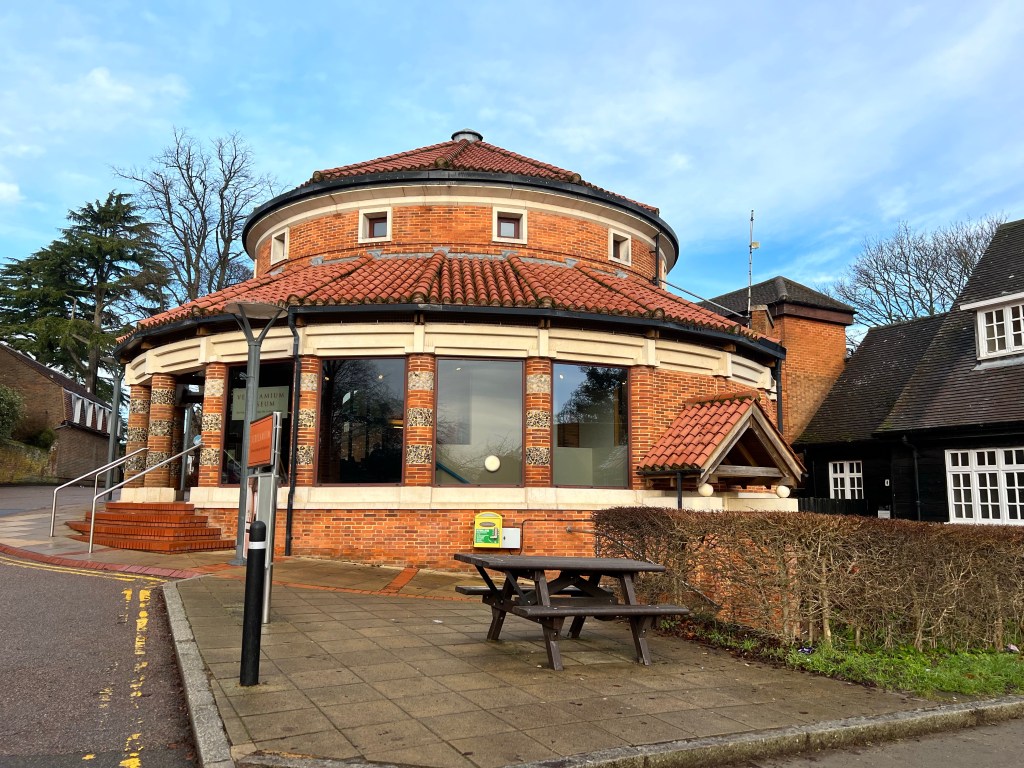
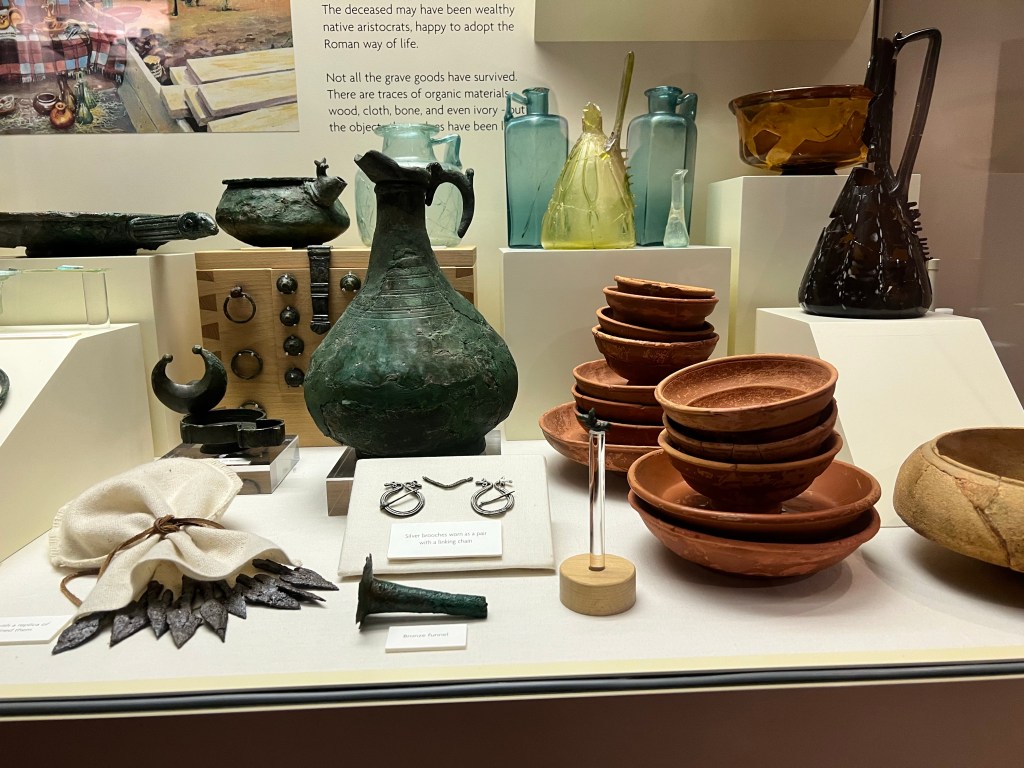
Most of the third day was spent exploring Verulamium Park and Museum about a mile south of the hotel. Verulamium, the third largest Roman settlement in Britain, was situated beside the River Ver at an Iron Age encampment called Verumion. The museum houses hundreds of artifacts unearthed across the large area including pre-Roman Iron Age relics as well as excavated Roman coins, tools, pottery, and jewelry, as well as magnificent mosaic floors and painted walls from Roman villas.
The museum focuses was on how ordinary civilians lived during the Roman occupation rather than the military aspect. The most impressive exhibits were the beautifully preserved mosaics, the wall paintings that were lifted from the ruins by gluing them on backing boards, and the Sandridge Hoard of 50 gold coins and 100 other coins from across the Roman empire.
Verulamium Museum, Sandridge Horde of gold coins, household wares
Near the museum were ruins of a Roman wall and Roman theatre. When the Romans abandoned Verulamium around 500 CE, the locals scavenged the ruins for brick building material for houses and for building the Cathedral.
Search “Verulamium” for a complete description of the Roman settlement and the museum.
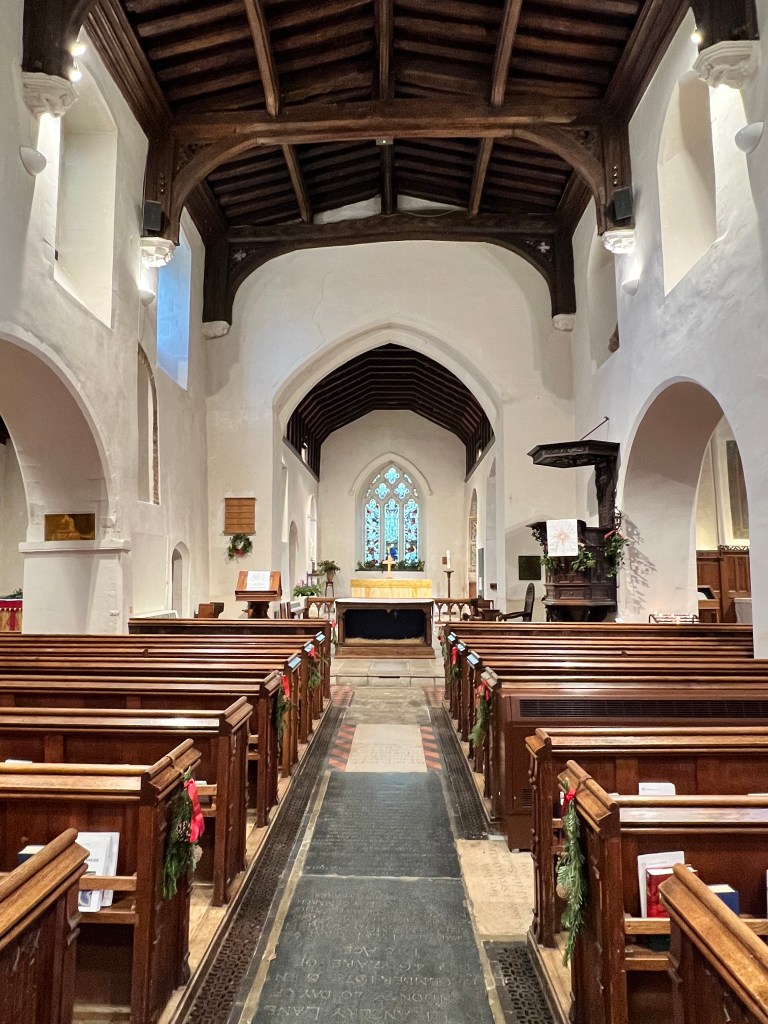
After several hours in the museum, we walked out the back entrance past St. Michaels, a small beautiful church and village, then through an upscale residential community on our walk uphill on Fishpool Street.
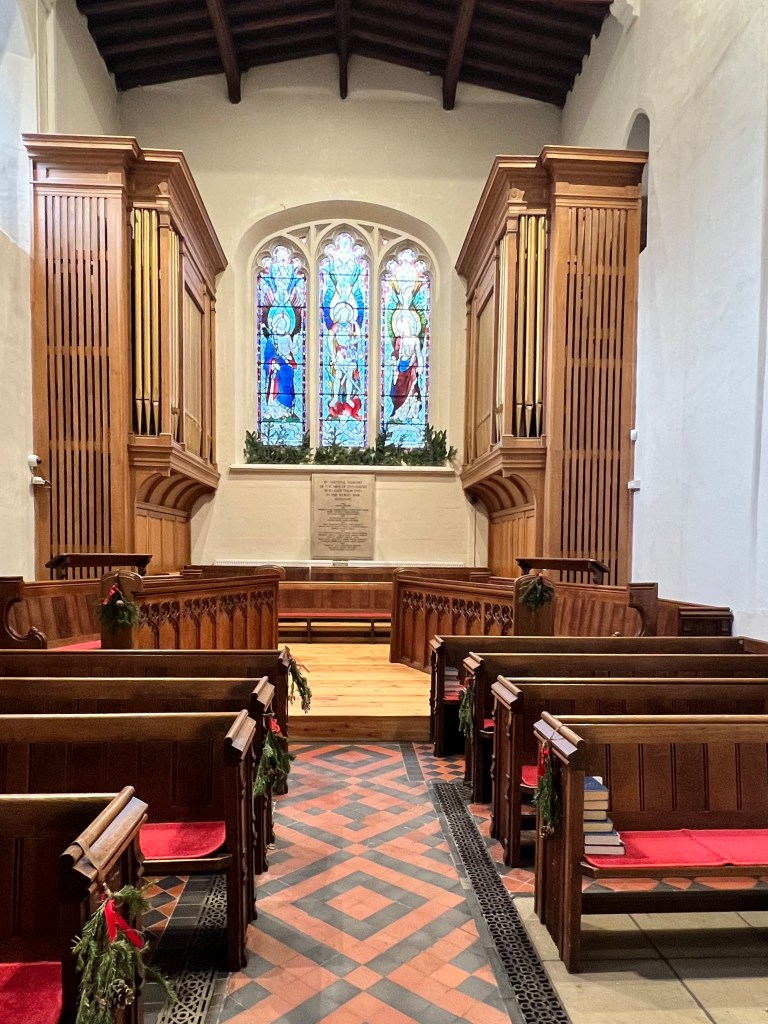
St. Michael’s Main Aisle and side Chapel. A beautiful gem.
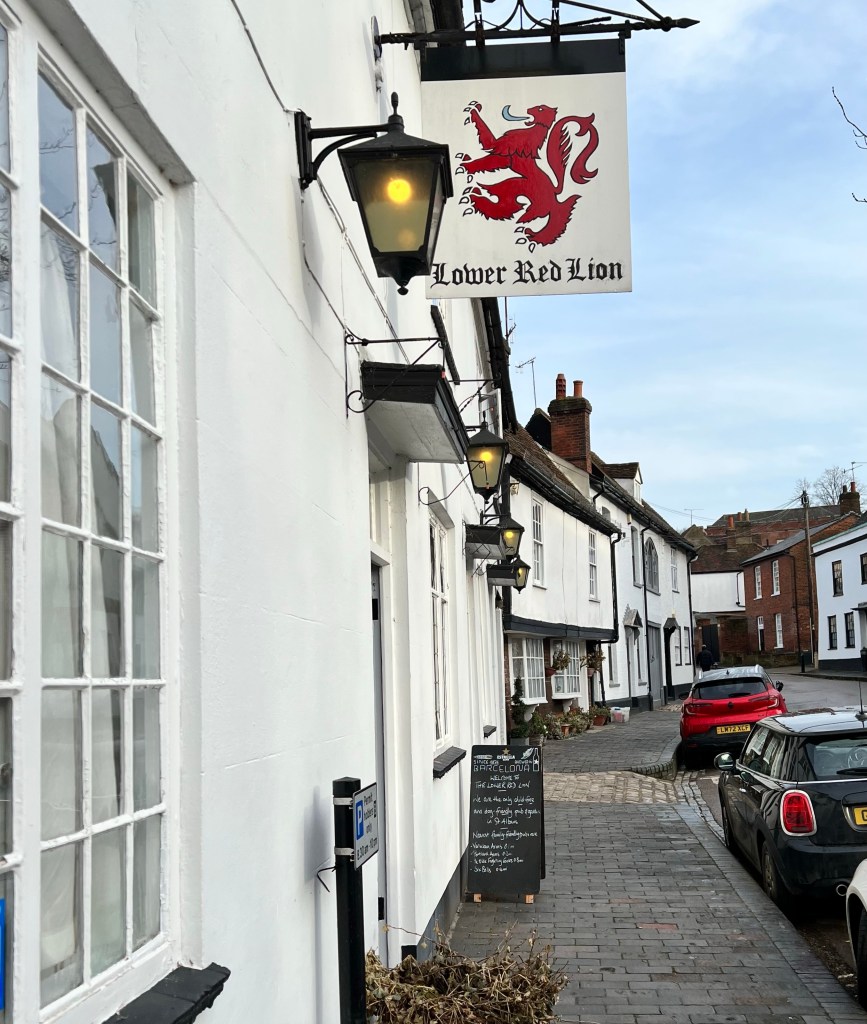
At the moment we were flagging, a street sign for the Lower Red Lion pub proclaimed “dog friendly and child free.
Lower Red Lion Inn and Sidewalk Sign
The sign added a list of nearby “family friendly” pubs. A great pub lunch of fish and chips and hot soup restored us, and the ancient three-legged pub dog Sammie visited for a rub. Closing the loop back to the hotel, I took the low road through the Cathedral grounds, while Becky stopped at the Hammersmith Bishop’s Cave shop for emergency cheese and crackers.
The Cathedral held Evensong on Christmas Eve, featuring youthful singing in the Quire. The service was lovely. On Christmas morning, we went back for a 9:30 family-oriented service. Choirs and worshippers sang both liturgical and traditional Christmas music. Singing in the huge Cathedral was an amazing vocal and emotional experience as the reverberating sound envelopes everyone.
Children were invited to view the huge crèche where the baby Jesus had appeared over night. Families walked down the central aisle of the longest nave in England (disputed by Winchester Cathedral). Later, as the service progressed, several children broke loose and followed personal pilgrimages through the Cathedral with parents in calm pursuit.
Christmas afternoon, we strolled around city center again, now almost empty except for a few restaurants with reserved seating. The only places open for walk-in were the Michelin one-star restaurant or the White Hart Inn Christmas Day dinner—each was available for 95 pounds per person (about $120 plus VAT and service charge). Instead we returned to the hotel for a pizza and cheese plate in the room and an evening of “Midsomer Mystery” and “Vera.”
On our last morning in St. Albans, we visited the Cathedral again for a more focused look at the building. A tour-guide told us of a scheduled 11:30 tour, then graciously spent 20 minutes showing us some of his favorite parts of the Cathedral. The scheduled tour was cancelled because the docents could not get the microphone to work, so we got another 20 minutes of personal guidance.
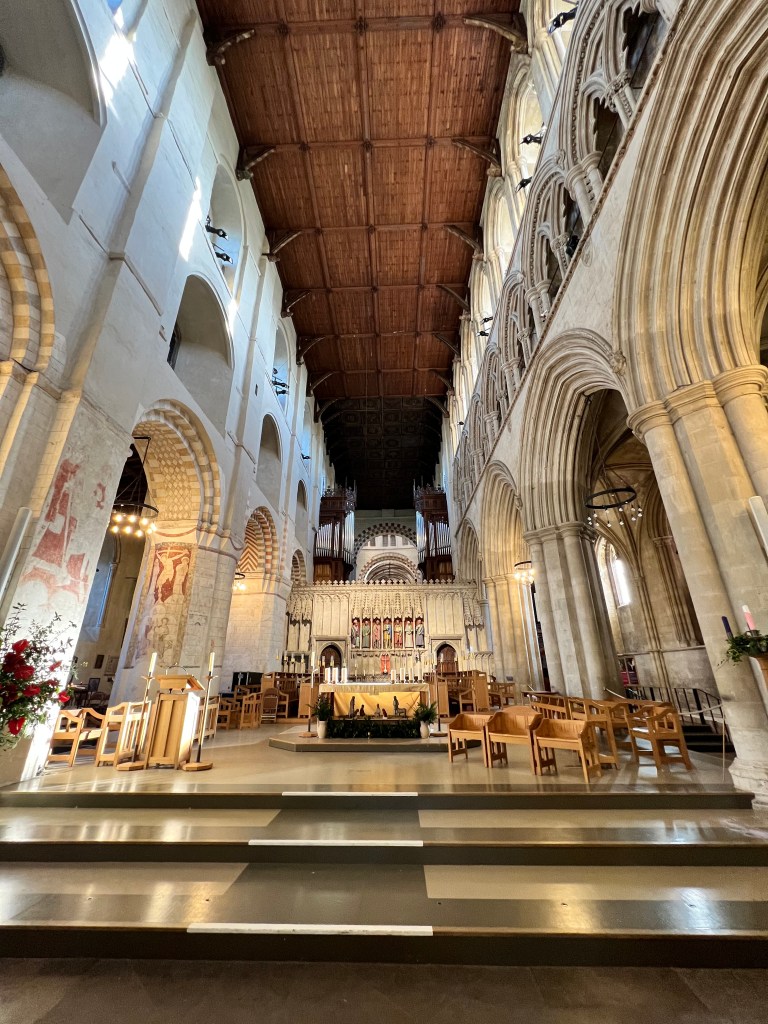
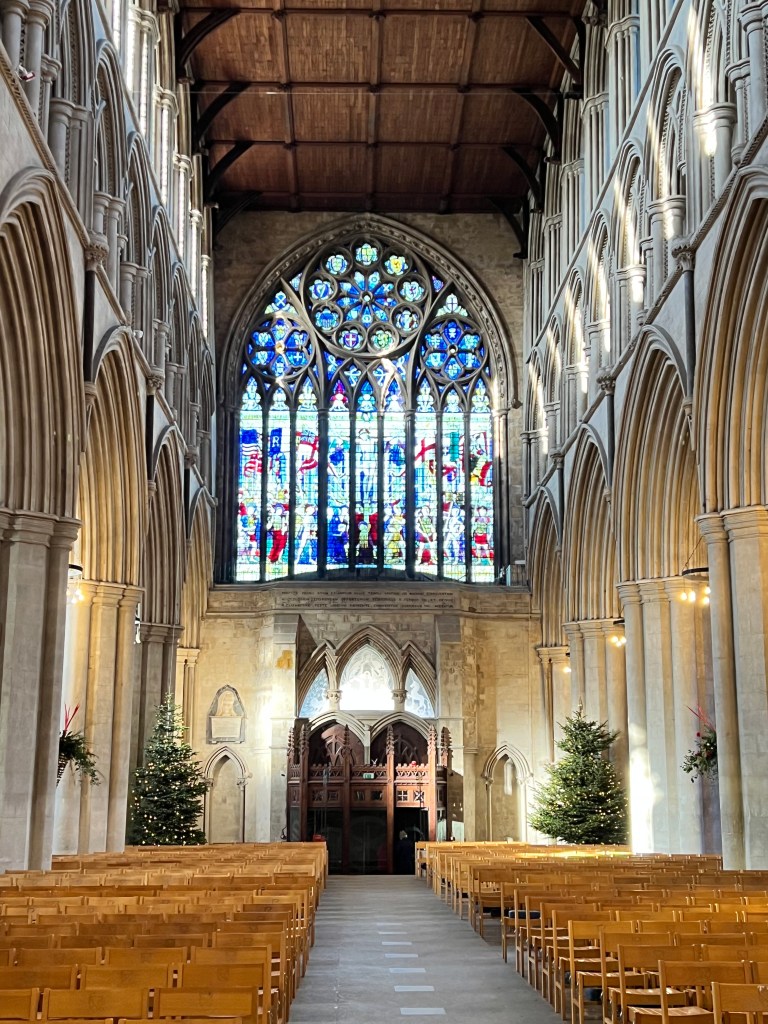
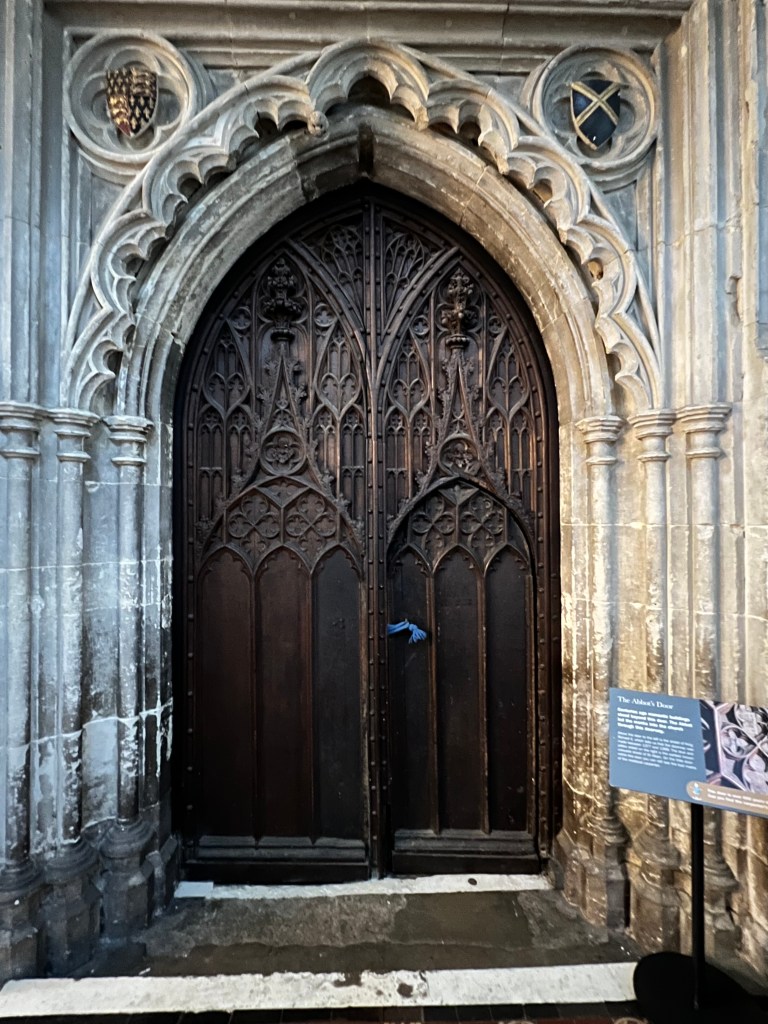
Interior spaces in Cathedral. Compare right and left walls in first picture. Rose Window, and Bishop’s Door Tap on Photos to Enlarge.
We also had the Cathedral guide book and a virtual tour online. We continued studying evidence of the Cathedral’s repeated building, damage and renovation over its 1000 year history of Norman, English, and Gothic architecture. Cathedrals tend make their own weather, generally chilly and breezy. On the tour, we passed a family with a 4-year old girl who was bundled up in hat, coat, leggings and scarf. Her repeated utterance was “C-C-cold, cha cha cha cha.”
Travelers may say that once you have seen one Cathedral you have seen them all, and certainly they have similarities. But St. Albans Cathedral is like no others due to its history, architecture, and tradition. Ely Cathedral and Winchester Cathedral are other unique examples worth seeking out.
The Cathedral website has a 3D virtual tour you might enjoy. stalbanscathedral.org
A mezze lunch at a Turkish restaurant completed the morning as we headed back to the hotel for a 2:30 taxi ride to Heathrow.
Our original plan was to stay at Samuel Ryder through Monday night and travel to Heathrow on the morning of the 27th, but reality and avoidance of panic dictated an alternate plan.
The M-pass was good for 8 days in December. We used two days coming and going to Dover and thought we could explore nearby villages. However, trains were not running consistently during the holidays due to scheduled track repairs and work stoppages (labor action). The train trip would have been an hour and half through downtown London even if they happened to be running that day.
The 10:20 flight on December 27th came with a strong caution to arrive 2-3 hours early for security. Getting to the airport by 7:20 seemed problematic. As a result, we arranged for taxi on Monday afternoon and spent the night at Hilton Garden Inn in the Heathrow Central Transport hub—only a 15 minute walk to Terminal 3. Although the hotel is 30 miles from Heathrow, the actual ride lasted over an hour including the stop-and-go traffic jam entering the airport. Being in a traffic jam on Monday afternoon instead of being anxious on Tuesday morning was a wise change.
In searching the Heathrow website, I read about an Indian bistro on Level 4 in Terminal 5 outside security. A week in England without Indian food would be incomplete. An hour of walking through tunnels, riding a train, and taking elevators or escalators from level to level brought us to Kanishka Kitchen. The lamb and eggplant wraps were small, light, and just spicy enough; we would definitely eat there again or maybe in their larger London restaurant someday.
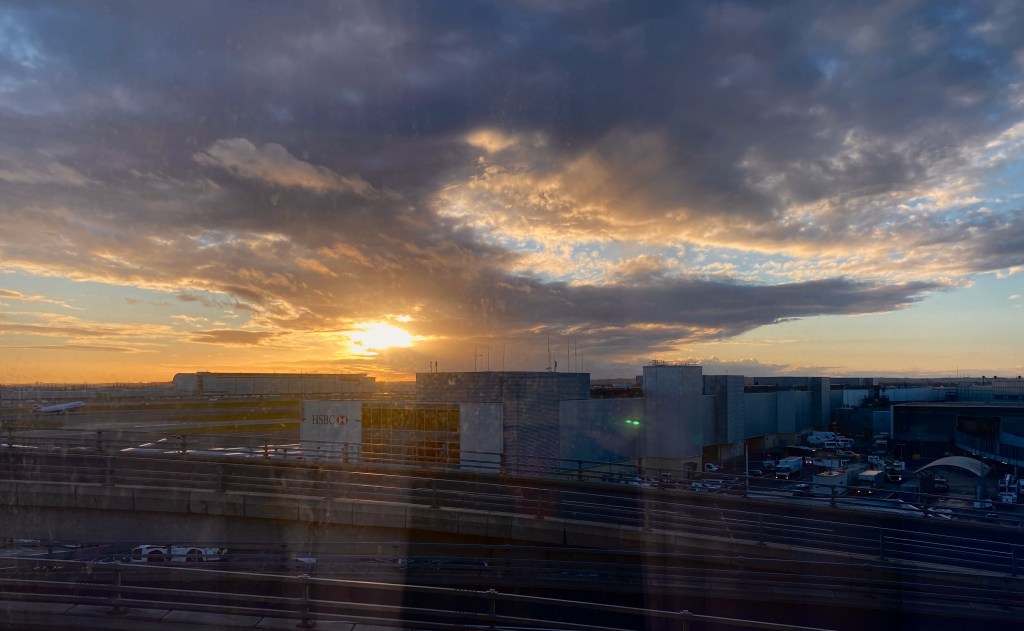
Sunset Over Heathrow Airport
The next morning we were through security by 8:00, at our gate by 8:45, and boarding at 9:25 on a Boeing 787 to Philadelphia. After a long day, we arrived in Asheville around 5:30 pm without luggage. In Philadelphia, after we carried luggage through custom check, the airport had an alternative luggage drop-off for already checked-in bags. Becky correctly observed, “We are not going to get our luggage. This is a mess.” She was right. We imagined our luggage marooned somewhere with the thousands of lost suitcases from hundreds of cancelled flights.
After almost an hour waiting for no-show luggage and filing paper work, David took us home. We were too exhausted to be too upset about bags. We appreciated how Eric kept the house safe by turning off the water and draining the pipes during the hard freeze we missed in North Carolina. Wanda watched out for packages and the neighbors were alert to our absence. We had warm house, bed, and water but no food. A quick trip to Hot Dog World solved that problem and made us feel home again. We fell into our own bed with our travel refrain, “Good to go, good to get back.”
The next day, American reported that our 4 bags would arrive on the 5:30 flight from Philadelphia. We drove out and picked them up only one day late.
Thank you for traveling with us. We hope you found something interesting and informative from our travelogues. This is my first attempt at using WordPress for the travelogue. It was a learning experience not yet complete. The smaller photographs may be enlarged by tapping on them.
“Travel is fatal to prejudice, bigotry, and narrow-mindedness, and many of our people need it sorely on these accounts. Broad, wholesome, charitable views of men and things cannot be acquired by vegetating in one little corner of the earth all one’s lifetime.”
Each day/night after leaving the Arctic Circle involved anchoring in a fjord or docking where we could walk off the boat. We docked in Narvik on Otorfjorden, anchored in Bindalsfjorden for an adventure day, then docked at Andalsnes, Bergen in Byfjorden, and Egersund before crossing the North Sea channel (which Norwegians call the Norwegian Sea) to Dover. Each day brought new opportunities to participate in a variety of activities–both off the ship and within the ship.
Southward. Norway, despite its efforts of neutrality, was invaded and occupied by Germans in World War II.
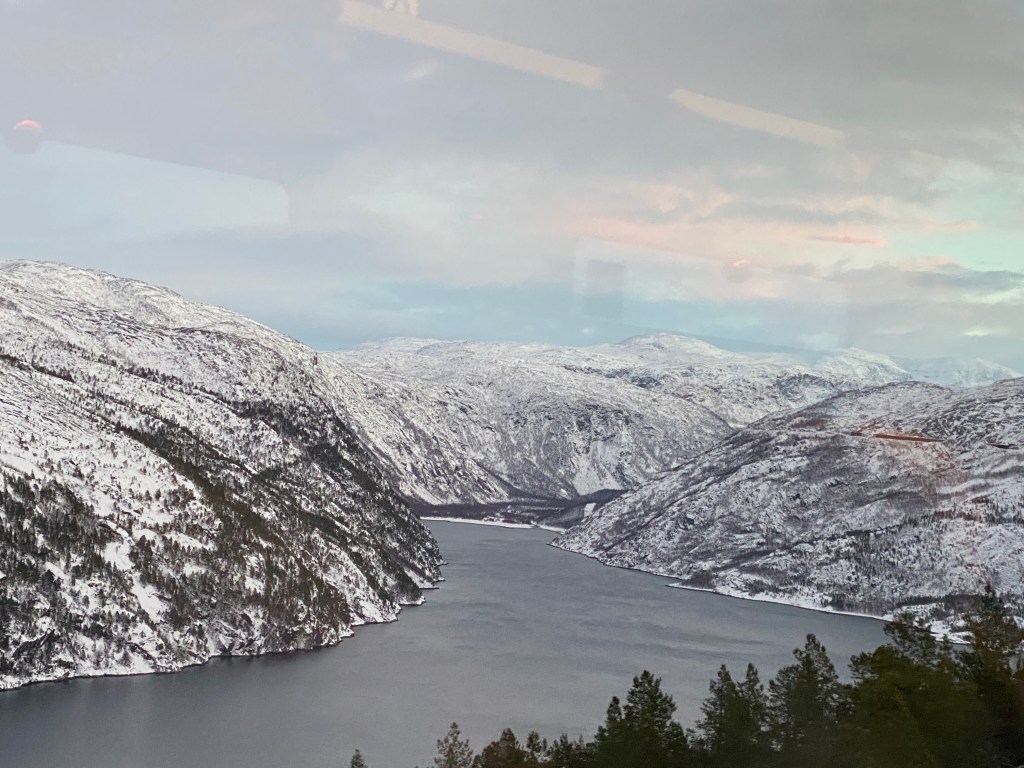
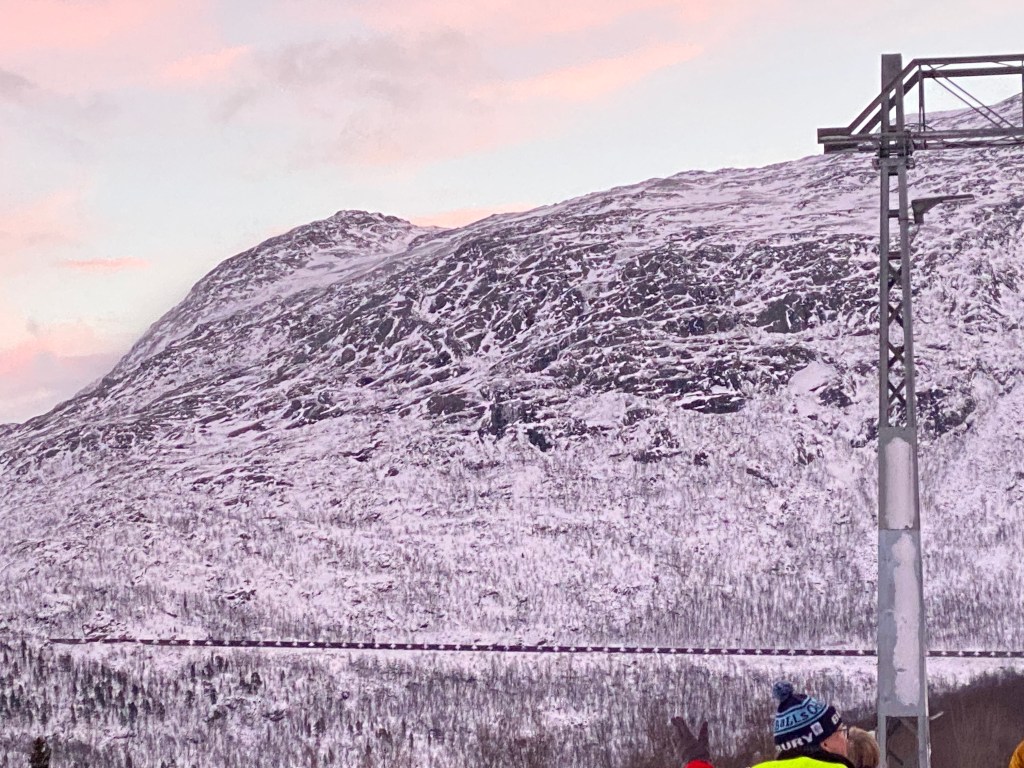
Narvik and Otofjorden witnessed ongoing sea and land battles between Norwegians and the Allies versus the Germans and some Norwegian quislings. A steep railroad built in the early 1900s was an engineering marvel hanging on the edge of the fjord mountain and connecting two of the largest iron mines in the world to a port that did not freeze over like those in Sweden.
Can you see the rail cars on the side of the fjord? I counted 178 cars on the iron ore train.
Capturing the railroad, port, and iron ore was important to German war plans, and their ships arrived en masse without warning in 1940. A garrison of Norwegian soldiers fled into the surrounding mountains using the railroad and engaged in guerilla-type warfare until the British and later the Allies eventually were able to connect and coordinate efforts.
German and British ships of every description were bombed in battle and scuttled in the wide fjord. The bow of one German battleship is still visible in the fjord, but hard to see. One heroic story involved the British battleship that lost its bow but managed to get all the way back to England. We did not see much at first because we were sitting on the wrong side of the train next to the sheer side of the mountain. After the first stop, we moved to the starboardside looking out over the fjord at the rugged black and white mountain-scape. The railroad took us almost to the Swedish border then back with photo ops at four stations along the route.
This day we had time for only one excursion. Choosing between the train trip and the Narvik War Museum was hard; we were mildly disappointed at not having time to see both. Our lovely new friend Ann (we nicknamed her Dame Ann) kindly brought us brochures from the museum. For WWII buffs, Wikipedia has an excellent description of the battles. Dame Ann recommended 1965 movie “Heroes of Telemark” starring Richard Widmark and a surfeit of famous British actors which dramatizes one operation in the protracted war, rather like “Guns of Navarone” only in Norway.
The next day MS Maud dropped anchor in Bindalsfjorden for an expedition day, meaning that activities would be more physically demanding. The rubber boats would ferry adventurers to an island landing site for activities such as hiking, kayaking, and a polar plunge at zero Celsius. Steve immediately declared a day of leisure. Becky was planning to go ashore until the expedition team announced a long boat ride, a wet landing which involved getting out of the rubber rafts “near” shore, walking up a steep muddy incline, and wearing snowshoes on the hike.
Many passengers analyzed the situation as we did and were happy for the younger, hardier, and more agile to go ashore. Our buddy Andy took the challenge and reported that he was totally “knackered” from the snowshoe climb but that the expedition team had done an excellent job preparing the way and the hike was beautiful.
Andalsnes, the next stop, is a picturesque town built into the mountains on all sides. Some of the surrounding mountains are 750 meters high and the fjord is 750 meters deep, approximately 2 miles from the top to the bottom. A gondola ride to the top of the mountain was available, but we skipped it because the day began with a blinding snow storm and fog that obliterated the view. A sunny afternoon was perfect for a stroll in the snow. Andalsnes is the home of the Troll mountain range—a favorite of BASE jumpers, folk who parachute from buildings and mountains and float to the ground. We saw a film about the man who “invented” the sport and his eventual jumping demise. Yet another EXTREME sport I would not try.
Snow storm arriving in Andalsnes
Everyone was looking forward to our stop in Bergen with the promise of Christmas Market and shopping in the second largest city in Norway. We docked just outside the city center and climbed aboard a bus with a local guide who pointed out the architectural and historic features of Bergen and the original settlement Bryggen. A few neighborhoods of crowded century-old wooden houses still exist; repeated fires plus WWII bombings plus an explosion of a German ship carrying tons of armaments destroyed most of the original houses, but some enclaves survived against all odds. Downtown Bergen was largely rebuilt after the war in modern, sleek Scandinavian style.
The Fortress in Bergen
When Oslo became the capital, Bergen went into decline until North Sea oil and gas were discovered in the 1960s and 70s. Now Bergen is the most prosperous city as it is the largest supplier of oil for Europe during the current Ukraine war. It also has become the zero-carbon leader for Europe through hydroelectric power generation—rather ironic.
The tour bus stopped near the Christmas Market, but our images of glorious, craft-filled markets were disappointed;food vendors occupied most stalls with only one shop holding Christmas crafts. For lunch, Dame Ann recommended brats cooked on a open fire which were delicious. We hoped to spend some time in the KODE art museums downtown, but they are closed on Mondays.
As we were wearing our Hurtigruten orange/red coats, two women stopped us to chat. They are from South Africa and had flown to Bergen to begin a different Hurtigruten tour to go far into the arctic to Kirkenes, near Russia. Unfortunately, the airline lost one woman’s luggage with all her warm clothing. They were still hoping for luggage recovery. We walked about a mile back to the ship past a number of small, interesting shops through Bryggen. Having little space to pack anything, we were more lookers than shoppers.
Our final morning in Norway was spent in Egersund, a small village of 1500-2000. Archaeological findings show settlements that go back 4000 years. Since Viking times, Egersund (Oakland) has been a fishing village, and that tradition remains strong. Huge modern structures off load and process tons of krill, herring, and mackerel for distribution around the world.
A guide walked and talked us through the charming narrow, cobbled streets lit with thousands of twinkle lights— a Christmas wonderland with many local shops open for business. Highly recommended were the chocolate shop andlocally made gin distillery but we mostly followed our look-not-buy idea, Becky found a quilt store and bought onemeter of Norwegian-made fabric. Local clay has been used for pottery since the 1750s which we would like to see, but the pottery museum was closed on Tuesdays.
Winding Down, Wrapping Up.The lectures and workshops on various topics continued on the southbound route including the last day and a half at sea. A specialist from ORCA.com was on-board guest Cetacean expert and gave several lectures on these animals-whales, dolphins, and porpoises. We learned about their evolution and differentiation, feeding patterns and routes, habits and social behavior, environmental impact, and sound making and hearing abilities. Based on her guidance, Lauren challenged us to identify various cetacean songs, clicks, whistles, and moans by species.
Tim and Tomi continued to give science workshops and lectures about the ocean. The discovery boat passengers collected plankton 4 times along the route. Tim had a huge electronic microscope for identification and analysis of the different phytoplankton and zooplankton in the samples. Both are fascinating and important to the health of oceans and therefore everything.
Katrina amazed us with her knowledge as historian and culture specialist. She took us on a tour of the beautiful art that Hurtigruten displayed on MS Maud including photography, sculpture, design, painting, prints. All were labeledas a museum would. She sponsored several art workshops—on runes, Sami symbols, and paper weaving.
She also gave more information about the history and culture of the Vikings and Sami peoples. Fjords may look like tiny streams and inlets from the ocean on maps when in fact they are miles and miles of wide and winding water. In fact, “vik” means water and “Viking” means people who live/work on the water. Most Vikings were farmers who lived communally in “long houses” and engaged in storytelling and singing about customs and folklore. Their religion included many different deities who ruled various natural phenomenon and were hierarchically organized.
Since land was passed to the eldest son, the rest of the boys in the family had to figure out how to live. Some of those were the explorers and adventurers renowned in legend and fact as marauders who terrorized peaceful and unsuspecting Celts and Jutes and Franks and Danes, etc. However after the pillaging, Viking settlers moved in and set up trade. You can believe all the gory images of the Vikings portrayed in movies (recently “Norsemen”), and they may be accurate, but they portray only a small part of the culture.
The last days at sea were for wrapping up, celebrating, reviewing, and saying good bye. The three top executives on board—Captain, Chief Engineer, and Hotel Manager—held a Q&A about their jobs. The Captain told us that our route was approximately 3500 nautical miles and talked about their navigation process. The Engineer described how Hurtigruten uses low pollutant oil and is actively looking toward new fuel sources. The Hotel manager has worked for Hurtigruten for two years. Her job responsibilities include overseeing food service, cabin assignment and comfort, and cleaning which goes on constantly. We had “green” days on which we skipped cabin cleaning and that cost became a donation to the Hurtigruten Foundation for the environment.
Other activities were a band night featuring members of the crew, a variety farewell show put on by passengers, and a champagne toast with passengers, officers, expedition team and specialists, and the crew. On this cruise, there were about 250 passengers and 140 personnel. The MS Maud could accommodate about 500 passengers, but everybody was glad that we had lots of room to roam and enjoy.
Geraldine, our professional photographer, documented our journey and presented a slideshow of her photographs on the last day. She has such an amazing eye. We look forward to getting her photographs for our memory book. She was particularly helpful to Becky with the camera and they became friends.
Daniel, the chef, was always watching food service and Shez served as maitre’d. Becky became friends with both of them. Daniel gave Becky his hot-and-sour soup recipe scaled for 100 servings but metric measurements will make it easy to use. The food continued to be interesting and tasty and mostly very healthy—except for the scrumptious breads and beautiful desserts. Morning and night we were treated to croissants, millefeuille, financiers, hot cross buns, puddings, sauces, miniature pies, napoleons of various kinds, cakes, and assorted ice cream and gelatos. We suspected contestants from the Great British Baking Show were working in the galley.
Saying good-bye to new friends and trading contact information were happy/sad events. We had dinner with Pete and Anne on Tuesday and with Andy and Judith on Wednesday. Both nights we talked until we were the only ones in the AUNE restaurant. Tonya sat with us for a few minutes on the last morning. We even met some folk from Ohio while waiting to leave the ship. As far as we could tell, only about 15-20 travellers were from the USA.
Our luggage was due outside the cabin by 10:00 on Wednesday night so that Thursday morning we could roll out of bed, dress, eat breakfast, and wait for the notification for leaving ship. Our point of embarkation was now our point of departure. We got a taxi to the Dover train station and were on our way to St. Albans for Christmas.
Hi, I’m Linda Antin, an independent designer and filmmaker who loves nature.
Welcome to our travelogue. Steve, Becky, Jim, and Betsy are on six weeks journey beginning in Amsterdam, continuing through Paris, Avignon and Bruges, and ending back at Amsterdam. This great adventure started with a great deal of planning last year when we booked Airbnb housing in each city. decided to stay each place for at least a week so that we could enjoy the lovely illusion that we were living there. We travel by train and learn the subway, tram, and bus routes for local transportation.
This year we created a subscribers list which makes posting so much easier. And I have gotten technical advice from Amy Landers in Hendersonville that has been great help, but I am still learning to ride the Word Press beast.
We add episodes once or twice a week depending on time and energy. You can read about our travels at your convenience and find out what we have been doing, seeing, eating, etc.
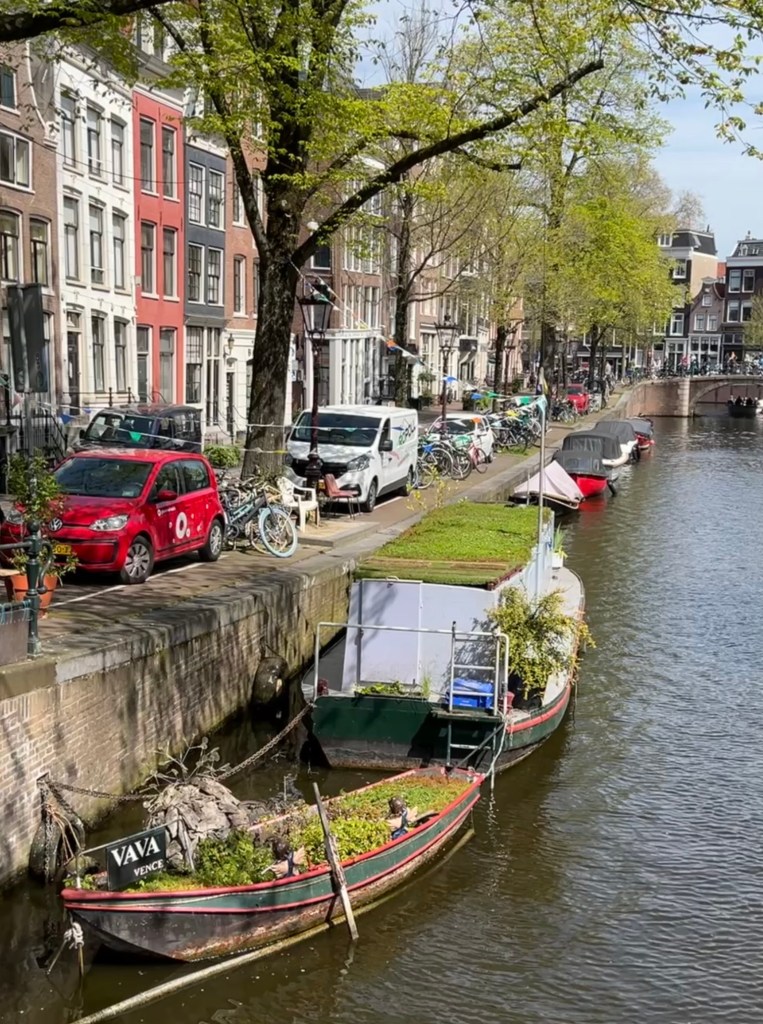
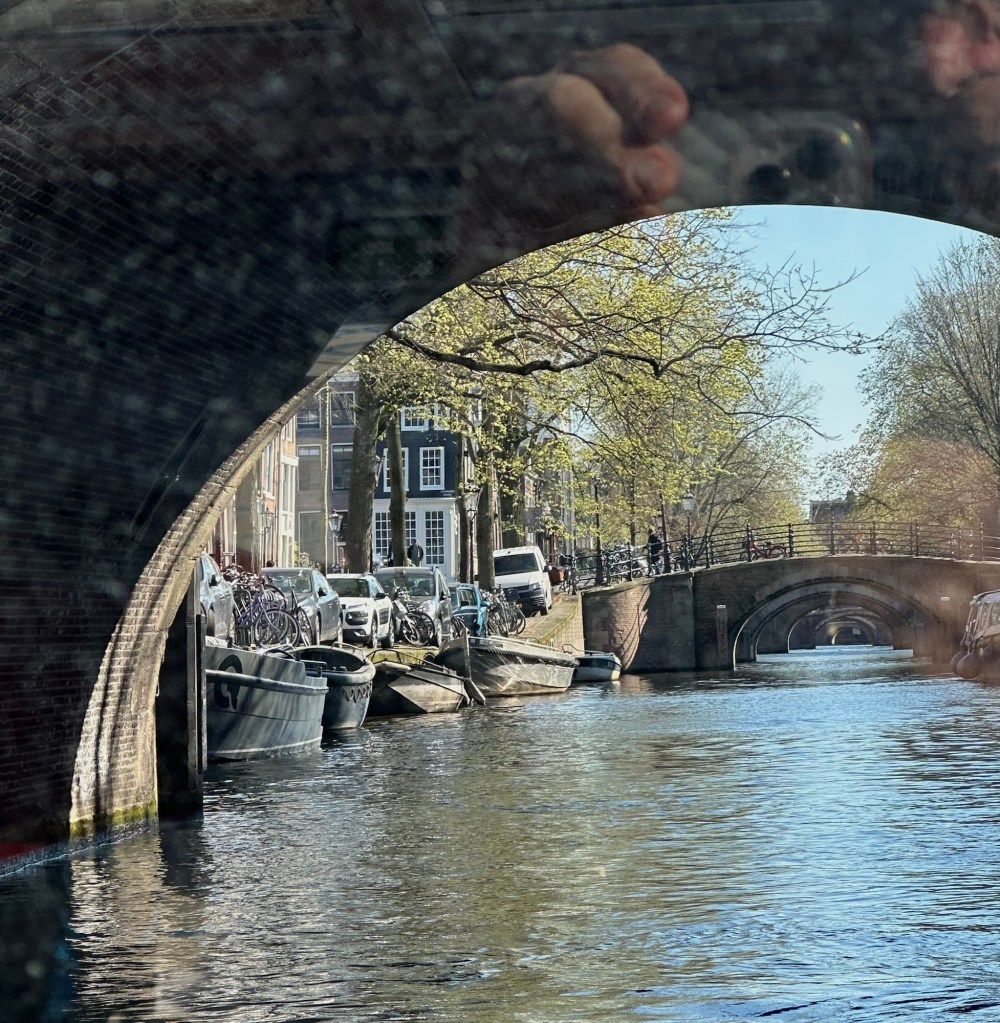
View of six bridges on canals in Amsterdam
Posts are in chronological order with the new posts recent trip seen first or on the top; older trips are scrolled under the current trip. If you dig deeper in the blog you will find posts from all over England last year and maybe Scandinavia in May and June 2023. Finally there are two episodes from St. Albans in December 2022. We enjoy reading the old posts and remembering all the fun we had.
The blog is a first of all a record of travels for our own memory and pleasure. Second, we enjoyed sharing those adventures with friends. We invite questions, comments, or suggestions.
Background
Steve is the lead writer with ideas and suggestions about content from everybody on the trip. Betsy and Jim add Robson Reports when they take a side trip or excurion by themselves. Becky is the editor who catches lapses of thought, poor word choice, and punctuation, grammar, and agreement errors. Becky is the chief photographer and photo editor although Betsy, Jim, and I add photography to round out the visuals.
















 Tipps for Travel