During our first week in Amsterdam, we enjoyed many cultural and artistic activities on our must-do list: Rijksmuseum, Van Gogh, and Keukenhof as well as exploring a great city by tram and on foot. Spending more time in Amstelveen allowed us to pretend to be residents rather than tourists: going to the park, shopping in local shops, finding the ATM. We also had time to venture beyond Amsterdam.
Definitely Delft
Betsy has been reading Rick Steves’ suggestions about places to visit in the Netherlands and he put Delft at the top of her list. Jim, ever our Manager of Motion, planned Bus 357 to the Metro Station at Amstelveenweg. Then we did a dipsy-doodle after one stop to a different Metro which hooked us directly to Amersterdam Zuid with an Intercity Train to Delft avoiding time and crowds at Centraal.
This was an excellent plan on paper. But the escalator at Zuid was not operational requiring a very long trek down steep stairs. First-class tickets for the trains meant we had access to had wide, comfy, red leatherette seats. But we missed the memo that folks who cannot find seats anywhere on the train crowd into aisles and empty spaces, especially in the vestibules at the exit doors.
Nor had we anticipated that the train to Delft stopped at Schiphol Airport and that everybody’s cousins would be flying away on Saturday morning. Or that they and their luggage would crowd onto the train. Or that the Delft train would be running late progressively 8, 10, 14, 18, then 25 minutes.
All these realities delayed our arrival at Delft by a more than an hour. But we were stoic in the face of adversity shared with our fellow travellers.
We immediately went to the Delft tourist center and bought four 5-Euro tickets for a hop on-hop off conveyance—more akin to a golf cart and more appropriately called climb-in, climb-out. You climb in on your knees, sit knees to nose, and extricate yourself without falling onto the pavement.
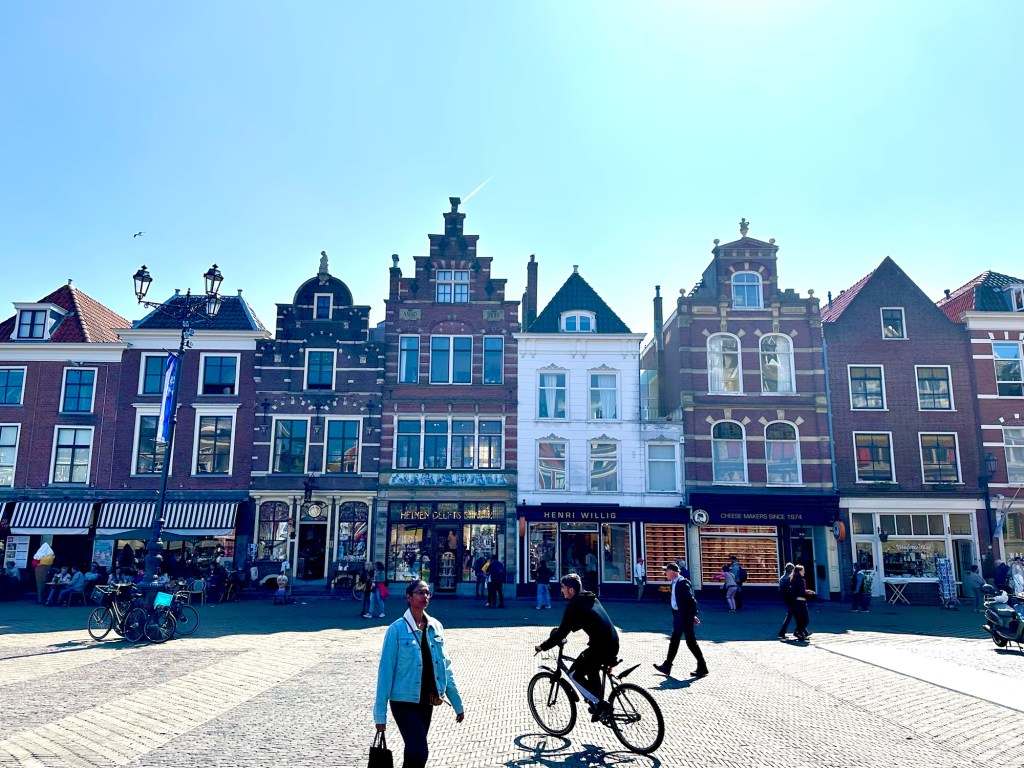
A 20-minute city tour was taken before we climbed out. Our tour guide did a great job of pointing out various important buildings. Delft, of course like most ancient cities, experienced a fire in the 1330s which destroyed most of the original wooden edifices. The city was rebuilt with stone and brick buildings representing architectural styles over 4 centuries.
Cargo from both the Dutch East Indies and the West Indies was unloaded into warehouses along the canals. Porcelain shards imported from the East Indies inspired what we know as Delft fine china with distinctive blue patterns. Delft was also a market town for local produce and had an important butter market. The butter was kept 10-degrees cooler in the canal under the aptly renamed Butter Bridge.
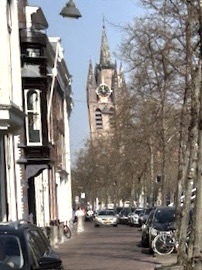
We saw the house where Vermeer lived and where his wife sold his paintings to pay the rents. Hence much of his work is lost. We passed the Old Church with the leaning tower where William of Orange was assassinated.
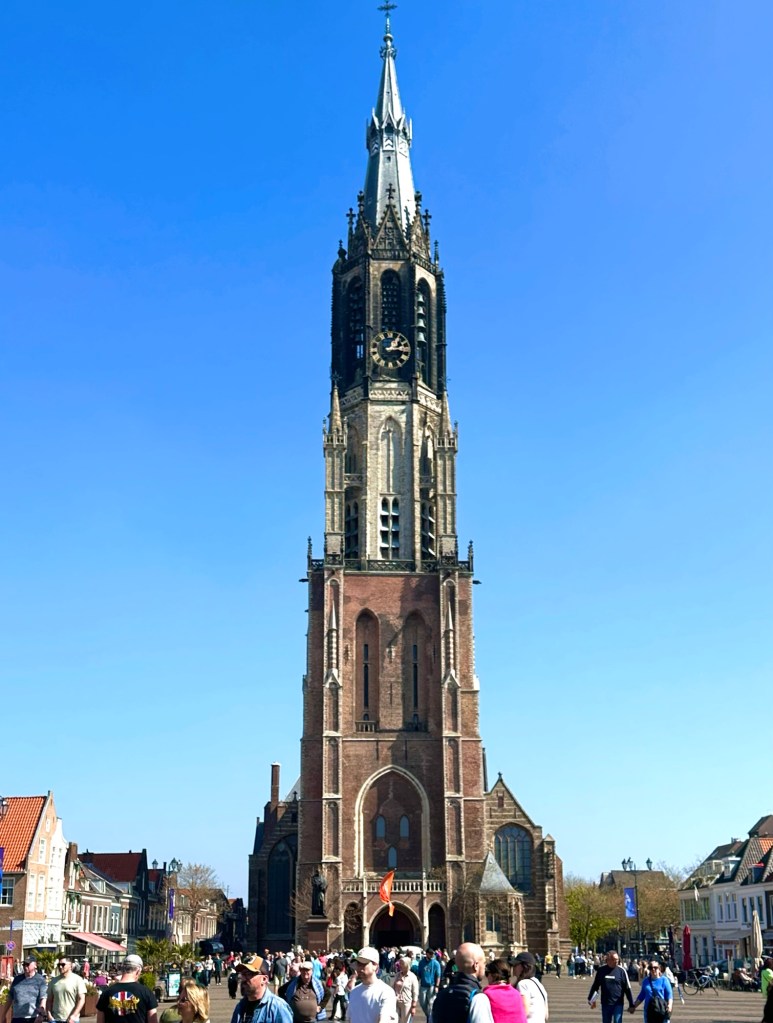
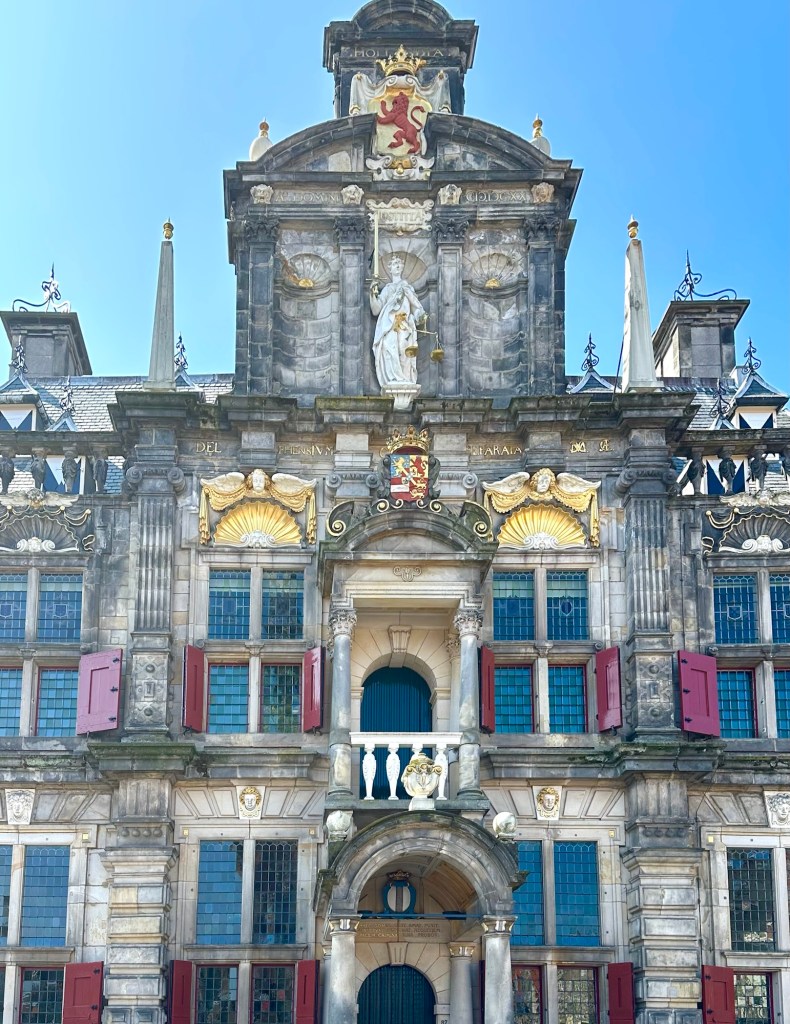
The climb-off tour ended on the large central square with the New Church on one end and the City Hall on the other end.
Picturesque old houses line either side of the square and along adjacent streets which are now occupied by businesses of all kinds—restaurants, Delft china shops, butchers, bakers, and cheesemongers, trendy clothing, and tourist tatt. One of these anachronisms was particularly jarring—a Subway was on the first floor where the first Dutch Bible was printed in 1477.
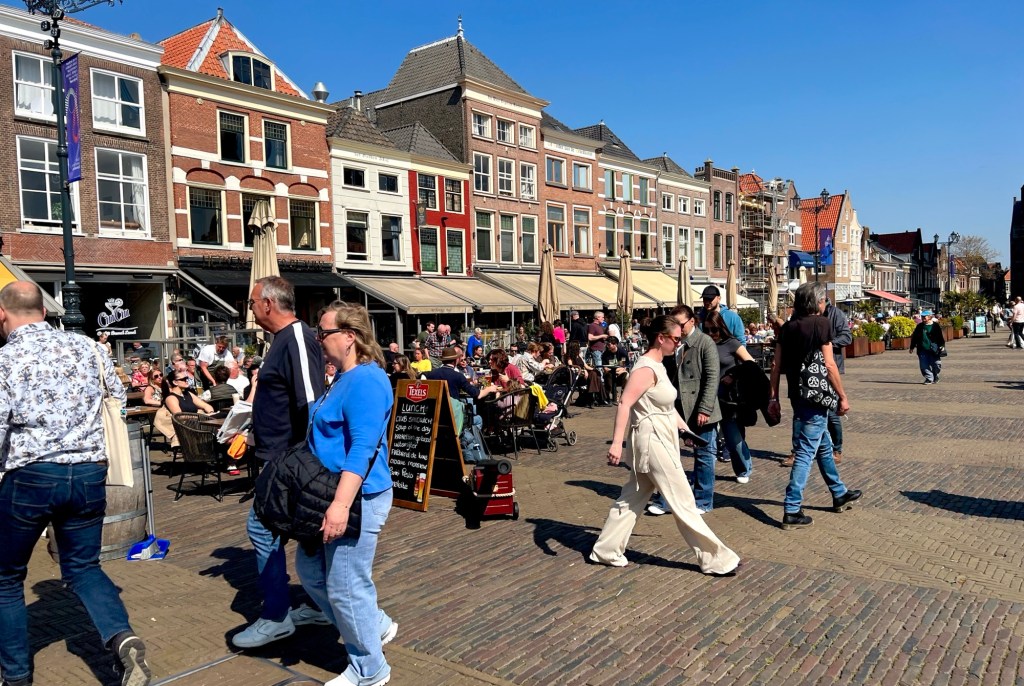
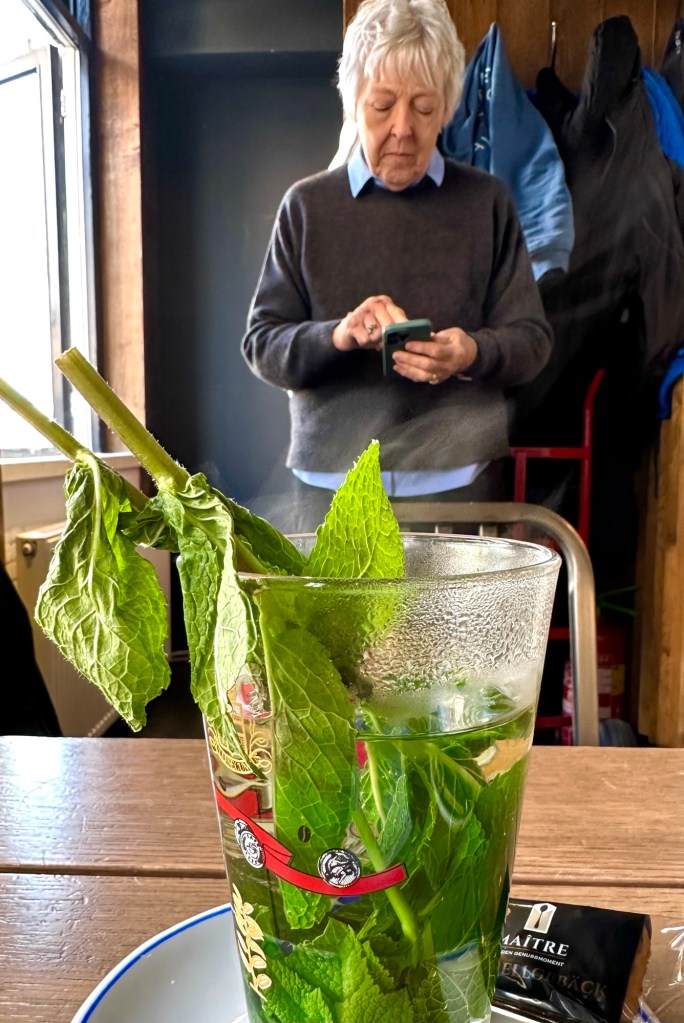
The restaurants and their open air seating were overflowing with folks sunning themselves, drinking beer and wine, and hungrily looking at menus but with little sign of food. We found a restaurant less busy, a Greek place down a side street. After some menu puzzlement, we ordered gyros and frites that were totally delicious. Becky asked for mint-tea thinking she would get a bottle of mint tea. Instead it was real mint in hot water and very refreshing.
After walking around the square, we paid entrance to the New Church built in 1381 and beautifully plain having been defrocked during reformation.

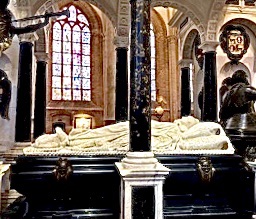
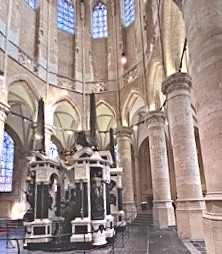
The gigantic, ornate tomb where William of Orange is buried occupies the center of the church. All of the royals since him are entombed in the undercroft. A video showed the entombment ceremonies for Queen Juliana and Prince Bernhardt in 2002.
In the later additions over the next three centuries, beautiful stained glass appears high above the stone walls.

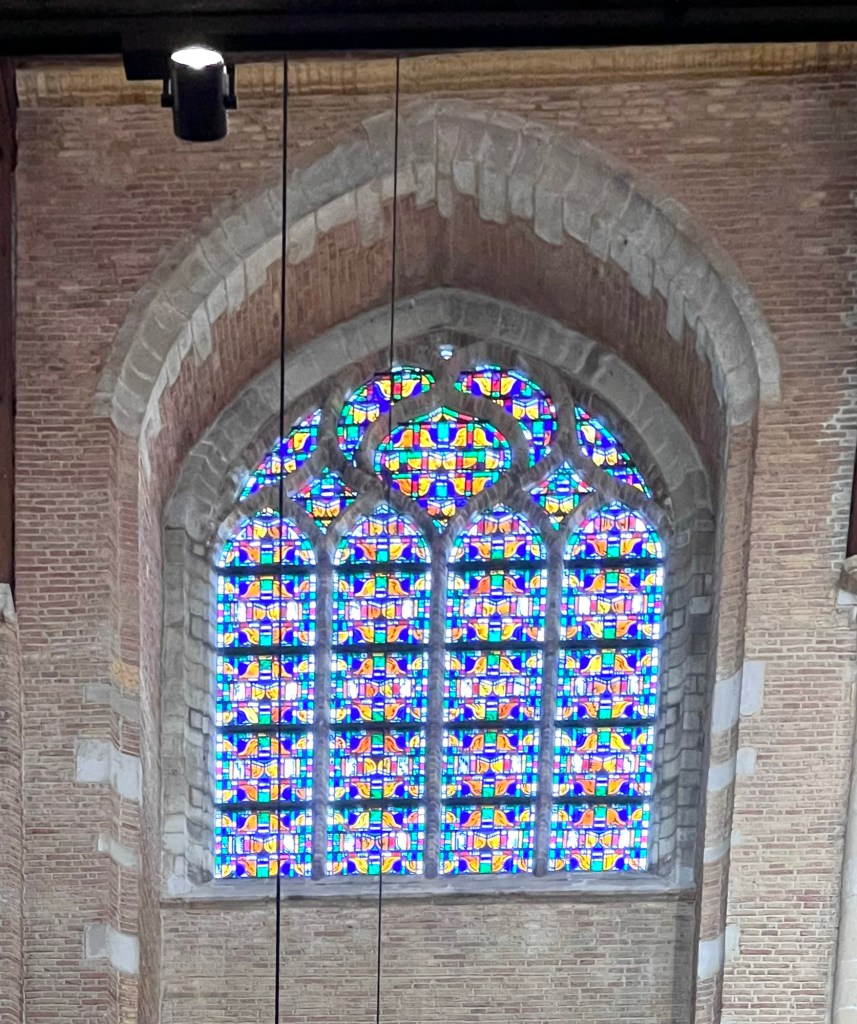
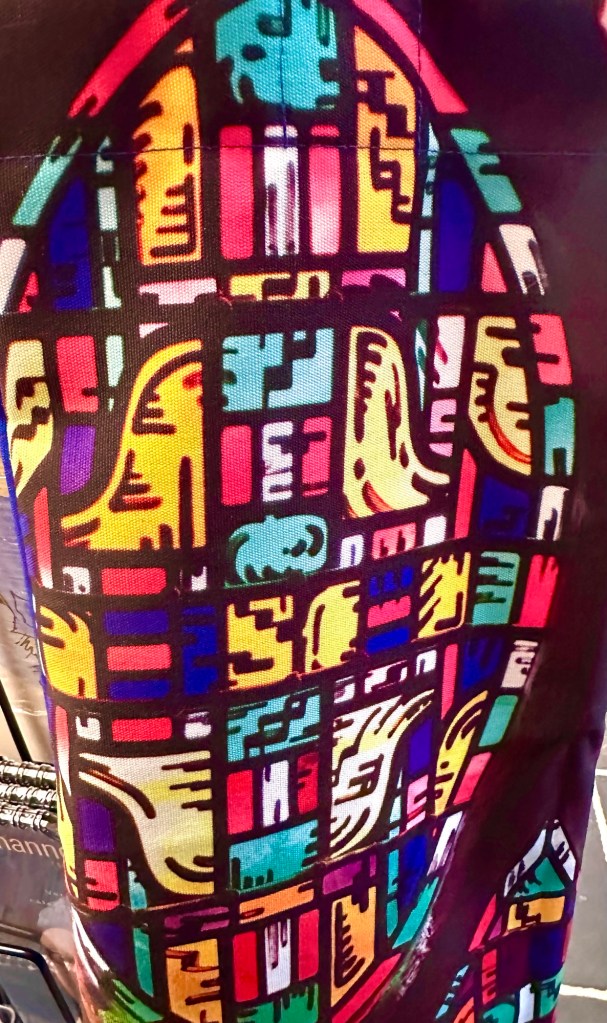
As we were leaving, a group of men wearing gray suits and mint green ties gathered near risers in the middle of the Church. We learned they were veterans and members of a Men’s Choir getting ready for a concert at 2:00.
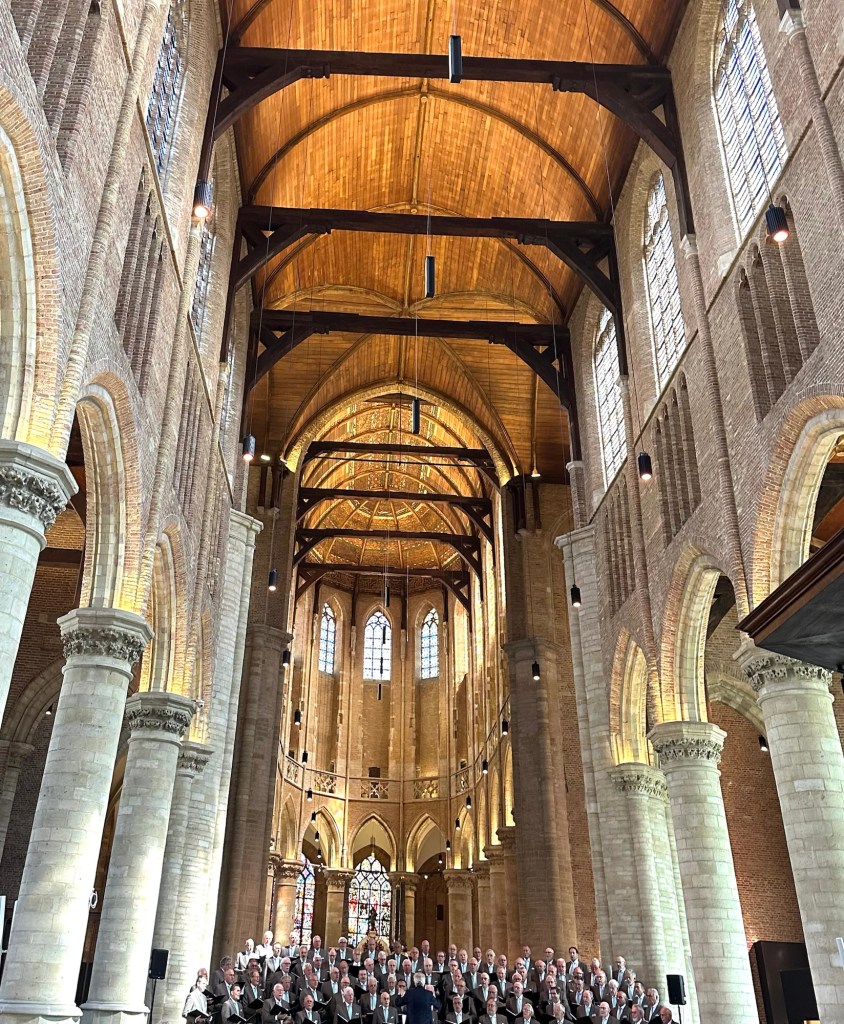
Becky and I love choral music in cathedrals with wonderful their reverberating acoustics. We stayed to hear the concert which was a mix of sacred music, inspiring songs, and popular songs. The sound was magnificent.
Robson Report. Remembering that it is impossible to do everything, Jim and Betsy decided not to attend the choir concert and instead took a walking tour through Delft. Beginning at the Market we passed the Town Hall, rebuilt in 1620 after the great fire and on to the Waag next door which was the weighing or customs house at that time.
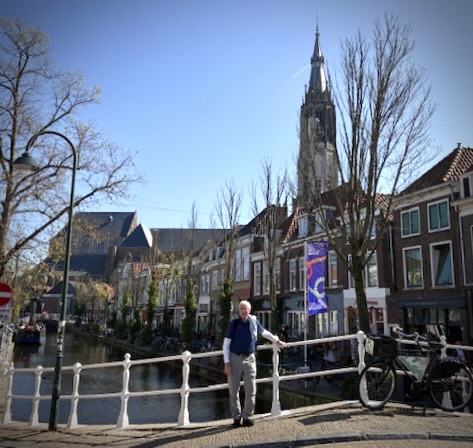
Continuing the walk down the Boterburg (Butter Bridge), we discovered a monument to Antoine van Leeuwenhoek, the inventor of the microscope. He is actually buried in the Old Church. Our walk continued past lovely residential neighborhoods on charming canals.
We regrouped about 3:00 and walked to the train station where we encountered different transit problems. Train and Metro tickets live on our phones and are required for getting on and getting off. Two phones—suffering zealous photo taking—were running low on power, and Becky’s power was out completely. Eventually we figured how to get on and off the train. We waited 20 minutes for the train to Zuid on Platform 1; when that train suddenly arrived on Platform 2, we joined the mad dash across the span. Heads up!
Schiphol Airport was on the return route, so the train gradually filled with people going to the airport. After depositing the outgoing passengers, the train filled with folks departing the airport. We were again trapped as the aisles and exits were packed. At 3 minutes before ETA at Zuid, we pushed toward the exit. We stood in the crowd at the door while the train was held for 15 to 20 minutes before pulling in and letting us out. Whew!
Betsy had noticed that Bus 178 stopped in Amstelveen and at ground level so we did not need the broken escalator. We tap in and out with credit cards instead of phones on the bus. Learning alternatives is an essential skill, and we already see how that becomes routine if you live here.
Eventually back at the house, pasta and salad were consumed. We discussed Delft and all what we learned about such a beautifully preserved ancient city. Betsy and Rick Steves were right about visiting Delft.
Powder laundry and powerful learning
Becky and I have an attitude about laundry. We do not like doing it while traveling. We look for full service laundries which take our dirties and return them clean and folded and ready to face another week. Even when we have laundry facilities on site, we are just NOT patient.
On Sunday morning, I loaded up a suitcase with all our dirties and headed off to a full service laundry near the Leidensplein bus stop on faithful Bus 357. When I got to said laundry, it was open but not for full service on Sundays. Washers and dryers were available so I bought soap and filled one washer then a second. I piggybacked two dryers. So for 40 Euros we had fresh clothes in only 2 hours. Success!
I invited three travelers to join me at the Resistance Museum at 2:00. This museum happened to be on the same street as the laundry and only 28 minutes walking. However, those 28 minutes would be by a fit 20 year-old. Those 28 minutes by 79-year old Steve dragging 30 pounds of clean clothes in a suitcase over cobbled streets turned into an hour.
Jim, Betsy, and Becky waited patiently, and we entered the Museum of Resistance during World War II about 3:00. It was a full-on multi-media story about how Netherlanders responded before, during, and following the German invasion and take over in 1940.
The route carried visitors through each year of the war with many exhibits and video narration showing how the clandestine fight against the Germans grew and was conducted: smuggling people and goods and ammunition to support the war effort and protecting Jews from the ever present danger of being shipped away. Many Dutch men were sent to work camps and industrial factories in Germany.
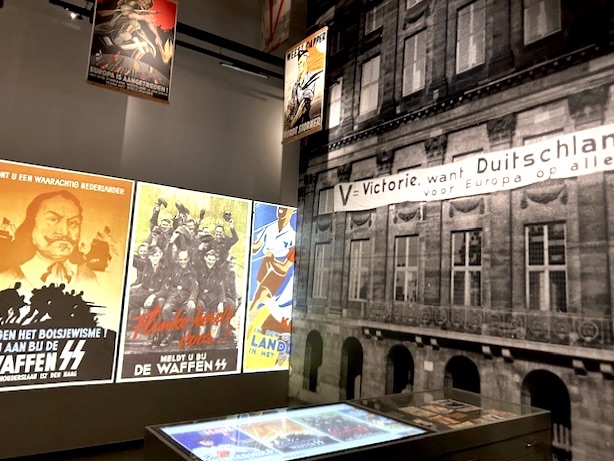
Of particular interest was how loyalties and alliances changed over time with various groups and organizations co-opted by Germans and infiltrators. People were scared of joining the resistance and for not joining the resistance. Finally, the cruelty of the Germans became so apparent and so appalling, more people were involved, but never a majority due to fear for themselves and their families.
An exhibit at the Rijksmuseum alerted us to Dutch colonial impact on the islands of East and West Indies. We were particularly interested in how the resistance played out there. The East Indies were attacked by Japan with promises of independence from the Netherlands. But in reality, they were as bad or worse than the Dutch had been.
Indonesian freedom fighters finally joined the Allied resistance to Japan hoping for liberation from the Dutch as well. At the end of the war, the Dutch returned with “all’s good now,” but the resistance had grown strong enough to fight for the freedom which was finally granted in 1949. In the aftermath of World War II, Dutch colonial possessions around the globe were finally freed.
Individual stories were presented in side rooms to highlight personal experiences. One was about a Dutch boy sent to work camps in Germany. He received a letter about his father’s death and was allowed to go home where he was greeted by his father who put him into hiding.
Several stories were from individuals in Dutch colonies who were torn between loyalties to their people versus the Dutch. Many finally sided with the Allies and became freedom fighters after the war using the fighting skills they learned. We got home full of information, but with many questions about how such awful things could have been done to people.
After the museum, we stopped for ice cream and caught a tram to Leidensplein where Bus 357 takes us back to Amstelveen. I was tired and still dragging the clean laundry, and Becky was not feeling well. The pain on her side from her fall at Keukenhof Gardens had gotten much worse.
She and I decided to take a taxi instead. On the way, her pain intensified and we stopped at an emergency center in Amstelaan. The doctor told us that an X-ray, did not show a cracked rib, but her examination did, so she received her pain medicine. We got another taxi and were “home” in 10 minutes. The Robsons had prepared dinner, and we were fast in our beds after an eventful day.
Last Days in Amstelveen
Our last days involved getting ready for our next stop in Paris. Jim finalized arrangements with the Paris Airbnb owner and contact. In his Master of Movement role, Jim arranged a cab to Schiphol the next morning. We wanted plenty of time to get there and figure out how the trains worked.
The Robson Report: The Robsons felt a strong desire to see more of the Netherlands, especially after falling in love with Delft. Although not usually big fans of tours, they signed up for an eight hour tour of villages outside of Amsterdam. Since we already knew where to bus tours parked, so we left the house a little before 7:00 feeling far less anxious about an 8:30 bus departure.
Leo, the bus driver, was retired from Interpol and an avid fisherman eager to share his fishing photos. Marion, their tour guide was ditsy, but very knowledgeable and shared tons of information with them in English!!
Our first stop was Marken, an island town only connected to the mainland by a causeway. In 1916 a terrible flood occurred resulting in hundreds of deaths and massive destruction. As a result, in 1929 two vast dikes were built to close off the ocean inlet called the Zuider Zee forming two inland fresh water lakes. This killed the fishing industry in Marken which is now a charming commuter village.
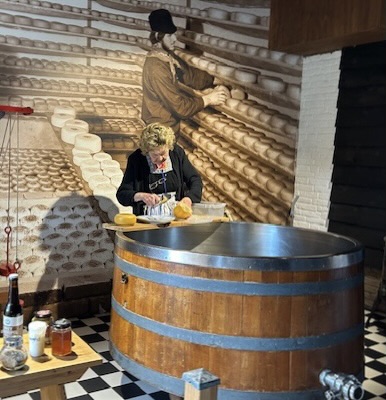
Our next stops were Edam for cheese making demonstrations and Volendom for lunch. This village was also a fishing community before the dikes were built. Now its economy is solely tourist based. There streets were overrun with tourists which was dismaying, but we did enjoy a wonderful lunch of fish and chips along the seaside boardwalk.
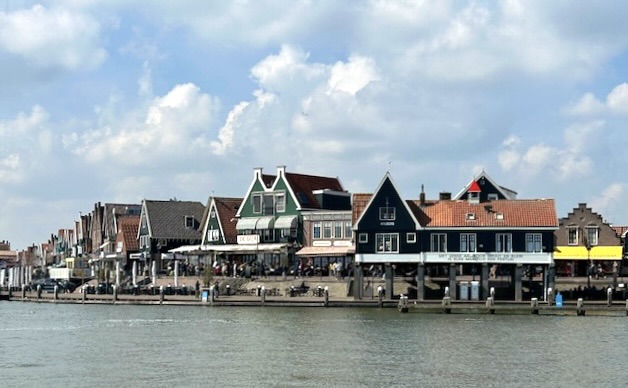
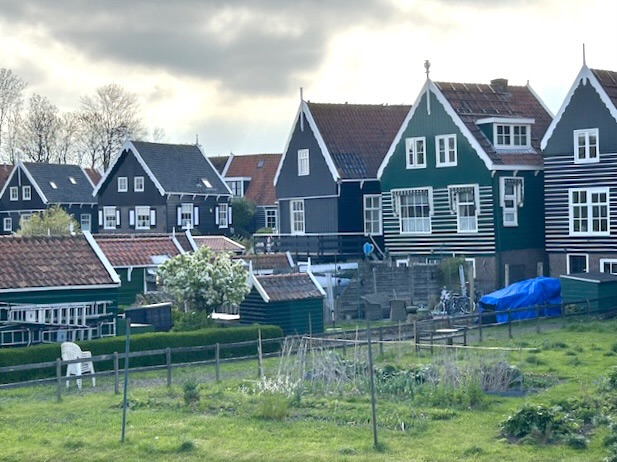

Our final stop was Zaanse Schans to view the many windmills there and learn how they are operated and maintained. Originally built to drain water to create polders (land previously under water), where they now grind grain.
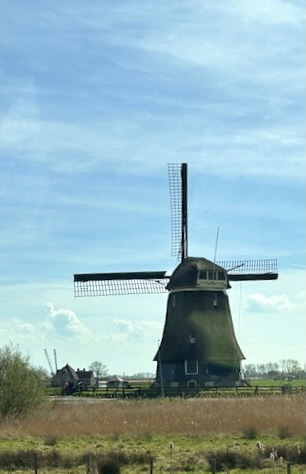
This was a very full day, but when heading back to Amsterdam they felt they had really gotten a great feel for the Dutch countryside.
On the last days, Becky and I mostly hung around the house, I took a short walk one afternoon to the Apotek to pick up a prescription for pain for Becky. The Apotek takes only cash or debit cards, but neither of my debit cards worked.
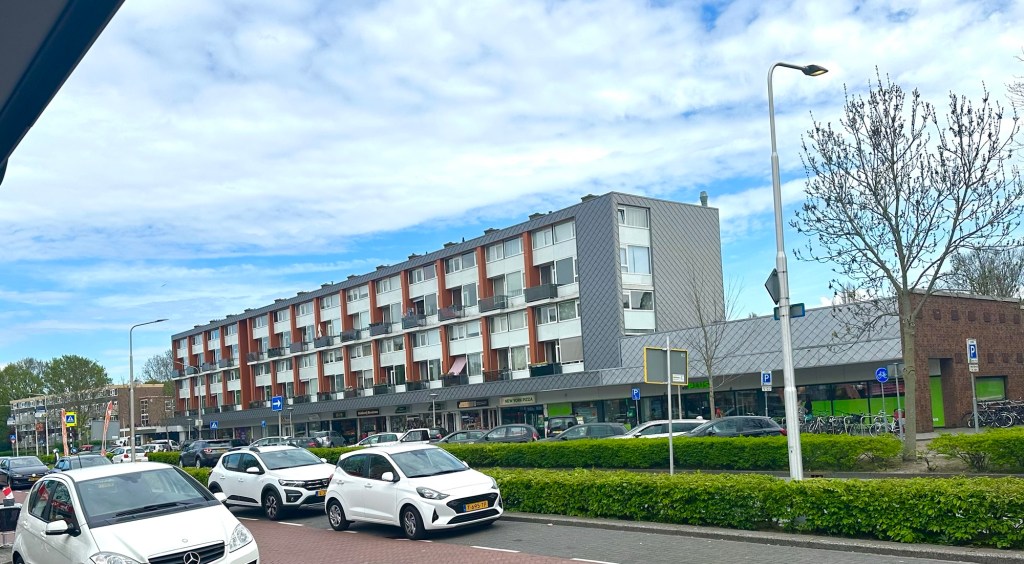
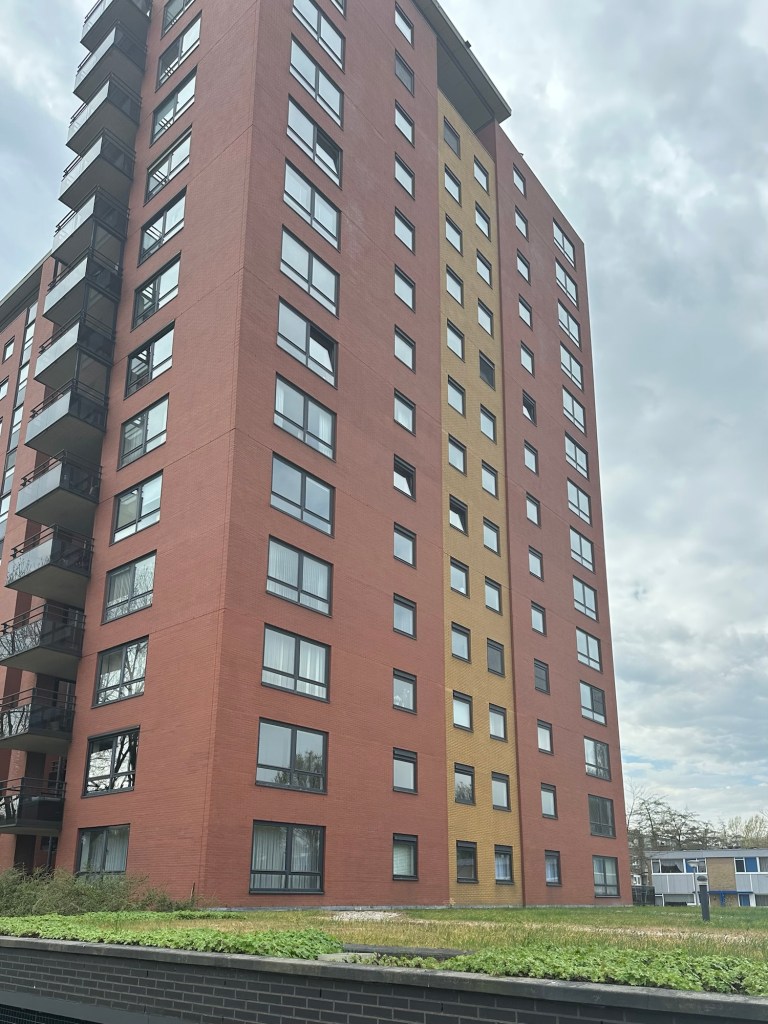
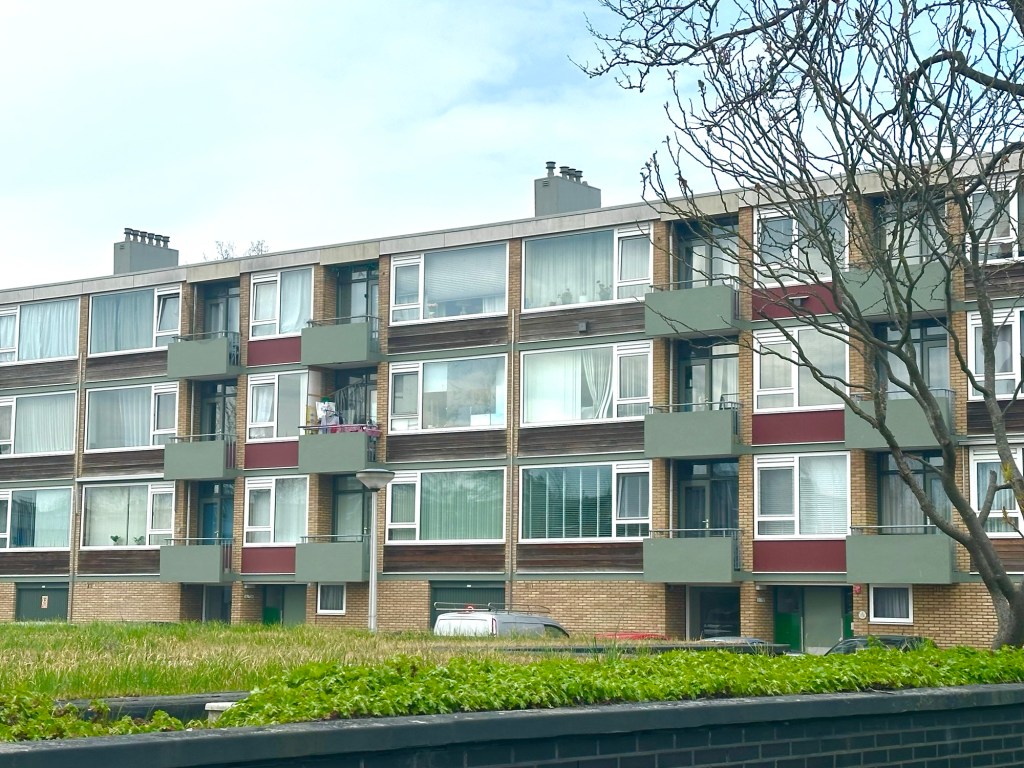
Out of cash, I had a long walking to shops to get Euros at a AMT. I passed many modern apartment blocks along the route. With large populations and limited space, apartment living is essential. I looked at apartments for sale; the least expensive one was 355,000 Euros for 72 square meters or about $400,000 for 720 square feet. The prices went up to 1.5 million Euros.
We wondered what the rental costs might be. The tour guide had told Jim and Betsy that rentals required you to remove all your furniture, decor, and flooring when you move leaving an entirely empty space for the next renter to occupy. Sounds like a great incentive for living sparely.

I wandered around the shops and bought bath gel and shaving cream, then some salad and a quiche for supper at the Ecological Grocery. I also found Da Vinci gelato which I sampled. It was next door to Vera Sapori where we had Becky’s birthday party.
I realized I did not have to walk back because Bus 357 would carry me back to the Apotek to pay for the prescription they were holding for me. Then it was only a short walk home. Jim and Betsy returned from their long walk around the park and lake after stopping at a local pub for a beer and chats with several friendly locals.
In the evening, we read the exit instructions, cleaned and straightened things up, washed dishes, and took out the trash and recycling. Fresh salad was served with remaining prepared meals: lasagna, curry, and broccoli quiche. Final packing was required for catching the taxi at 9:00 in the morning.
Leaving Amstelveen
On the last morning, Jim and Steve—kitchen dogs by name and deed—ate whatever remained in the refrigerator for breakfast. We took our luggage out the back door to wait for our taxi. Caroline from next door turned the corner in her tiny car at the time we were expecting a large taxi to arrive. Our first reaction was OH NO! But then we saw her and waved goodbye.
A Mercedes Benz station wagon followed and twenty minutes later we were at Schiphol Airport which houses train, bus, Metro, and air connections. It is huge with different levels for different modes of transport.
Being there early allowed us to find our way around the terminal, take a rest break, buy sandwiches and drink for the train, and arrive at Platform 5 and 6 to wait for the Eurostar train. An electronic sign showed the relative position of first and second class cars with their numbers so that we could stand close to our boarding places.
Becky, Betsy and I were on Car 12 and Jim was on Car 13. Even with all our preparation, getting up two steps onto the cars with luggage was a challenge. Jim was masterful hoisting bags up into the 12 Car. But then he got trapped on the platform behind a woman who was only one step up and blocking the door.
He had to save himself and run for an open door on Car 13. I helped the marooned woman—her husband had abandoned her—get her bag up into the car. Then I need help getting our luggage stowed. Thank goodness for Canadians from a family group of 10 who jumped up to help. They were younger and stronger than I and lifted our bags into already crowded overhead shelves. Four hours later we arrived at Gare du Nord in Paris with new adventures in store.
Thanks to Marita and Carl for their hospitality
Many thanks to Marita and Carl for opening their home to us. Here are a few things we really enjoyed about staying in your home.
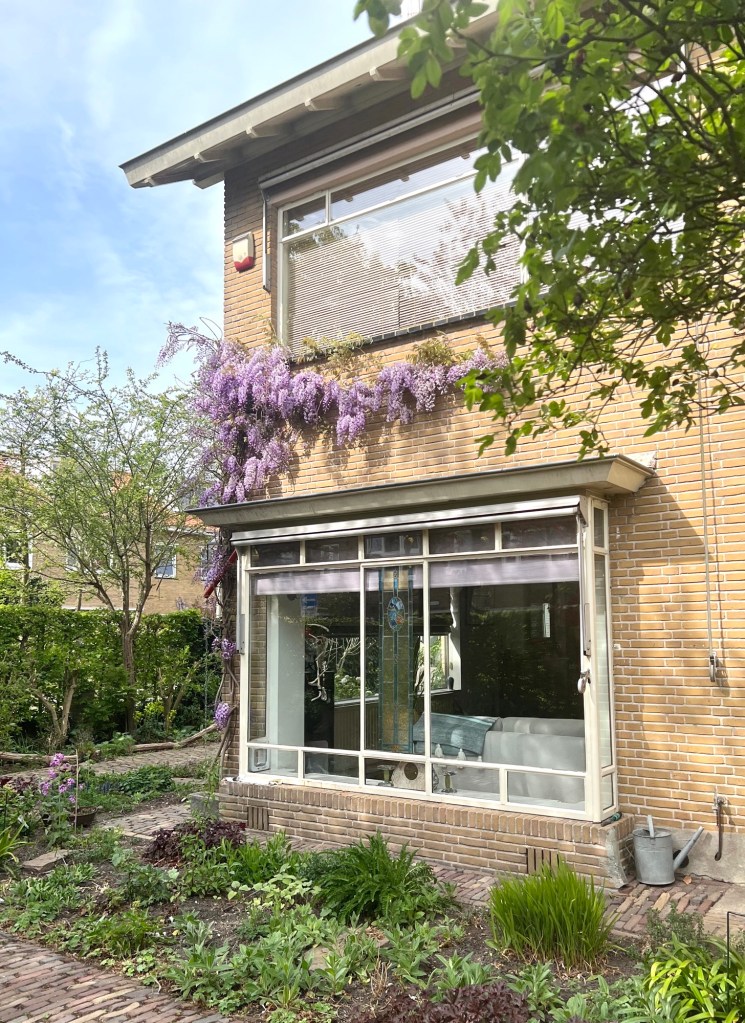

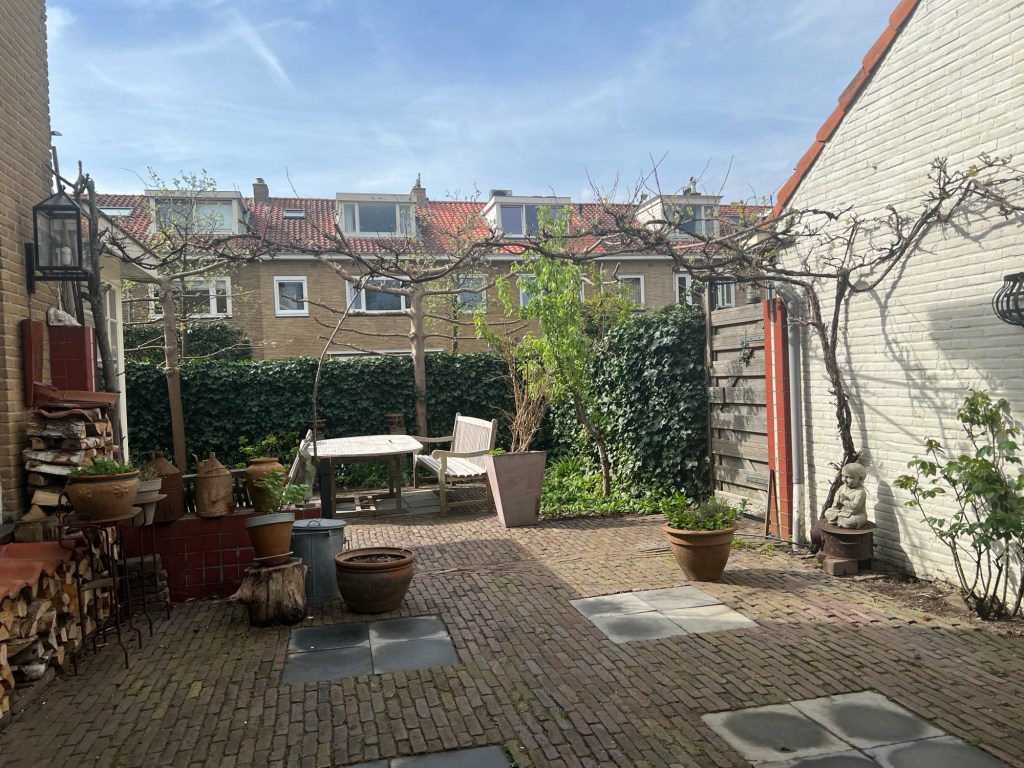
- The house was supplied with everything we needed for easy and comfortable living and cooking.
- We loved being in a neighborhood with Martin and Caroline next door and many friendly neighbors with dogs and children for entertainment on our walks.
- Access to transportation was GREAT! Only three walking blocks away we had choice of 3 Buses routes that connected everywhere.
- Shopping was also easy with the huge city center mall one bus stop away and local shops two bus stops away or easy walking distance. The open air market on Friday was a favorite. And we recommend the Boulevard Cafe at the mall.
- The neighborhood was beautiful with parks for walking and spring flowers every where in gardens.
- We enjoyed two outstanding dinners at local restaurants: Italian at Vera Sapori and Indonesian at Lemon Grass.
- Thanks again for your hospitality. We had a great time
Steve’s response to the Resistance Museum
I took the required course in American history during my first semester in college. The young history professor, William Marina, had a special area of interest in revolutions—theory and practice, good or bad, and how they come into being.
He presented significant markers that lead people to vote for or to revolt against power from either internal or external forces. Examples we studied were the American revolution and revolutions in France, Russia, rise of Nazism in Germany prior to World War II, as well as “liberation” movements in South America, North Africa, and China. They all had significant markers.
- Creation of “enemies” based on differences: economic (rich or poor), cultural, racial, and religious characteristics used to whip up hate.
- Propaganda that demonized the enemies and appealed to a sense of helplessness and persecution of the “masses”. Repeated stories of evil deeds by enemies upon the good people, whether true or false.
- Destruction of cultural institutions which serve people and create a sense of commonality and mutual respect such as courts and rule of law, churches, schools, government agencies, universities, social clubs. Such institutions become either targets of distress and disloyalty or turned into powerful promoters of hate, vengeance, and ill will against enemies
- A charismatic leader who promises to fix all the problems and charms the electorate into supporting violent overthrow of the government or an election victory which they interpret as giving them all power.
- Unquestioned loyalty to the new order and punishment to those who resist.
I was a college freshman and naive. Of course, I thought, this could never happen in the United States. Our founders were wise enough to distribute power into three branches of government which check and balance each other.
 Tipps for Travel