The Great British Traveling Show
Day 1 Finding our Way and Westminster Palace
The last stop on our Great British Traveling Show was five days in London. Jim studied the train, bus, and underground and became the Maestro of Urban Movement throughout our stay—carefully orchestrating the easiest, fastest, and cheapest routes to various locations. Payment for all bus and underground travel is easy—contactless with a credit card.
When we arrived by train to Paddington Station around 11:00, Jim knew that Bus 62 would take us from Paddington to within a few blocks of Mel’s apartment in West Hampstead. The 30-minute ride gave us great views of neighborhoods, shops, and crowds of people going about their daily lives.

Finding and following street names and numbers in London is a puzzle. Efforts to grow suburbs and rebuild older areas in a very old city requires new streets with new names and rerouting old streets. The result is that street names change from one side of an intersection to the other and that street numbers jump around from block to block or abruptly start a new sequence.
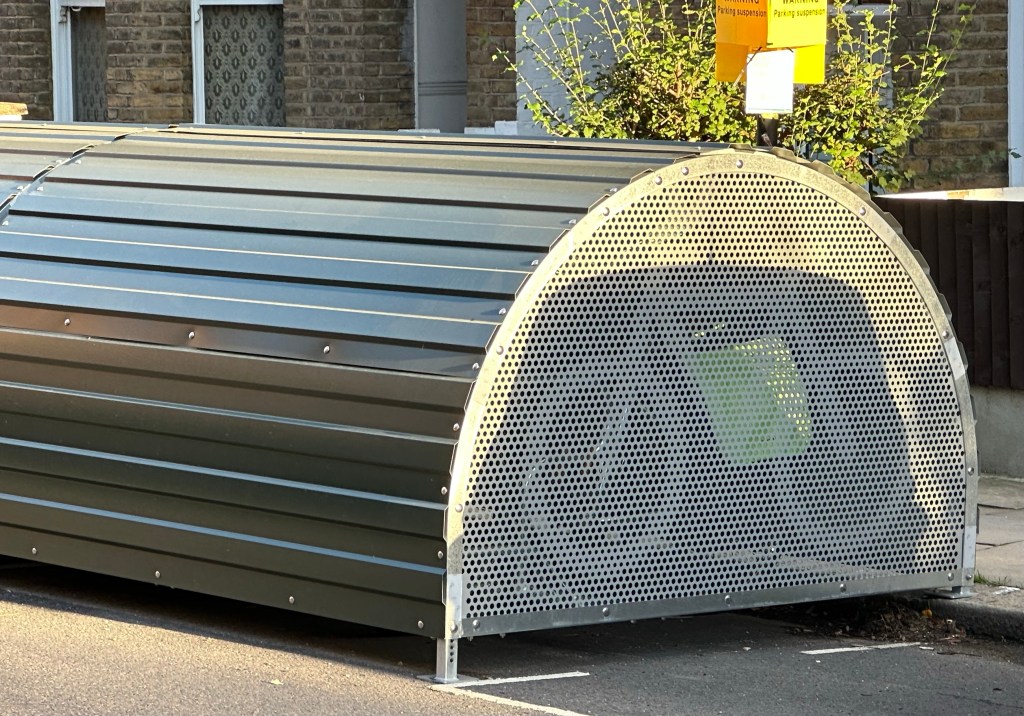
Finding our Airbnb was confusing because the apartment had both an exterior street number and an interior apartment number. Becky found the out-of-order street number, and Jim asked a stranger coming out of that door. A dozen or more apartments shared the same street address. Since we arrived early, Mel, our Superhost, graciously let us drop off our luggage while the apartment was being cleaned.
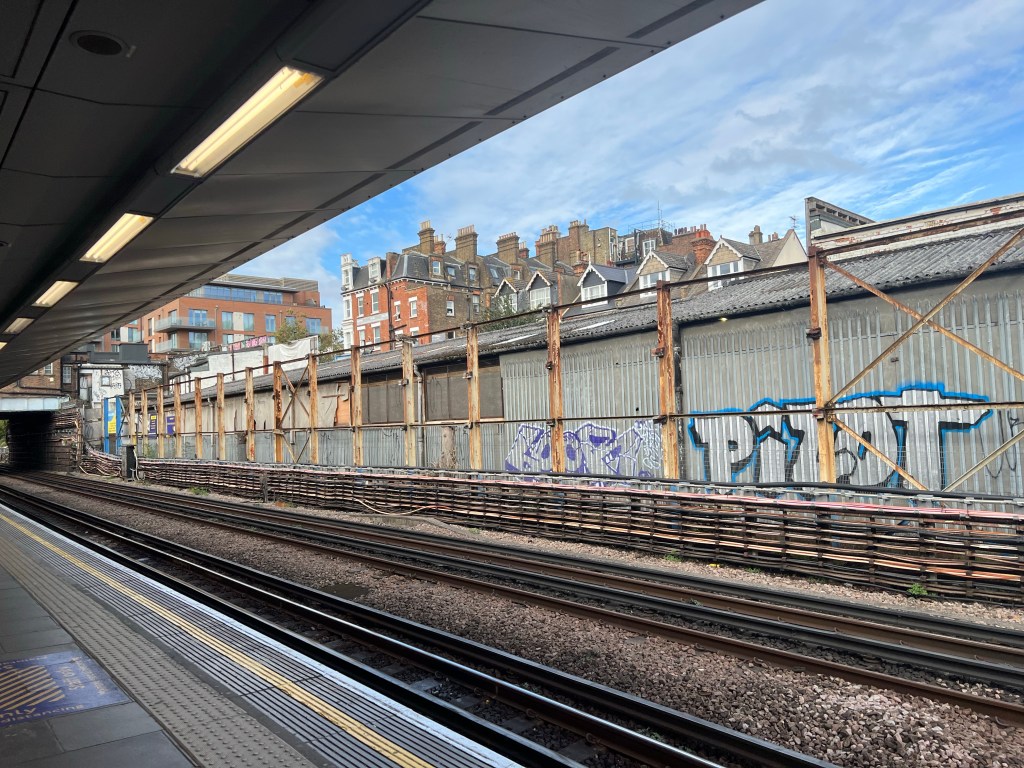
After unburdening ourselves, we walked 6 blocks to the underground at Kilburn Station for lunch at a Greek sidewalk cafe. The Jubilee Underground Line then whisked us to Westminster Station where we bought tickets for the Houses of Parliament tour.
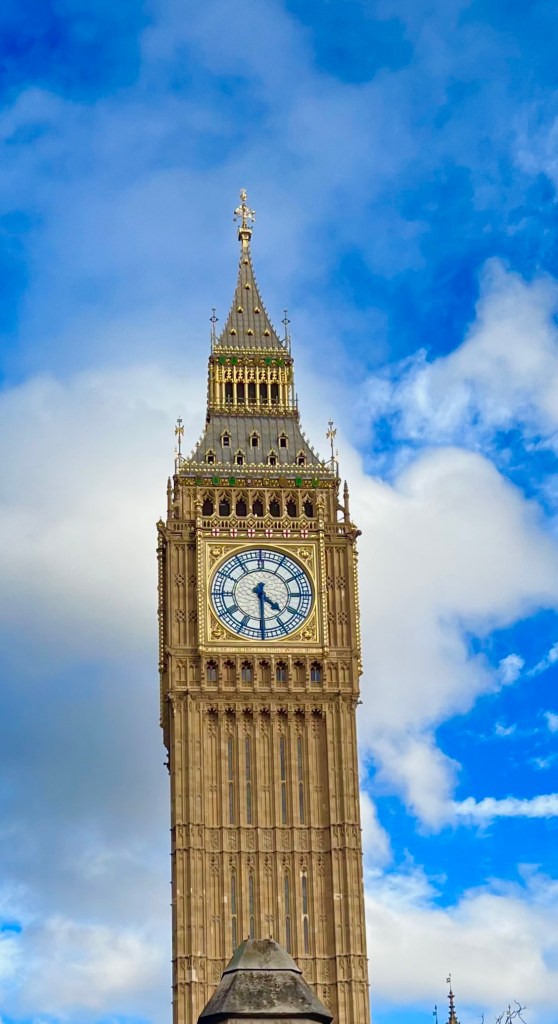
The first thing we saw was famous “Big Ben,” recently refurbished, painted a brilliant blue, gilded and restored on top of Elizabeth Tower at the corner of Westminster Palace. Big Ben is actually the name of the bell in the tower not the clock, but nobody quibbles about that distinction.
Westminster Station was also our first encounter with never-ending London crowds. Coming out of the Underground, we faced a teeming mass of humanity that filled the sidewalks on both sides of Westminster Road and Bridge.
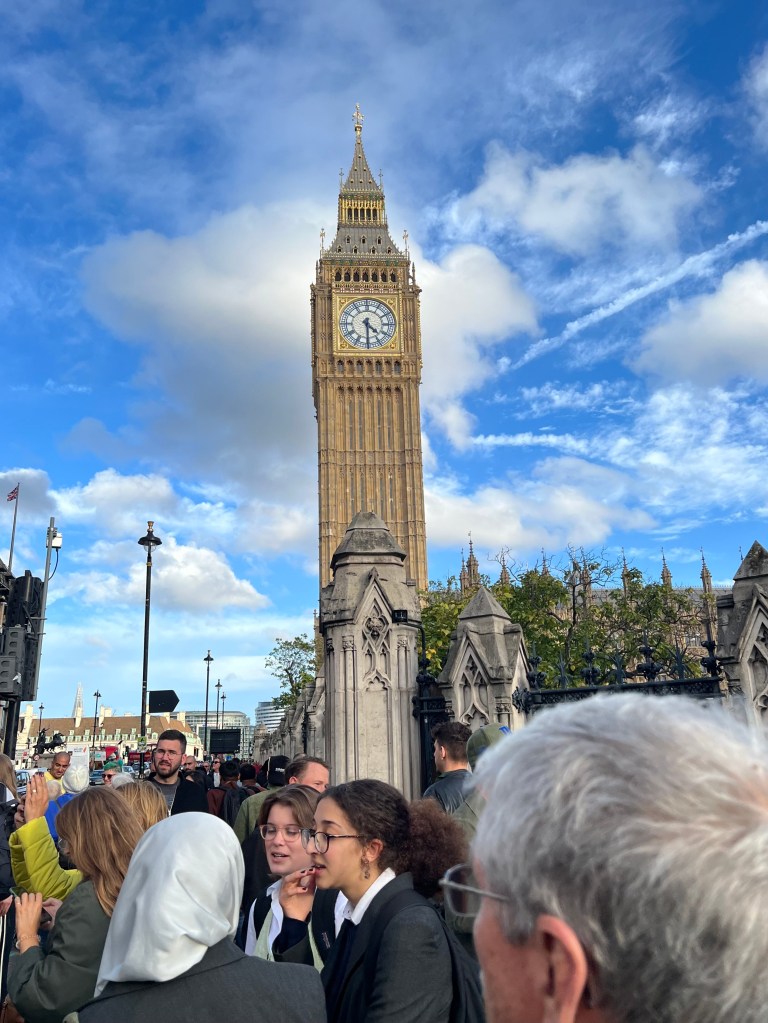
We stayed close to avoid getting separated or pushed apart in the crowd while crossing the road toward the Westminster Palace, commonly called Houses of Parliament where the House of Lords and House of Commons meet.
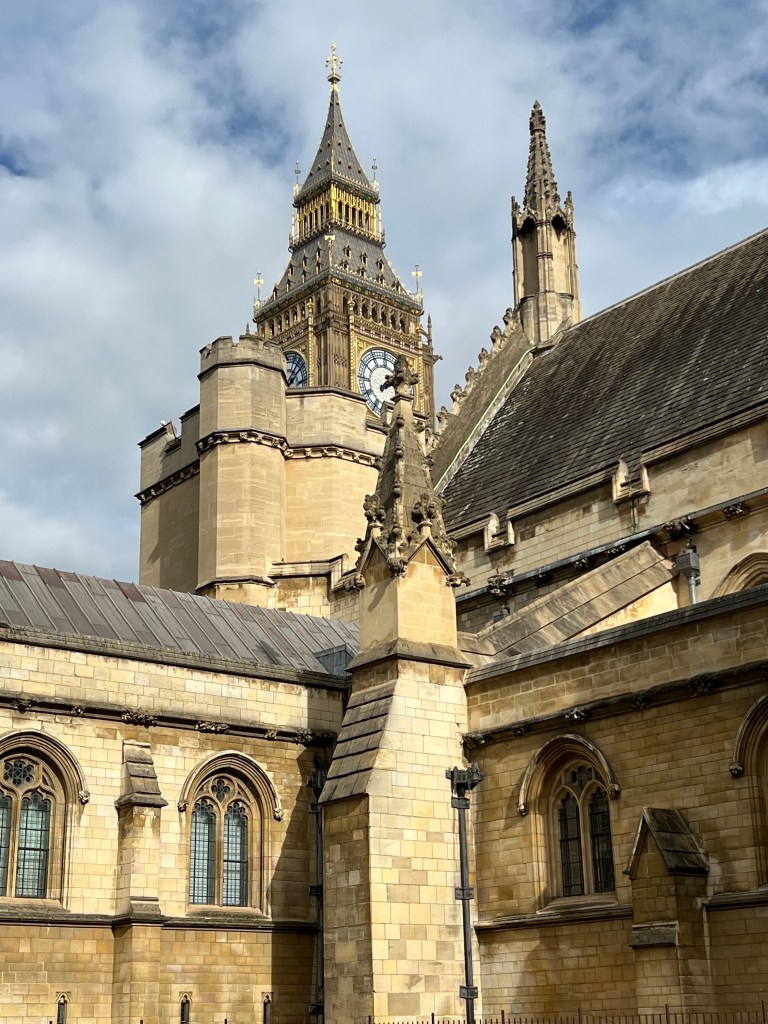
The audio tour began in Westminster Hall, originally a royal palace built in the 11th century.Due to fires and damage over the centuries, much of the building was rebuilt in the 1800’s. The Chapel of St. Mary Undercroft, the Jewel Tower and the Cloisters of St. Stephen’s date back to medieval times. The rest of the building reflects a High Gothic style.
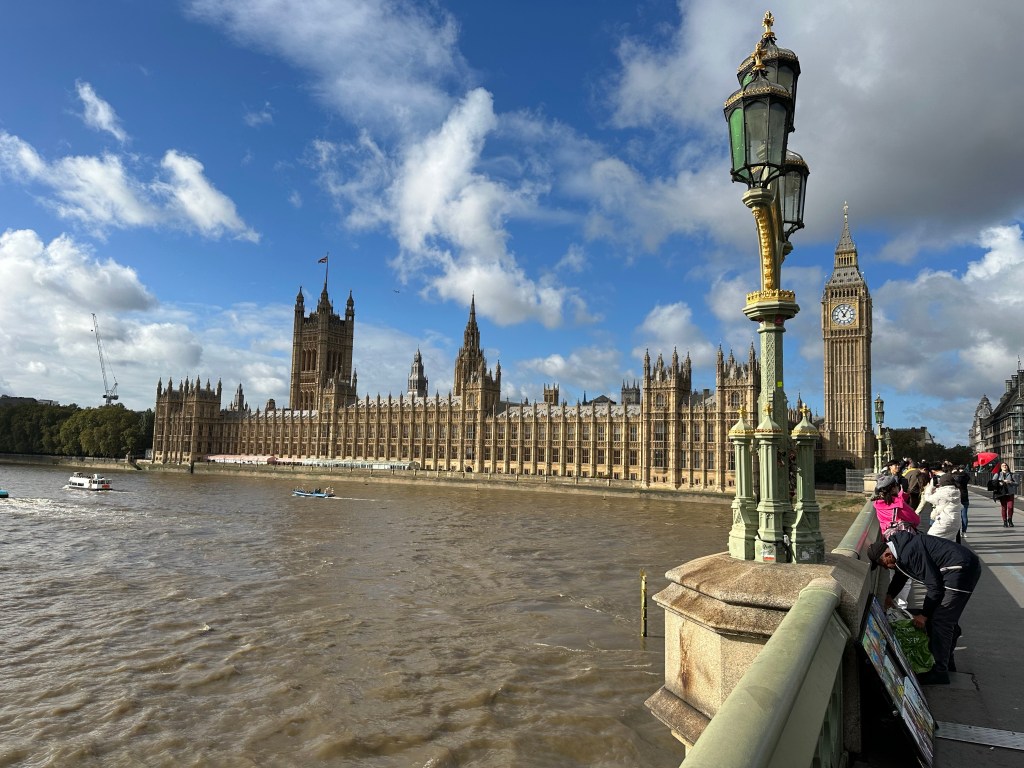
On the audio tour, each of the major rooms in Westminster Palace was described with its purpose in the government, significant statues and paintings, and important historical events that happened there. The route was confusing as we circled through the same rooms several times.
Westminster Abbey was only a block away, but we were done for the day and pushed our way back through the crowd across the street to the underground station at rush hour. When we got back to Kilburn Station, the nearby Tesco offered packaged dinners to reheat in the microwave and basic groceries for breakfast.
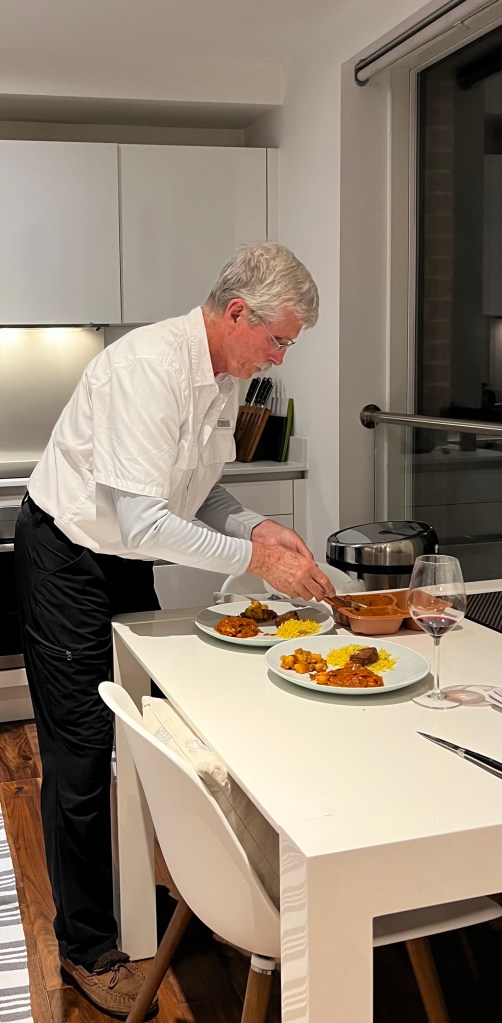
We relaxed over hot trays and cool salads with time to recap the day and appreciate Mel’s great apartment for its size, amenities, and proximity to transport.
Day 2 Crowds, Crowns and Confusion
The Tower of London and Crown Jewels were on the Robson agenda for the day. Becky and I wanted to find the Courtauld Gallery, a small museum featuring exquisite Impressionist paintings. The travel plans were straightforward—Jubilee to Westminster then jump on the Circle Line. The trip was not that simple because the Circle Line was closed for track repairs.
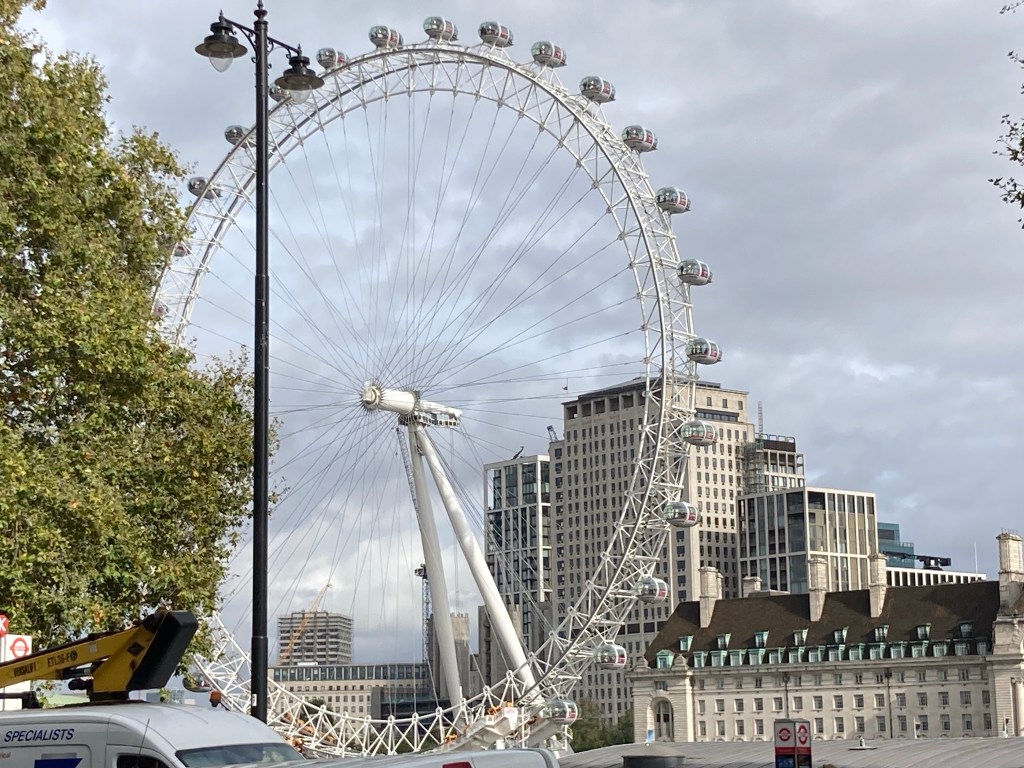
The Robsons were successful in getting to the Tower, while Becky and I strolled along the Thames to Waterloo Station, where we were only a few steps across Waterloo Bridge to the Courtauld Gallery now relocated in Somerset House, but we didn’t know that. We got on another subway and wound up close to the British museum where we dropped in for morning coffee. After watching the crowds, we continued walking and asking for directions which always seemed to take us in the wrong direction. We did see some interesting sights including the colorful new buildings on St. Giles Street.
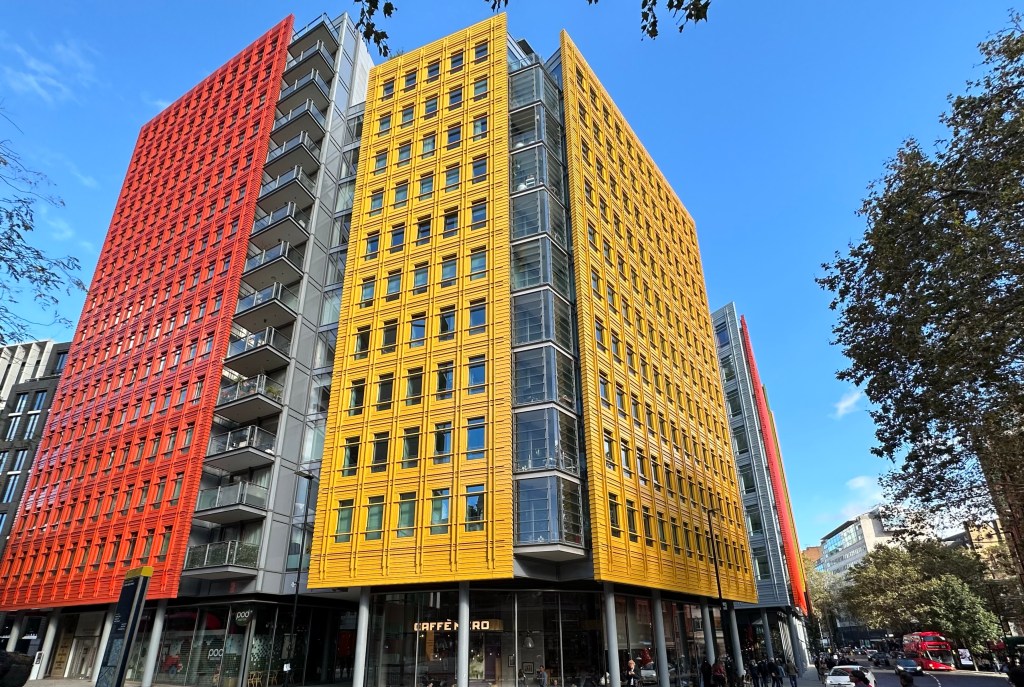
While we were wandering the streets of London, the Robsons were much more successful on their plan for visiting the Tower of London.

Here is the Robson Report. The Tower of London is a vast walled complex of buildings begun by William the Conqueror toward the end of 1066. Jim wisely suggested that we immediately line up for the Crown Jewels exhibit. We waited for 30 minutes, but soon the wait was an hour or more.
The jewels are an unbelievable display of exorbitant excess collected over the centuries. They consist not only of crowns dating back to 1661, but also ceremonial swords, shields, staffs, etc. some of which date back to the 12th century.
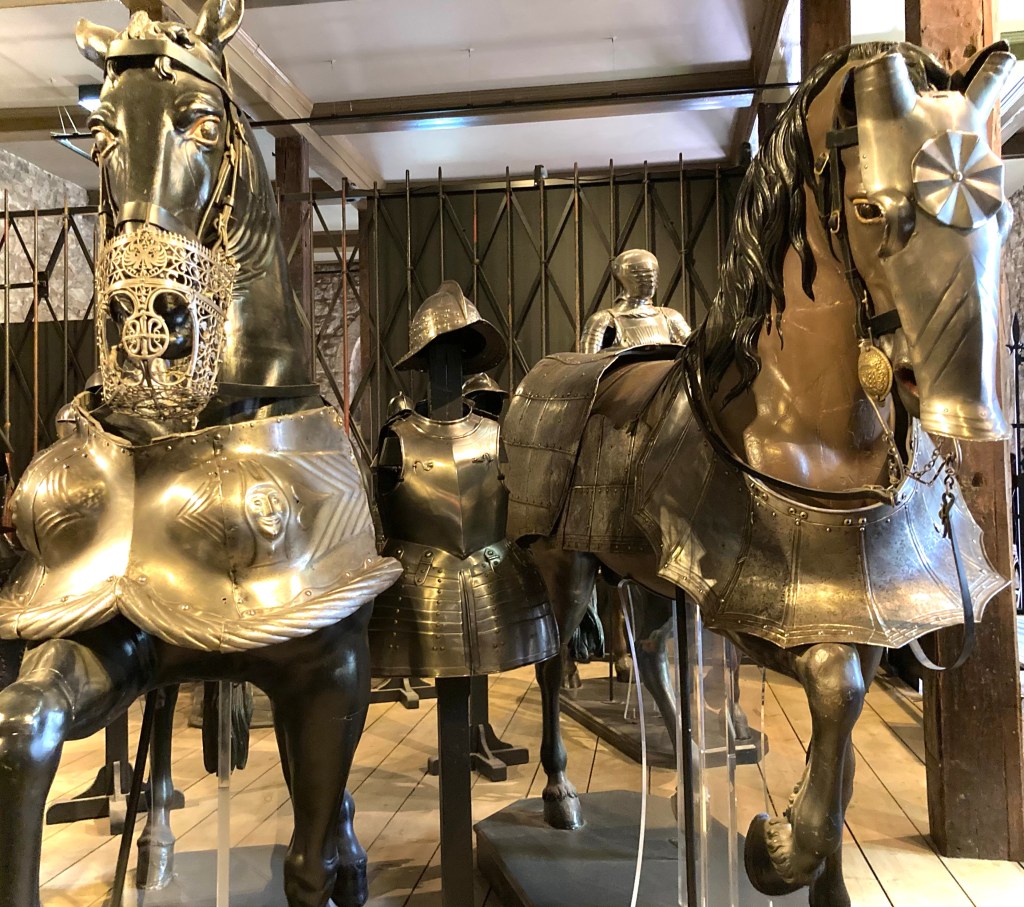
A massive steel vault holds the current Crown jewels. While viewing the jewels, you stand on a conveyor belt which keeps the line moving quickly with no time to peruse anything. Many of the jewels from previous crowns (some dating back centuries) are reworked into crowns of the current monarchy which explains why so many old gold crowns are devoid of jewels. Still, the huge collection of gold and gems is impressive, leaving us with the sobering feeling of just how removed royalty has been and still is from the common citizens. The term “Crown” refers not only to gold crowns we saw but alludes to the authority of the Royal family.
We took another audio tour through the White Tower, one of the oldest parts of the Tower complex built in the early 1080’s. It was the strongest part of the fortress and housed the king, his representatives and a chapel. Henry III ordered it whitewashed in 1240 to make a more commanding presence on the Thames to inspire awe in the townspeople then and visitors today.

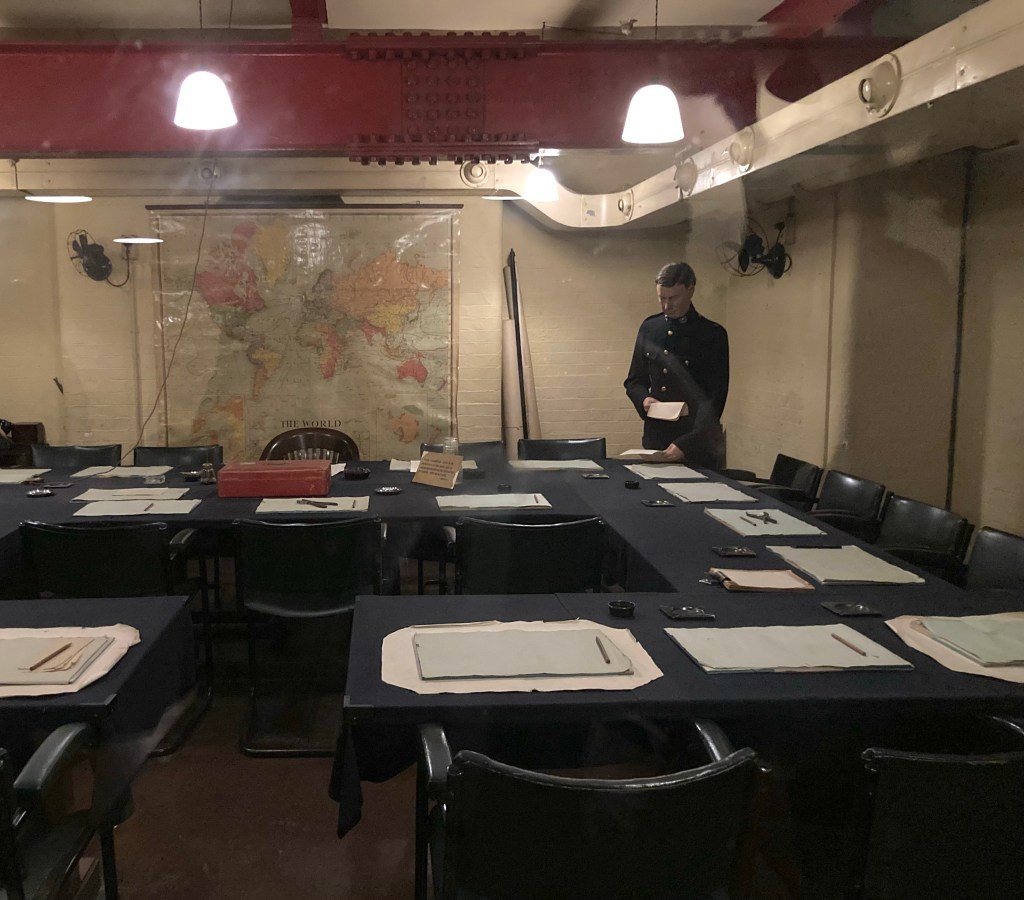
As exciting as the Tower was, we found the Churchill War Rooms and Museum even more fascinating. This underground nerve center was where the British government directed the Second World War. An audio tour walked us through the top-secret corridors for a glimpse of what life would have been like during those tense days and nights. One could spend an entire day wandering in this amazing secret bunker. Everyone who worked, and sometimes slept there, understood that one direct bomb hit would destroy them and the coordination that was necessary to win the war.
Evensong at Westminster Abbey was at 3:00, so we headed past a tall monument to the Great London Fire of 1666 and London Bridge with only enough time for a quick sandwich outside the cathedral. We could hear chanting from a pro-Palestinian demonstration but were really unaware of how large this demonstration actually was. Oblivious to all this going on just down the street, we headed inside.
This cathedral is where Charles and Diana, as well as William and Kate, were married. State funerals are also held here. It is massive and amazing. We have seen so many beautiful cathedrals on this trip. Each one is unique and really awe inspiring. The choral Evensong was nice, but not our favorite. We were spoiled by the simpler one at Exeter College in Oxford.
The plan was to meet the Robsons at Westminster Abbey for Evensong at 2:30. About 1:30 we faced a long walk and hailed a cab to take us from the East End to the West Side, but these plans went awry because roads in central London were closed for a Palestinian protest march. Huge groups of protesters gathered at five or six places around the city and were converging on Trafalgar Square exactly where to cab dropped us.

The Square was already full of people with signs and bullhorns. The marchers were two blocks away blocking streets in several directions; London Police were everywhere. When we checked for directions to the Abbey with a police officer, he quickly escorted us across the paths of two approaching groups.
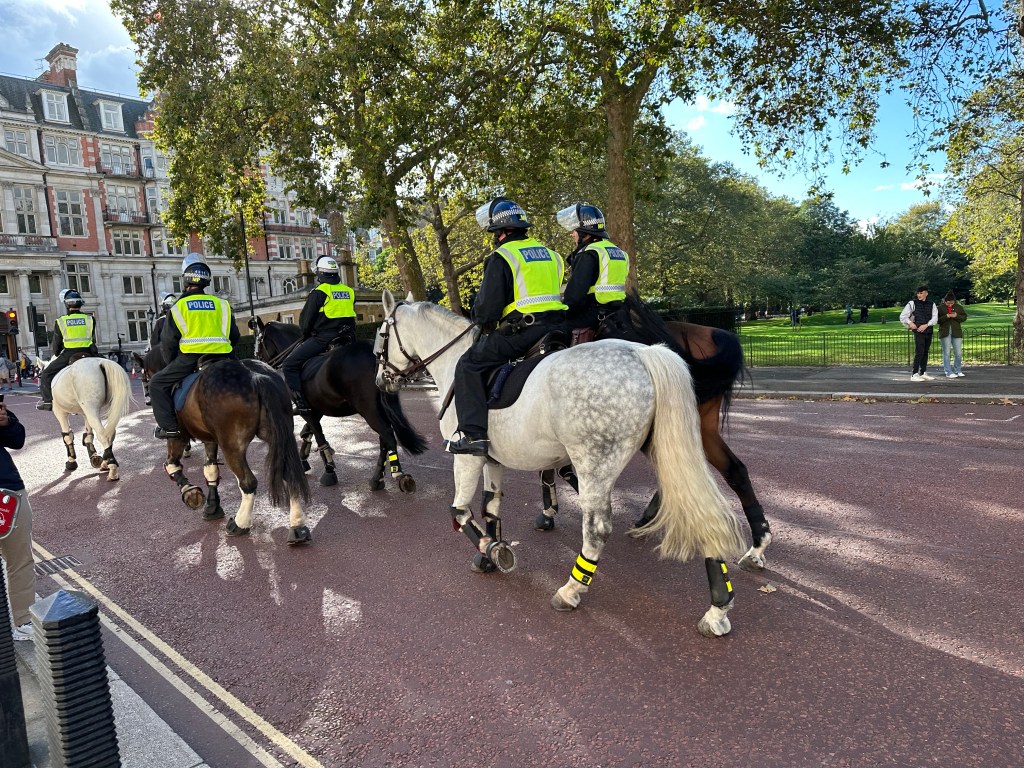
We passed a long row of paddy wagons and police on horses along Whitehall Street and Horse Guard Road—backups in case of trouble. As far as we could tell from the news, there was no trouble beyond random skirmishes.

We missed meeting the Robsons at 2:30 but got there in time for the organ concert and prelude. Becky saw the Robsons as we entered but we were seated on the opposite side. In contrast to the simple Evensong at Exeter College, this Evensong was very, very, very elaborate with a phalanx of elaborately robed bishops, abbots, and attendants leading a procession down the central aisle. The music was magnificent, and every inch of the Abbey is richly decorated with elaborate columns and sculpture.
When the service was finished, Robsons were gone before we left the Abbey. We both encountered hundreds of protestors in the street returning from the rally. They joined commuters and tourists in the tube station around 5:00. Chaos ensued. All the escalators were jammed. The elevators that were working had long lines with strollers and wheelchairs. The trains were jam packed for hours. It was actually scary being in the middle of so many people pushing and pushing.
We survived the underground crush and regrouped at the apartment where we were tired and needed comfort food. I suggested going back one stop to West Hampstead because most of Mel’s food suggestions were there.
Scarrino’s is a neighborhood Italian restaurant where we enjoyed the food despite the volume of voices and background music. A family group of 15 seated at a long table nearby ordered a 5-foot long pizza which they devoured. Whole lotta pizza and whole lotta shouting back and forth.
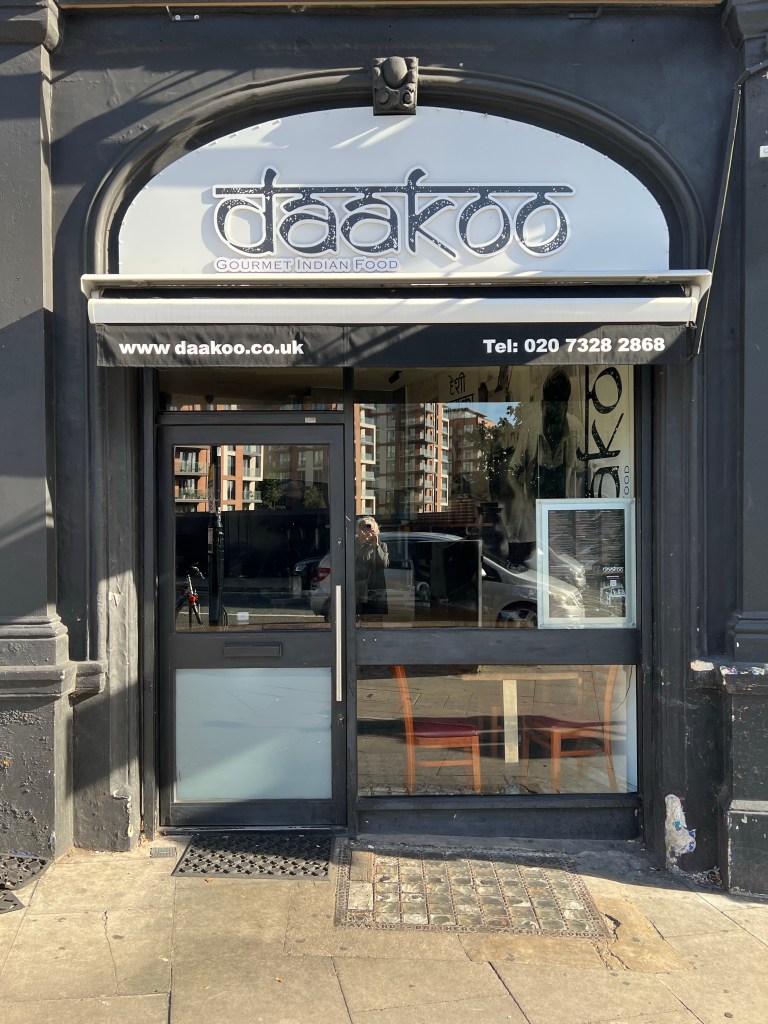
On the way back to the tube station, we noticed Daakoo, a take-out-only Indian restaurant, with its counter holding a dozen take-out bags ready for delivery. That seemed like a good recommendation for another night.
Day 3 Buckingham Palace, the Courtauld Gallery, and Exploring London
The Robsons left early for Buckingham Palace to see the Changing of the Guard. They were not the only people with that idea on this beautiful Sunday morning—approximately 20,000 people joined them around Victoria Circle.
Here is the Robson Report. The event, an extravagant display of British pomp and circumstance lasting an hour, was nothing like we had expected. Jim figured out a perfect vantage point to see things unfold despite the masses of people. Marching bands and soldiers came toward the palace from far away and paraded in precision once inside the gates; this seemed to go on forever.
At some point in the morning, the guards changed, but from our place on the Victoria and Albert Statue we were not sure when this happened. We were not alone in our confusion as others around us kept wondering when we were going to see the guards change! Despite this, watching British pageantry at its finest was quite an experience.
As we started back to the subway station, a violent fight erupted between some young men at the entrance to the station. Instead of fighting our way through, we walked up the street to Trafalgar Square where I noticed another church, St. Martin-in-the-Fields. This church is famed for its acoustics; many concerts have been recorded there making it world renowned. Jim first learned about the church while typesetting concert programs for our business, First Impression Graphics. He was really curious to see it, so we entered and discovered an a cappella choral performance had just begun. We sat in a back pew and enjoyed a really special performance by six amazing singers in a magnificent small church. Jim was delighted with this unexpected event, a true “lagniappe”—one of his London highlights.
Not being eager beavers and early leavers, Becky and I set out after 10:00 determined to find the elusive Courtauld Gallery. We might never have looked for it except our friend Paula had alerted us to its relocation and reopening. We plotted a course on Bus 189 which delivered us to the front door of Somerset House. Hurrah! The entire city block sitting above the Thames at Waterloo Bridge has been refurbished as an art and education complex housing the Gallery as well as the Courtauld Institute (an art study center), several other galleries, and a law school located in different wings.
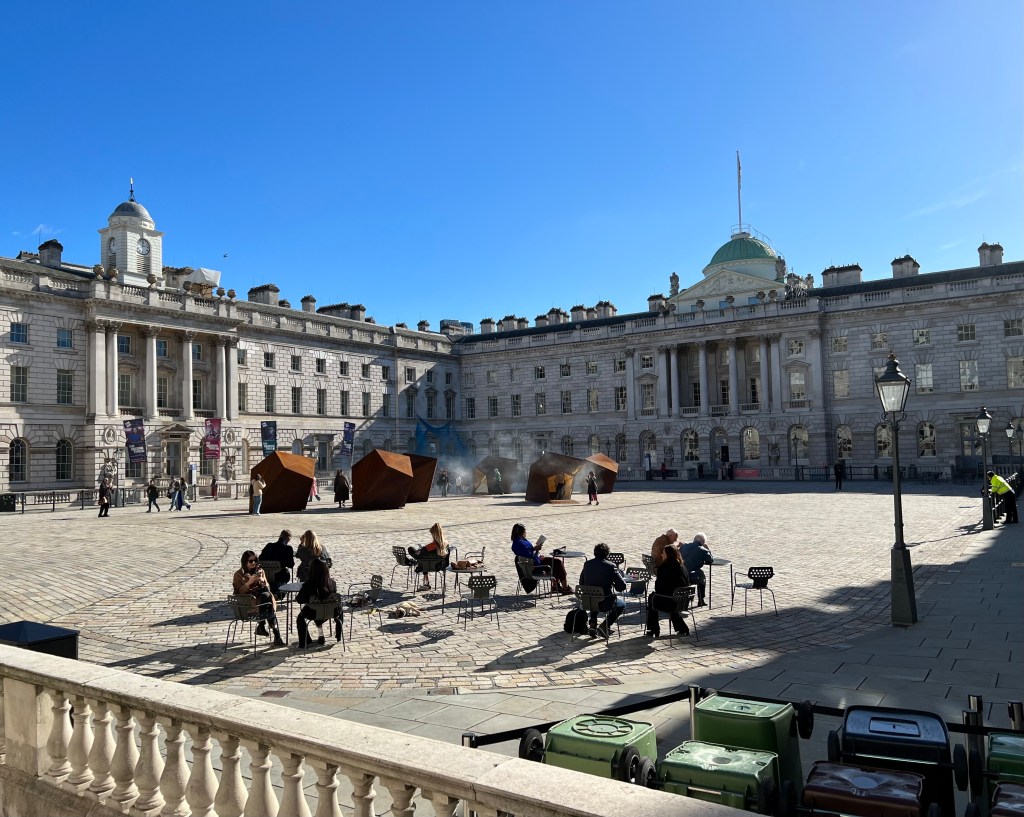
As signage was “discreet,” or non-existent, we had to ask three times to find the entrance, but it was worth the effort.
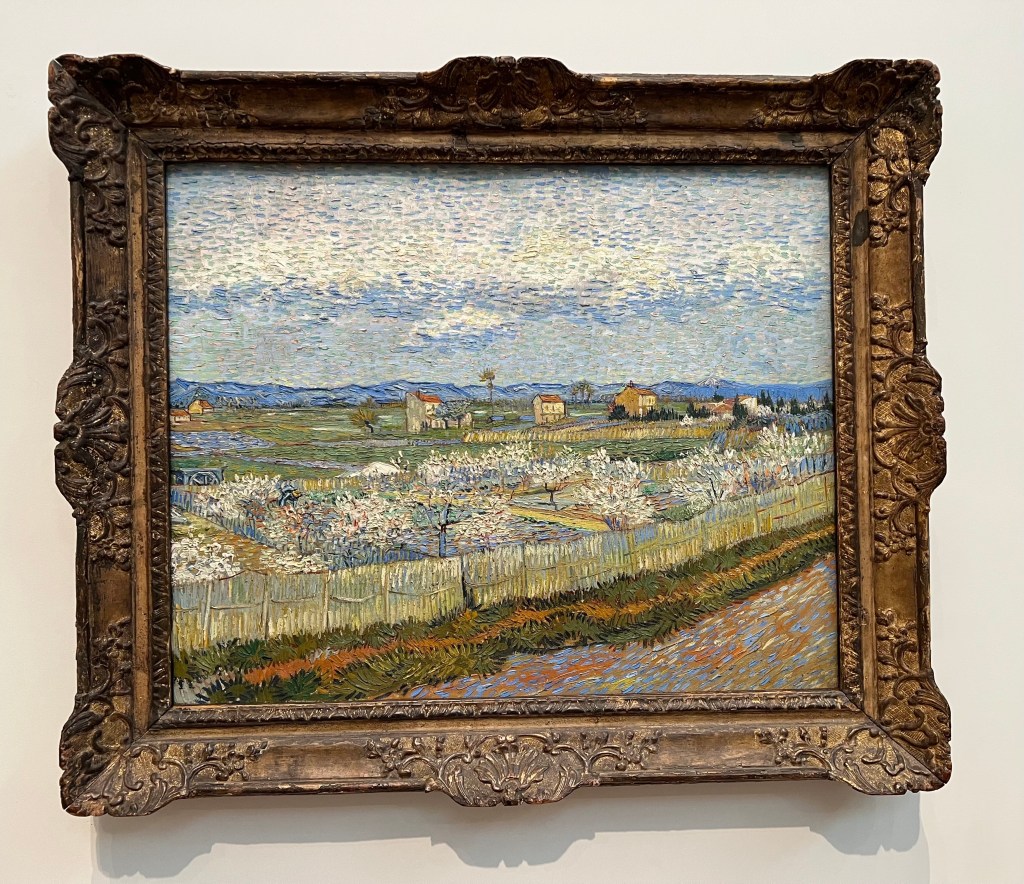
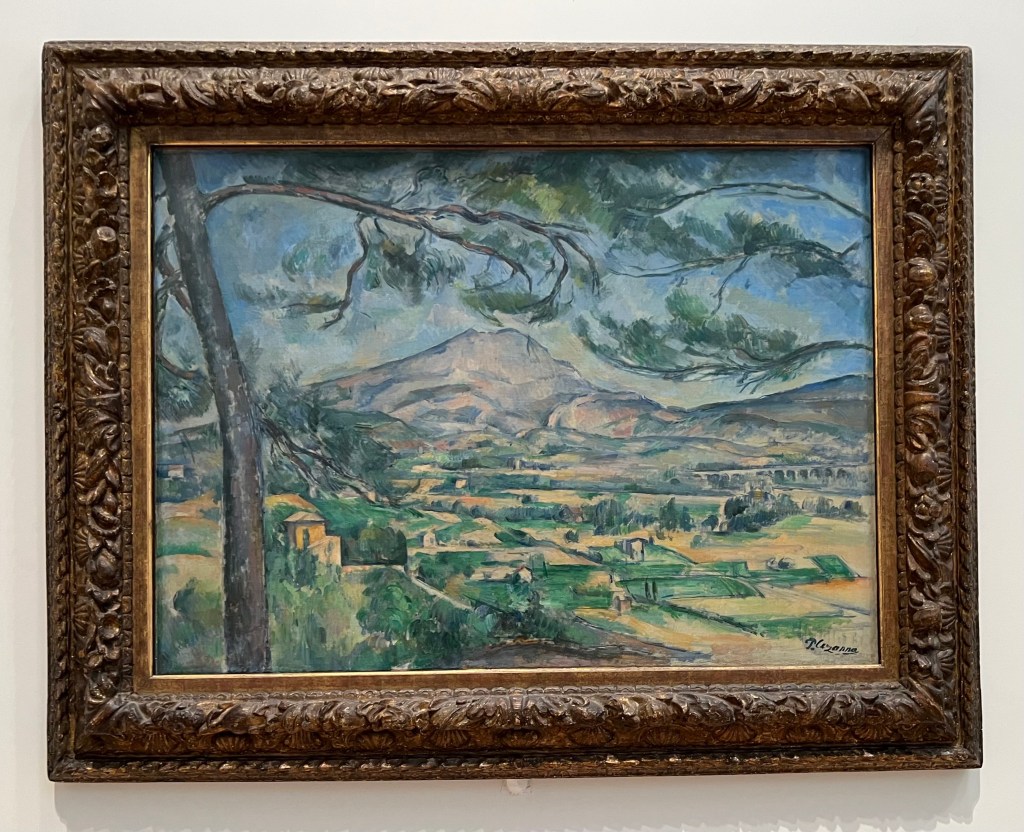
The Courtauld Gallery had 3 large rooms hung with impressionist and post-impressionist artists: Manet, Renoir, Cezanne, Seurat, Toulouse-Lautrec, Gauguin, and Van Gogh. What the collection lacked in number was more than compensated by the quality.
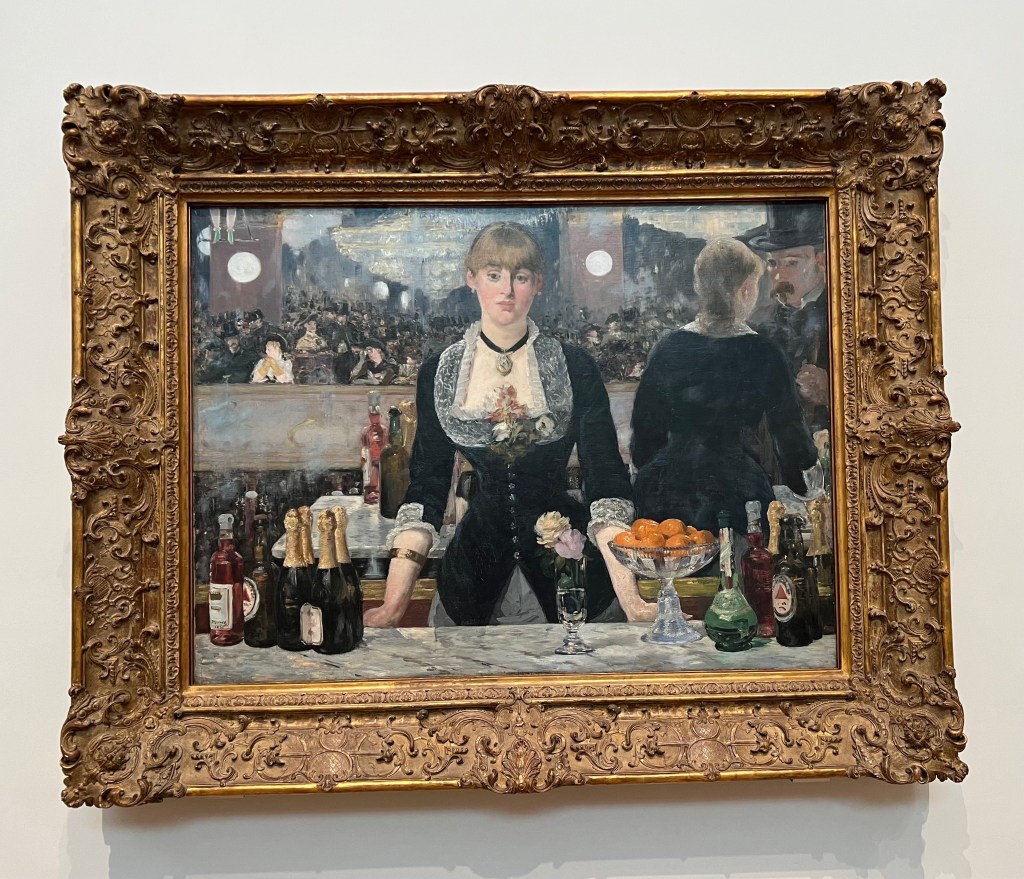
Each painting was an exemplar of the artists’ finest work. We had only seen photographs of these works in art books. We spent most of two hours looking at 25 paintings and stood gape-mouthed at the beauty. We were amazingly close to these stunning paintings and viewed our favorites several times.
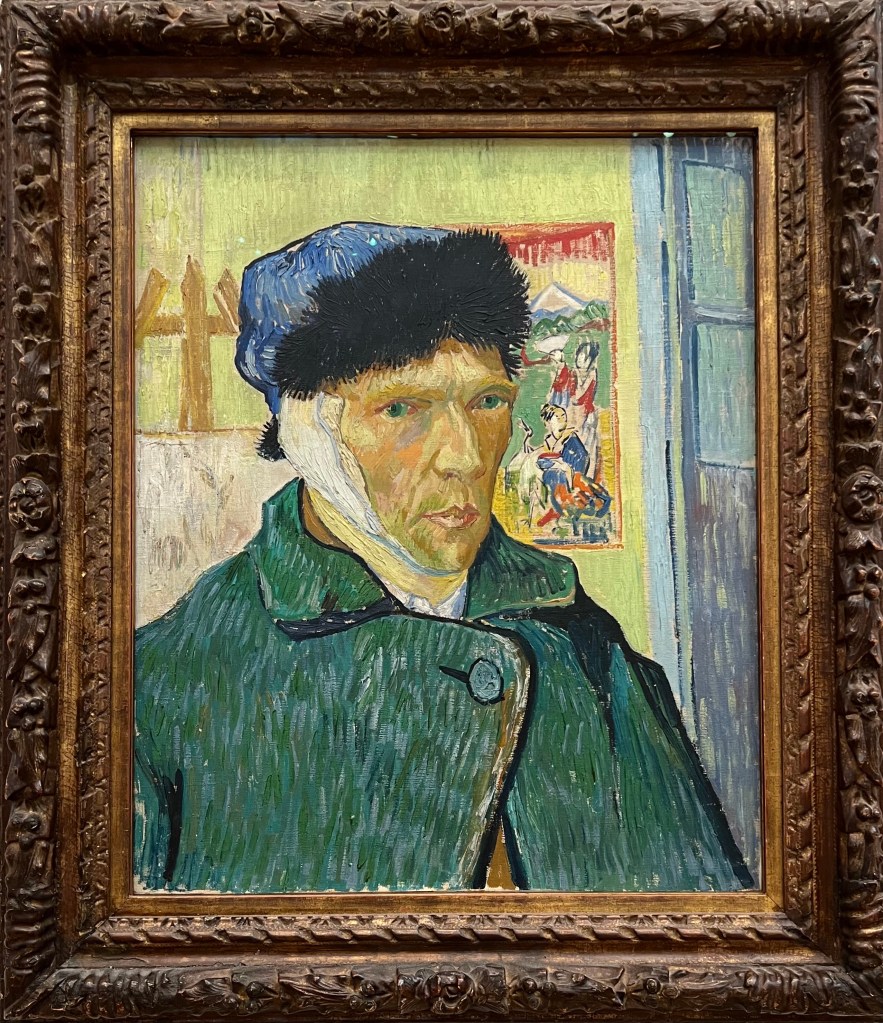
The Gallery displayed the crème de la crème collected by Stephen Courtauld and his wife Katharine. Many were bought directly from the artists whose work at that time was shunned by critics and the public in France, England, and the United States. The Courtauld family had earned their fortune in textiles—manufacturing silk fabric. They also developed a special black draping crepe popular for funerals, most notably that of Prince Albert.
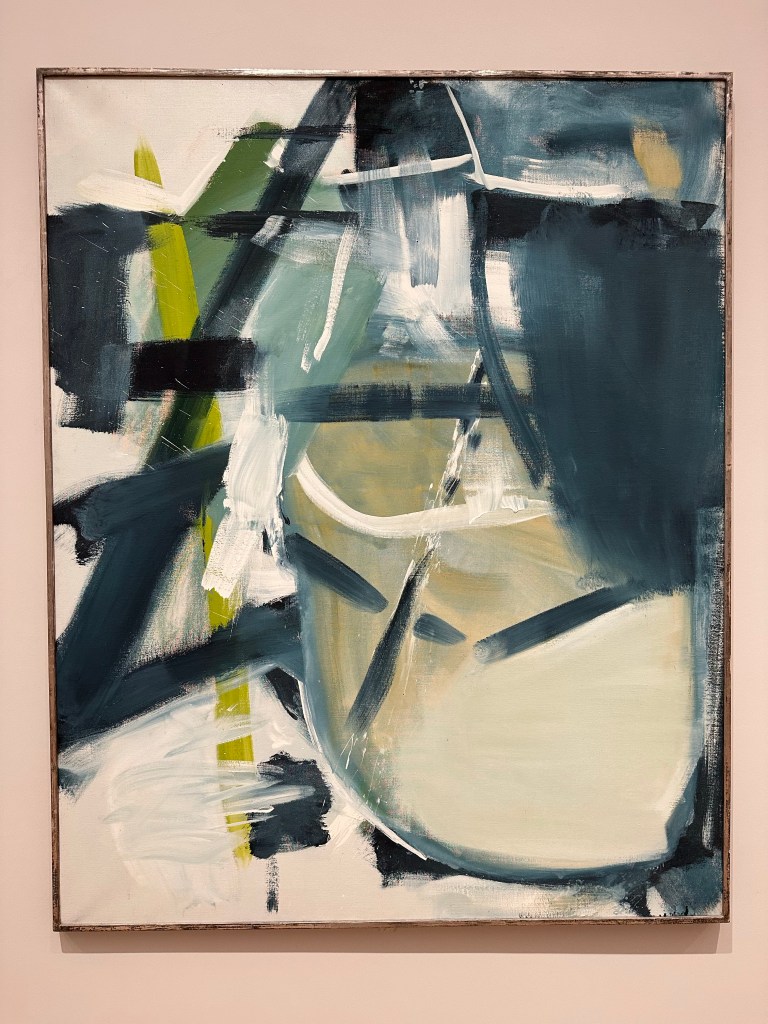
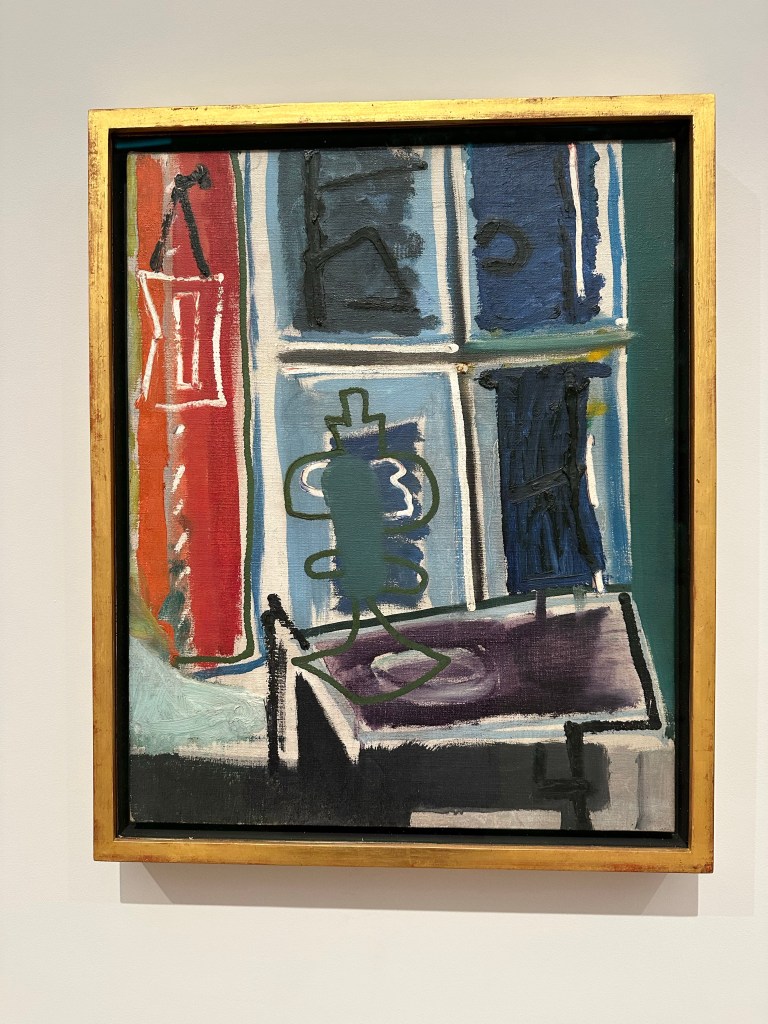
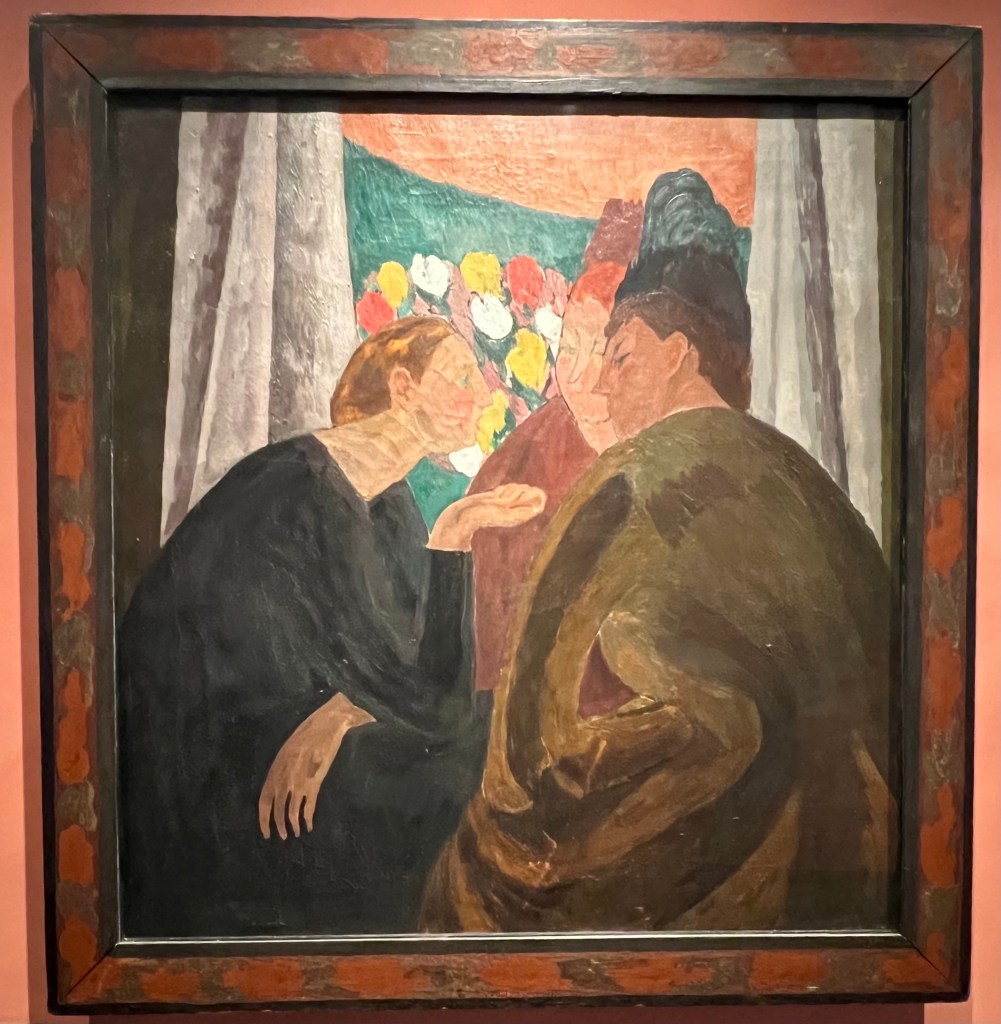
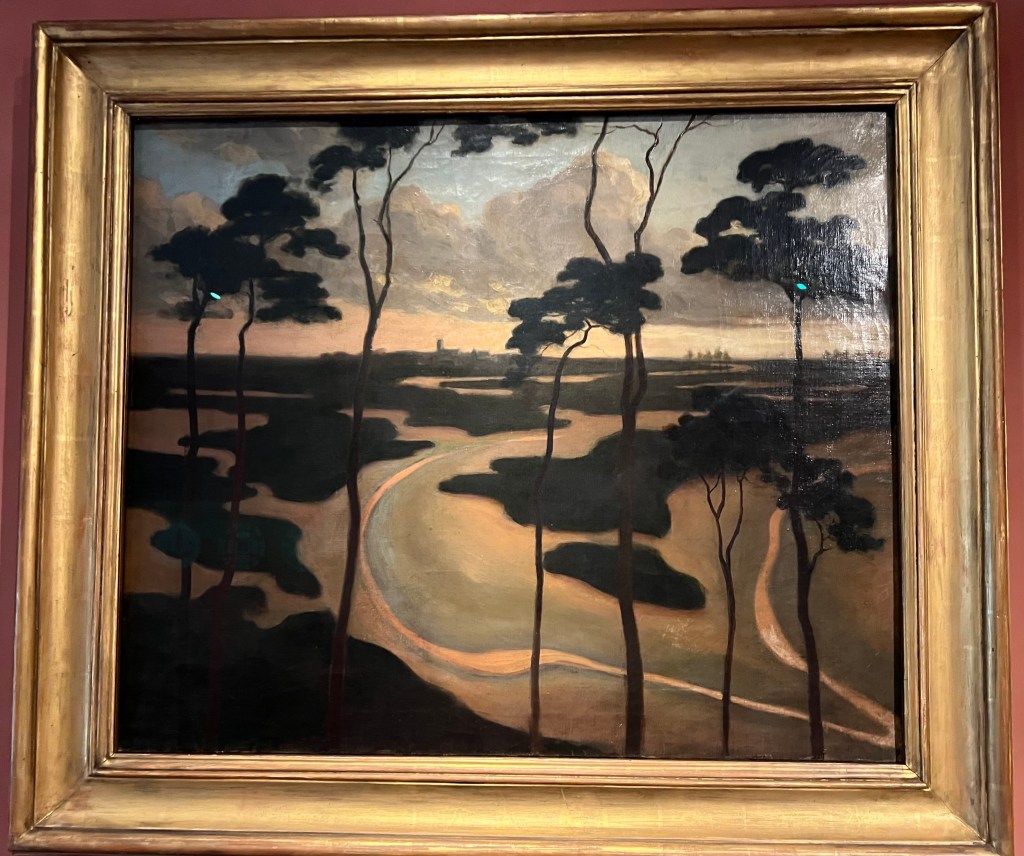
Two smaller galleries were adjacent to the main collection. One featured contemporary British Impressionists and the other held a variety of works from the infamous Bloomsbury group.
In the early 20th century, Virginia Woolf and her sister Vanessa Bell were leaders of this movement which advocated an arts and crafts aesthetic. Infamous because members of the group led complicated personal lives.
Across the street, the Lyceum Pub looked as if it had been there since 1900 or maybe 1800. Traditional pub fare—fish ‘n chips and bangers with mash—were on the menu; we could not pass them up. We returned to Kilburn on Bus 189 because its route took us on such a wonderful tour. Riding up top this time, we saw the heart of London—Piccadilly Circus, Trafalgar, Selfridge’s Department Store, Regent Street, Bond Street plus Abbey Road and Studios in Hampstead. We could imagine the Beatles walking across the striped intersection there. It was a grand tour of London for the price of £2 bus ticket.
Returning to Mel’s apartment, we enjoyed some downtime followed by wine, cheese and stories of the day. Jim and Becky went foraging for frozen pizza at Tesco while Betsy preheated the oven. We were just too tired to get back on the subway and search for a fancier meal.
Day 4 In and Around Windsor Castle
Exhaustion and/or some kind of bug hit Steve and Betsy. Steve decided to stay at the apartment for the day, while Betsy (despite feeling lousy) persevered with Jim and Becky and set off for Windsor Castle. Two subway changes and a short train ride got them to the steps of the castle in about an hour.
Here is the Robson Report. Windsor Castle is the oldest and largest inhabitable castle in the world. It was built by William the Conqueror around 1070. It took 16 years to complete and was intended to guard the western approach to London. It was always a special home to Queen Elizabeth II and the childhood home of the present King, Charles III.
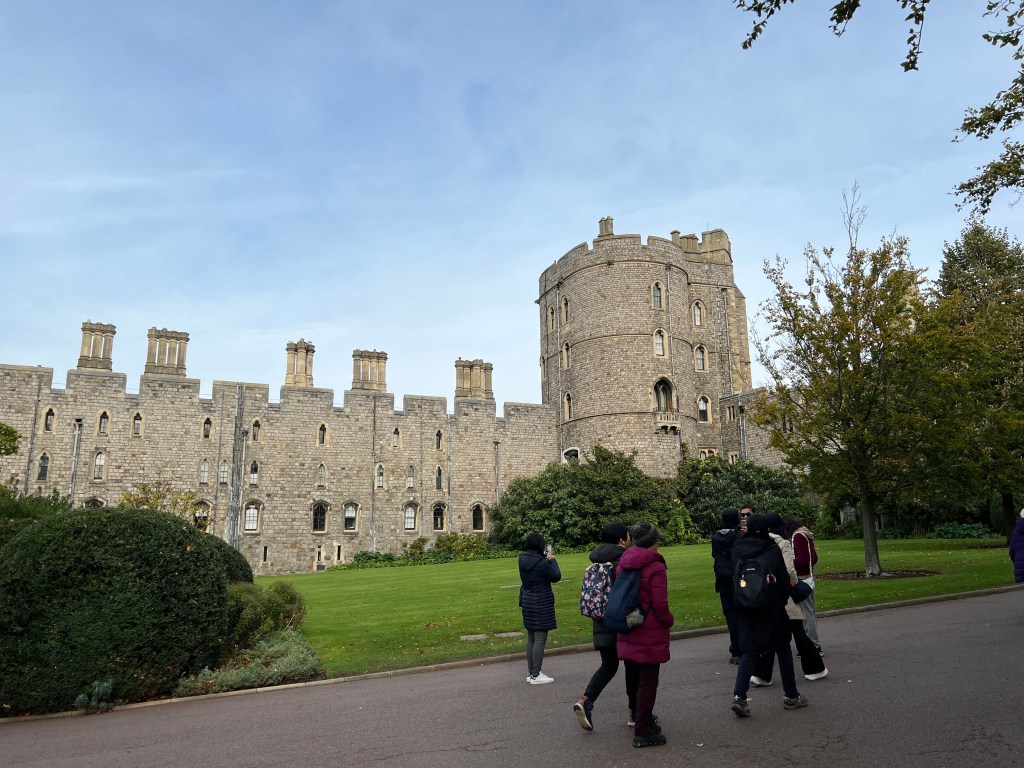
Despite being a huge walled complex with hundreds of rooms, this royal residence felt homier somehow, if a castle can be called homey. An audio tour took us through a large part of the castle and into St. George’s Chapel, adjacent to Windsor Castle, where the Royal Family worships while in residence and where Harry and Megan were married in 2018. The areas where the royal family actually work and live are not open, but it really was a fascinating place to visit.

The Castle is also a museum of fine art filled with British treasures from the earliest times. In addition, the building is used for state functions and entertaining.
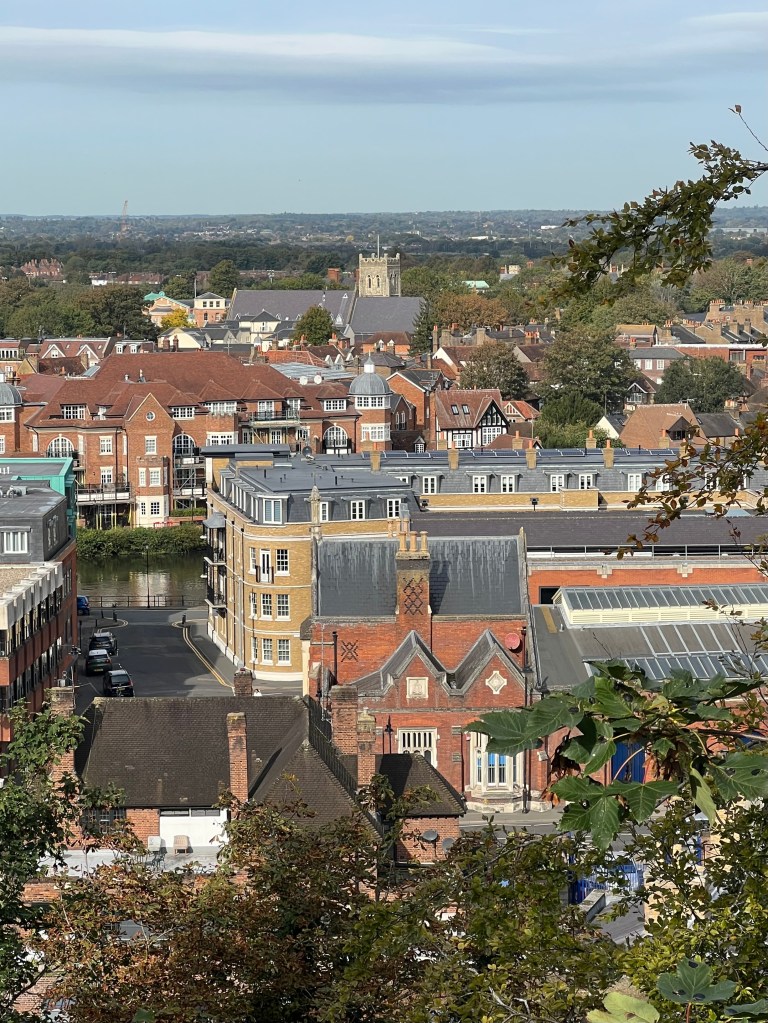
After three hours of intense looking, we were ready for lunch. A small pub nearby,The Horse and Groom established in 1709, served us cups of warm soup which we needed as the day had turned very chilly with first sign of autumn. Time came to head back via trains and buses.
As we were walked from the underground to Mel’s apartment, we passed Steve on his way to pick up Indian dinner for us from Daakoo. We collapsed and waited for him to return with a fantastic meal of curries and stir fries with papadum and naan. We understood why the restaurant is so busy.
We have really enjoyed eating in Great Britain!Traditional English food tends toward bland and heavy. We ate fish and chips several times at the start of our trip, but tired of the high fat quotient. Thai, Indian, and Italian meals are far more appealing. Ethnic food really shines here, and each meal we had was marvelous. Despite eating like kings, all the walking we did ensured we did not come home with extra pounds!!
Old Joke: Poor Canada. They could have had British manners, French food, and American technology, but wound up with British food, American manners, and French technology.
Days 5 and 6 Leaving London
Our last day in London was all about getting to Heathrow Airport that afternoon. We packed bags, stripped off the bedding, and took out the trash and recycling. Dragging suitcases around is tough and naturally restricts you from entering almost everything. Mel, our Superhost, again allowed us to leave bags so we had a few hours before heading to our airport hotel.
The Robsons took an hour-long ride on Bus 189 ride through London passing Abbey Road & Studios, Piccadilly Circus, and more high-end stores that we dreamed possible! We headed to the Courtauld Gallery which Becky and Steve enjoyed so much. It houses an unbelievable collection of Monets, Manets, Pissarros, Renoirs, Degas and one Toulouse-Lautrec. What a feast for the eyes!
After considering options and needing to be back at Mel’s at 2:00, Steve and Becky also rode Bus 189, got off at Somerset House, had a light lunch of smorgasbord at Olle and Steen, a Swedish bakery, got back on Bus 189 for a farewell ride arriving at Mel’s at 2:02.

Jim had plotted our exit strategy taking the underground to Paddington with transfer to the swift Elizabeth line to Heathrow Terminal 2 where our hotel was located. The five terminals at Heathrow are connected by trains in an underground central station with long walking passages to each terminal. Despite many signs, you feel as though you have taken a wrong turn and are completely lost. I remembered getting to the hotel (where we stayed in December) with a walk across a huge underground parking lot. Finally, among the signs we saw a small Hilton Garden Inn insignia which, like breadcrumbs, eventually led us to our destination.
Getting from the apartment to the hotel at Heathrow took about two hours. We were glad we were not making the transfer the next morning. The plane was scheduled for departure at 10:00, meaning we would have to be at the terminal at 8:00, meaning we would be leaving the apartment at 6:00. We would have been frantic! Any little missed connection could have caused a big problem.
Instead, we were relaxing in the rooftop bar watching airplanes taxi, take off, and land on runways around us. Jim somehow is able to recognize the shape of many of the airplanes, so he did plane-spotting for us. The couch were Becky and I sat was deep, low, and not that comfortable. Jim asked the woman at the next table if we could have her extra chair. He asked if she was alone and she answered, “Unfortunately, yes.” He rolled the giant chair over for me to sit in so that my knees were not touching my nose.
We were enjoying our libations as the woman, Marguerite, finished her meal. I asked if she would like to join us which she did for a lively and interesting conversation. She told us about her life (born in Goteborg, Sweden, where we visited in May), her marriage (a long-distance relationship with a man in Pittsburgh until she said enough is enough), her jobs, and her hobbies (returning from a walking holiday in Switzerland). This sounds like she talked the whole time, but it was really an interesting interaction with a fascinating person who had lived a life so adventurous and so different from ours. Another bonus of travel is meeting and talking to strangers.
We left the hotel about 7:15 and walked, walked, walked to Terminal 2 through security to a gigantic seating area surrounded by duty-free shops where many people were busy loading up. We had not eaten breakfast, so Jim and I went in search of coffee with hundreds of other caffeine-seeking people at 8:00. Our strategy was divide-and-hunt; I stood in line at Costa Coffee while Jim searched for other options. I was in the lucky line which moved rapidly so I texted him to return. The ambient noise was so loud and amplified in my hearing aids that I was functionally deaf. I needed him to negotiate our order with the counter person.
We secured coffee and croissant just before our gate number posted. After finishing coffee, we joined the crowd of 350 people on a long walk to the gate. As we approached, nobody was moving into the seating area. We could see an airplane outside and a lot of check-in personnel wandering about aimlessly, not checking anybody in. Something was up. After we stood in the crowd for 20 or 30 minutes, they announced a gate change.
I am sure it was a mile walk to the furthest gate in the terminal where we stood for another 20-30 minutes. For reasons unclear to us, some passengers had to undergo an additional security check of their carryons! Eventually we were able to sit down and wait for something to happen; there was no airplane at this gate. That something was loading us all on buses which ferried us back to the original gate and to the 787 we had seen.
Apparently, the moving bridge to the airplane quit moving and could not be fixed. We needed a gate at ground level so that buses could take us to the stranded airplane. We walked up a ramp into the airplane. This whole operation took about 2 hours and 5000 steps to get us aboard. The 350 people demonstrated admirable patience and forbearance in the situation.
And we were off—only 2 hours late. The pilot said we would make up some time and we did, arriving only about 30 minutes behind schedule. In Philadelphia, we checked out through security and customs, collected our bags, and checked ourselves and bags through security again (thank goodness for TSA pre-check). At this point, Jim, Betsy, and Becky headed to the gate for Asheville while I went to the gate to Columbus for a meeting at Ohio State. The gate agent briefly held the flight because Steve was “no show.” When questioned about her companion, Becky responded that he had missed the connection. They probably thought I was too drunk to board, and she left me at a bar in the airport. David picked up three weary folks around 6:00, and I got to Columbus and my hotel about 7:00.
Thus ends the Great British Traveling Show with four travelers in their beds, exhausted from all the fun we had over 37 days, and three of us with some kind of crud that hung on for 10 days and required medicine. Jim was immune to whatever the rest of us got. As Maestro of Urban Movement, his escape from the malady was a just reward.
 Tipps for Travel