MS Maud arrived early to Dover on the morning of December 22nd. The excitement of a new adventure made it easier to say goodbye. We were very happy not to face the whole journey to the US right away. A taxi delivered us to the station by 9:00 for a 9:48 train into London. At St. Pancras station we changed trains for St. Albans, 20 minutes northwest of London.
We had more issues with our electronic M-Pass, but the train agents opened the gates for us in Dover. The pass finally activated in London. Six people from the ship were on the London train with us. We formed a fire brigade to get everyone’s luggage off because incoming passengers stormed onto the train, not waiting to enter until we got off. Rush, rush, and bustle.
St Pancras Train Station—the old and the new
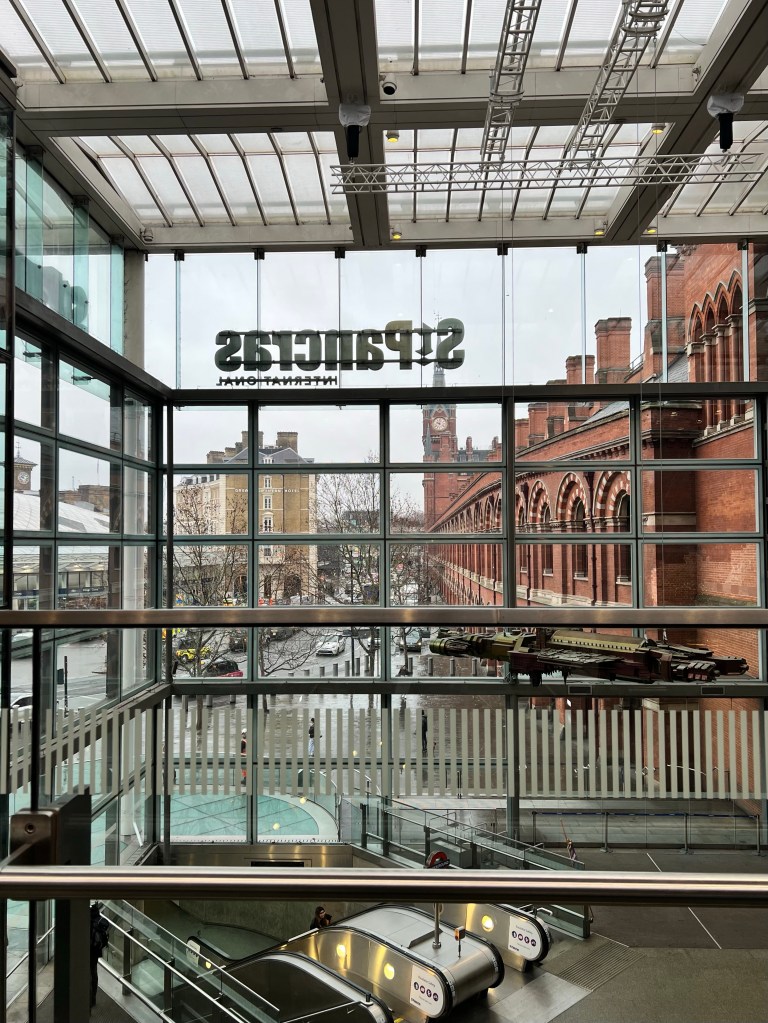
As we changed trains, we observed a sad Christmas event. A nattily dressed young man, probably headed home for the holidays, huddled in the middle of the platform attempting to corral his luggage and too many shopping bags. Gift bags holding bottles of wine had crashed, causing the contents to pour out across the train platform. The bouquet added a festive aroma to the morning and perfumed his problematic situation. Rush, rush…..
From the St. Albans station, a taxi took us to the century-old Samuel Ryder Hotel in the city center.
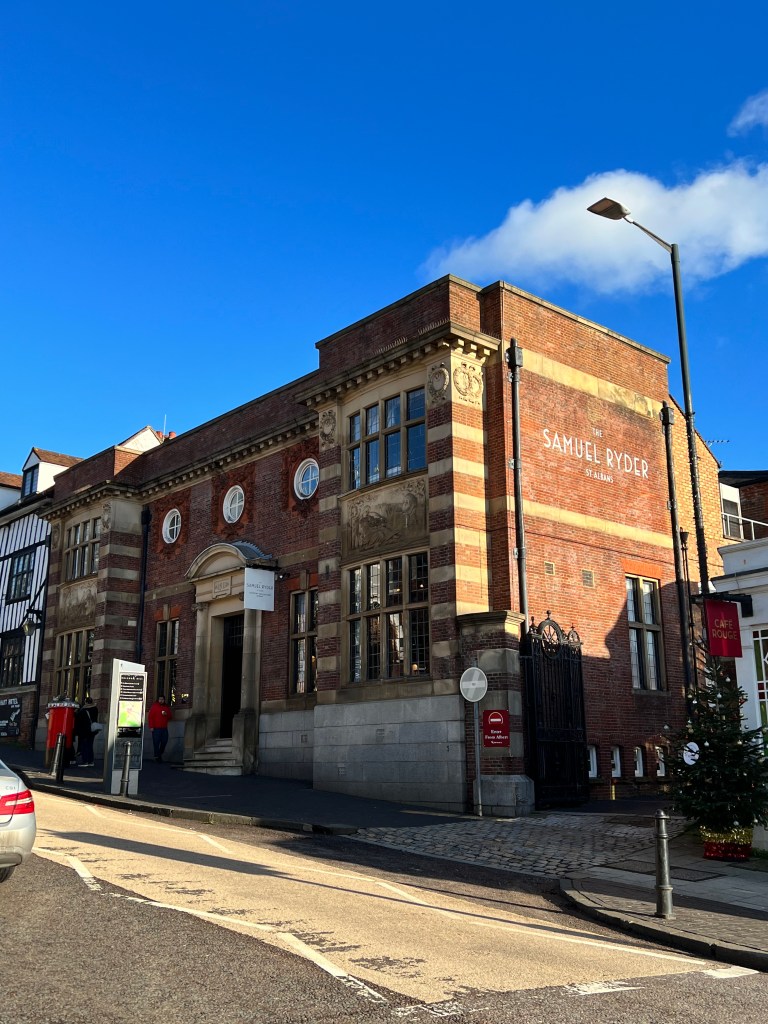
It was a wise decision as an inch on the map was at least a mile up and down hilly streets. The first floor of the historic building, once Ryder’s business office, was renovated for reception, lounge, and breakfast seating.

Modern, comfortable, cozy rooms are attached behind the facade. The updated hotel is decorated with a variety of abstract and contemporary graphics which we enjoyed such as this golf-themed one.
- Samuel Ryder, an English entrepreneur and golf enthusiast, founded the Ryder Cup between top American and British golfers. The hotel is located next door to what was once his seed business but is now the Café Rouge. (For the rest of the story, search “Samuel Ryder” not “Sam Ryder” who is an American golfer.)
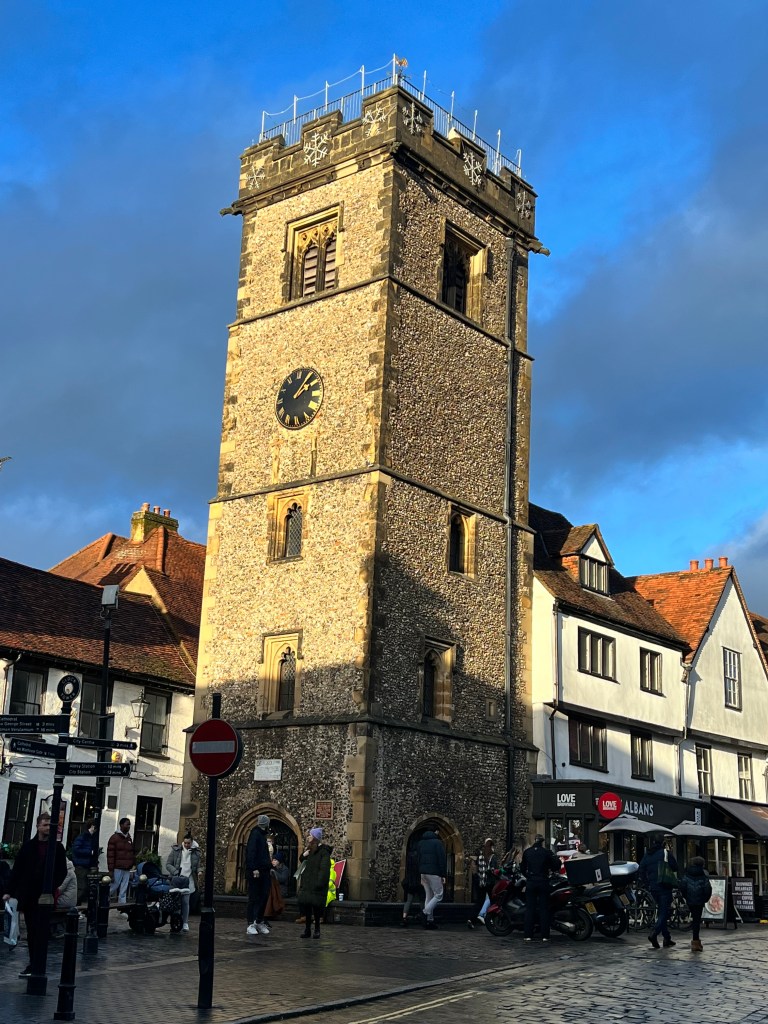
More importantly, the hotel in the city center is convenient for walking around and exploring a beautiful, historic, and archaeologically rich area. After settling in the room, we walked four blocks up a 20 degree incline to the aptly named High Street. In those four blocks, our street had three different names: Holywell Hill, Checkers, and St. Peter’s. The streets and sidewalks are centuries-old with an uneven mix of brick, cobblestone, rock, cement, cracked cement, with patches and loose materials. Uncertain footing made us very careful.
- Why St. Albans? We were asked several times, even by residents. The simple answer was that we had never been there. Actually we picked St. Albans because of its fascinating role in English history. Neolithic and Roman settlements, the Norman Conquest, the Cathedral and Abbey Church of St. Alban, the Wars of the Roses, and Elizabethan intrigue put St. Albans at the center of many political and historic upheavals. (Search “History of St. Albans” for the whole story.)
The Samuel Ryder hotel serves a wonderful breakfast starting with fresh pastries, fruit and yogurt, and 8 choices at a huge self-service coffee maker with the touch of a finger—Americano for Becky and Café Latte for Steve. Then, we ordered from a variety of cooked breakfasts: full English, poached egg on avocado toast, eggs Benedict, or four pancake choices. Becky declared that the eggs were poached perfectly, so she ordered them without the avocado smear every morning.
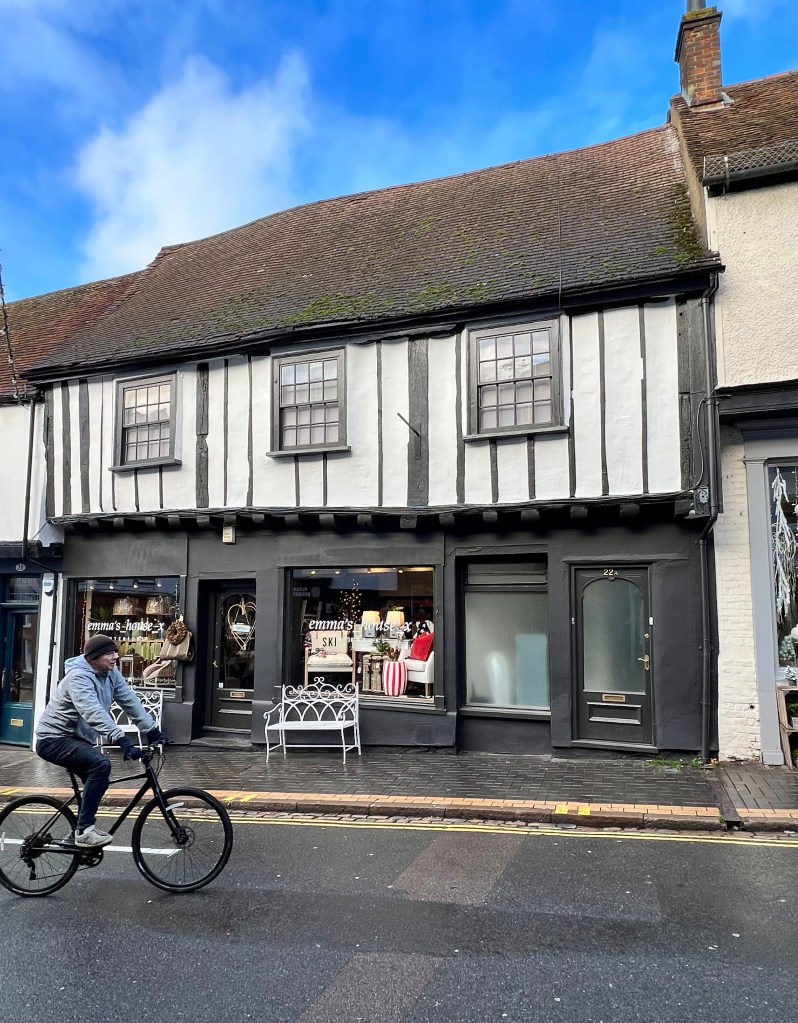
Half timber house on St. Alban Street
Many restaurants in England serve festive holiday lunch and dinner parties and do not accept walk-ins. Groups of family, friends, and business associates plan celebrations in December and through the New Year. We expected this and observed many such parties in progress; other places had signs that declared “Bookings Only.” Little Marrakech, a small mezze restaurant, was open and offered a menu of steaming tagines, spicy lamb or vegetable—perfect lunch on a chilly day. We wandered for another hour, then returned to hotel for a nap because we had 5:00 tickets for a pantomime, not Marcel Marceau pantomime, instead British pantomime also known as “panto.”
Panto, a traditional Christmas entertainment in England, is a hilarious, family-oriented stage production very loosely based on a classic children’s story such as Cinderella, Sleeping Beauty, or Puss in Boots. Hilarious and loosely are the operative descriptors. Certain stock characters appear in panto: the Dame played by a large man in outrageous bosomy costumes; a dancing horse played head and rear by two people; a hero and his love; a nefarious villain up to no good; and an interlocutor, or emcee, who talks to the audience, sometimes interprets what is going on onstage, and acts the clown. The entire show demands audience participation—especially booing and hissing the villain’s every appearance. The entire performance is riotous. Think “Shrek the Musical” colliding with midnight performances of “Rocky Horror Picture Show.”
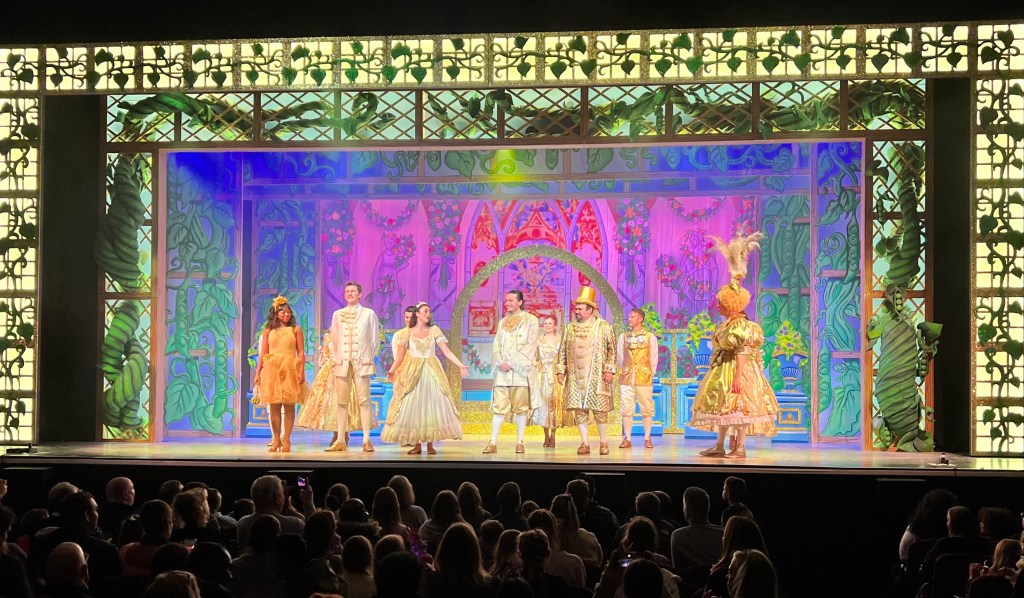
“Jack and the Beanstalk” was everything we could hope—wildly elaborate sets and costumes, exuberant dancing, double entendre jokes, and audience singalong to modern (ABBA, Neil Diamond) and traditional songs (Grand Old Duke of York). The characters included hesitant Jack Trott, his best friend Billy as emcee, his encouraging girlfriend, his boisterous mother Dame Trott who picked out a gentleman in the audience to woo with mildly salacious greetings throughout the show, and Caroline Trott—a two-person dancing cow of course, instead of a horse. The villain named “Backinanger” was played by a semi-famous TV actor; many taunts and jokes referred to his 10-year stint as a character on “East Enders” whose only ambition was to be in boy band. The ludicrous plot revolved around whether Jack would sell Caroline to save the world from the villain’s Climatron machine.
Tickets were held at the Alban Arena box office, but they had trouble finding our reservations so we were a few minutes tardy, and the usher took us to empty seats which were better than our assigned seats. The audience of parents, grandparents, and excited children were greeted by Billy and warmed up by repeatedly screaming “Hello, Billy.” Many excited children required sudden trips to the loo during the performance. There was a constant stream so to speak. At interval we struck up a conversation with a family sitting behind us. Becca, the mother, is an elementary school teacher so we had a nice chat.
We began day two in the St. Albans City museum. St. Albans was at one time a center of print-making and book-printing. One exhibit showed dozens of fine print illustrations by local resident Frederic Kitton for original editions of Charles Dickens books.
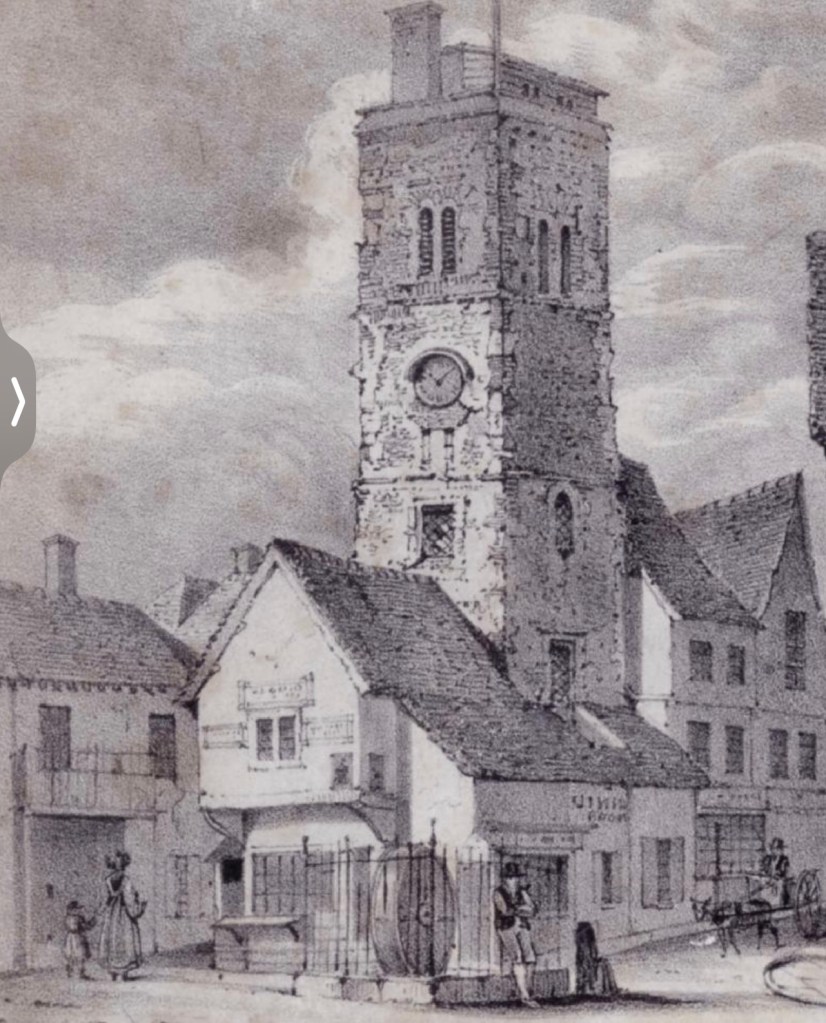
The other exhibit featured Henry Moore’s sketches of coal miners in cramped spaces underground. “In the Dark” is an apt name for charcoal and pencil drawings he drew as inspiration for sculptures.
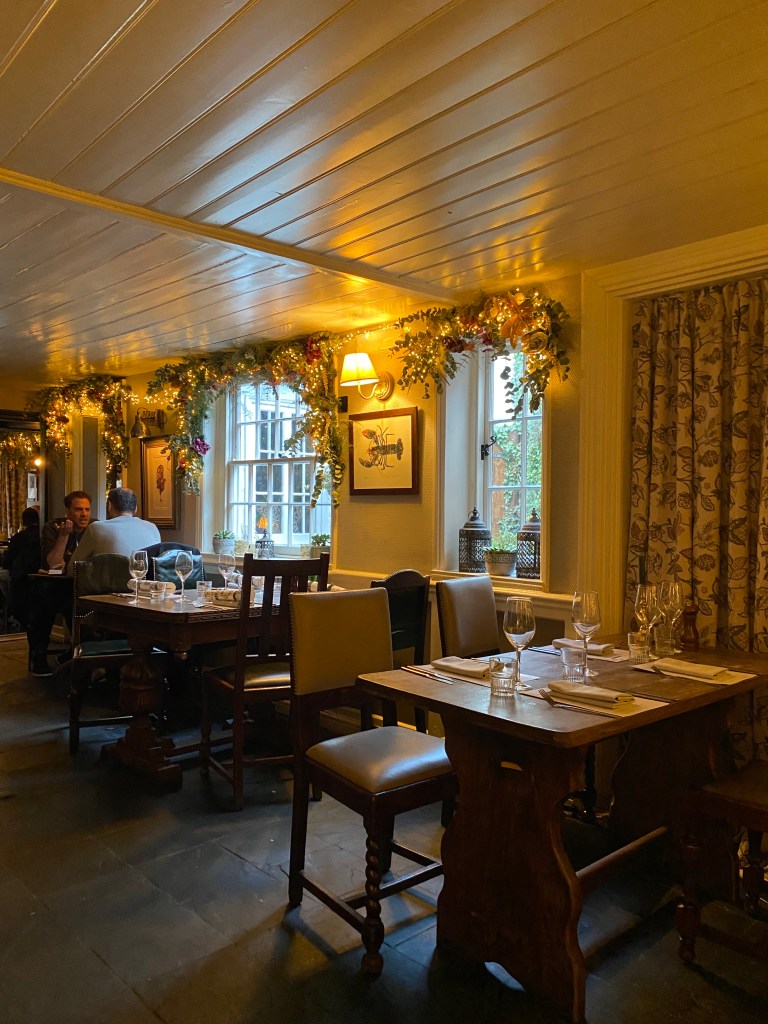
Knowing we needed to “book” a nice meal at Christmastime, we had made reservations for 2:30 at Dylan’s in the Kings Arms pub halfway down St. George’s street, a three block pedestrian walkway between High Street and Fishpool Road.
We enjoyed a fine three-course meal with a mushroom pastry for entree and custard for dessert. The food and service were great in the historical setting, and a cacophonous party of 10 added a festive touch. They had a head start nurturing their spirits.
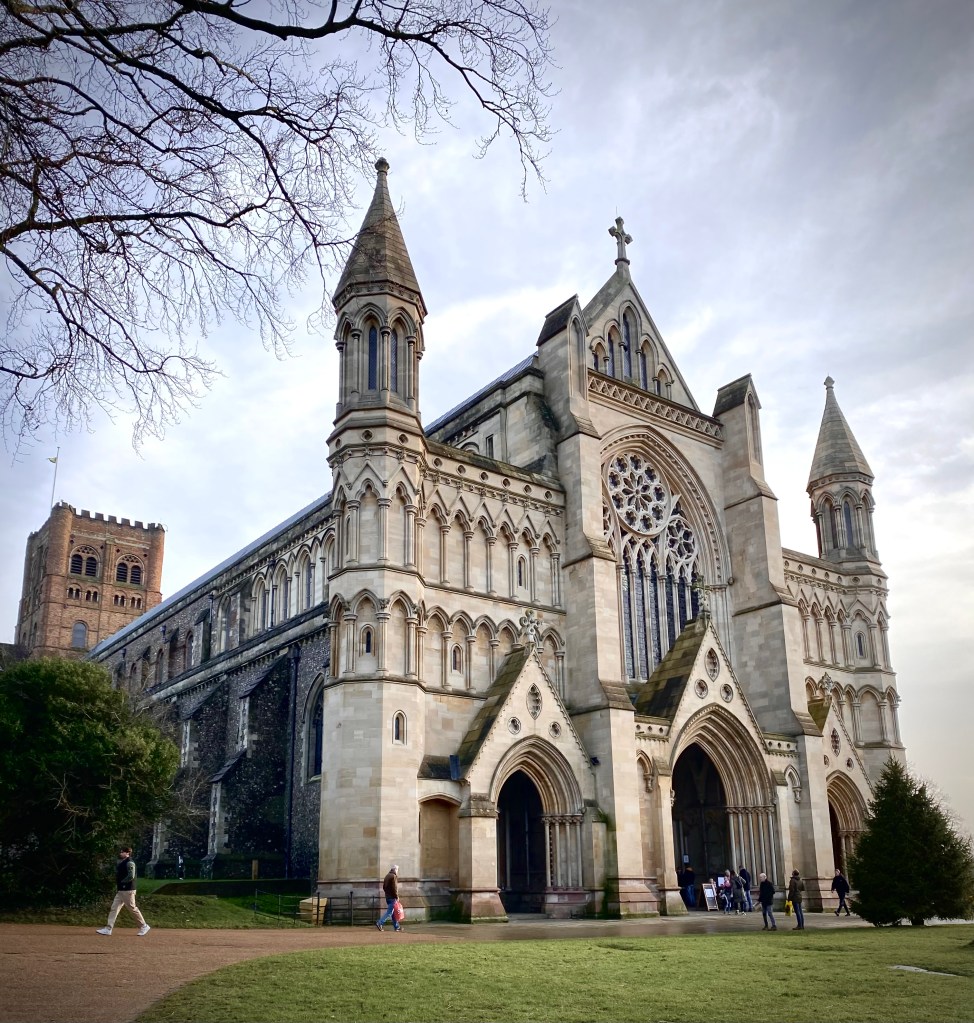
After the meal, we walked around the gigantic St. Albans Cathedral. The church site goes back to Roman times when a resident named Alban was hanged for harboring a Christian monk from the Roman authorities. (This was before Rome sent Christian missionaries across its empire.) Alban was the first English saint, so the site became a place of pilgrimage and successive churches were built there. His crypt stands in a special section of the Cathedral near an altar honoring the monk.
A Norman church with tower, beautiful arches, and 64 hand painted columns still serves at the core of the Cathedral. An Abbey was attached for hundreds of years until Henry VIII split with Rome and dissolved, destroyed, and rent asunder the abbeys throughout the kingdom. The town of St. Albans saved the Cathedral by buying it from the crown to serve as the parish church.
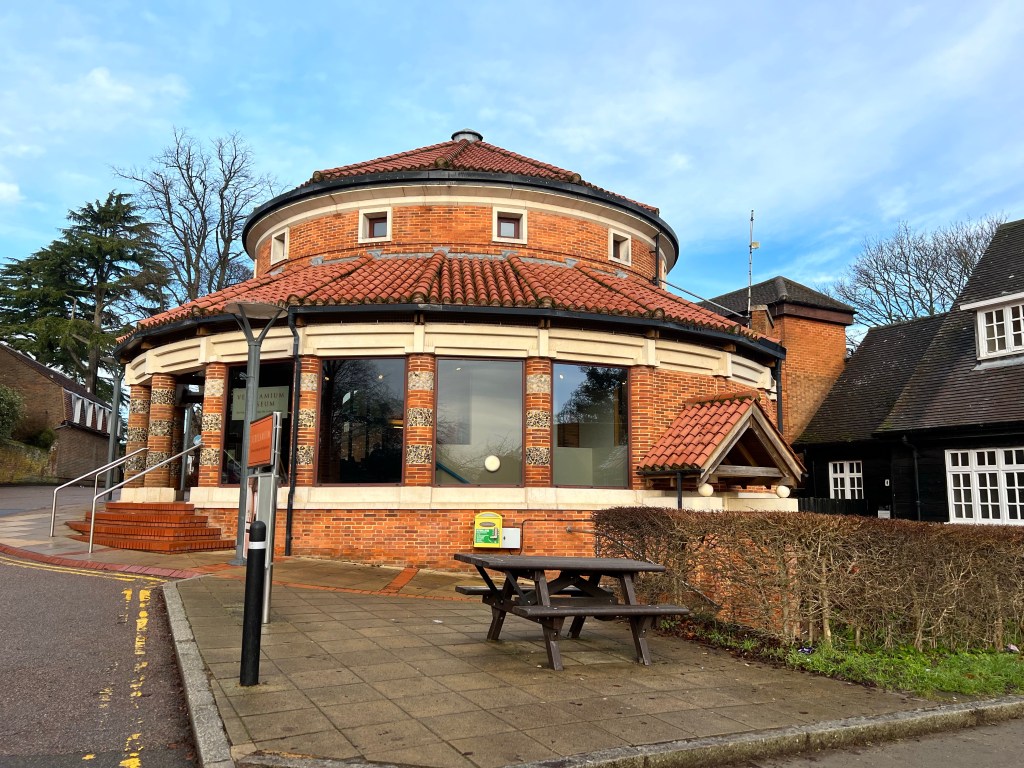
Most of the third day was spent exploring Verulamium Park and Museum about a mile south of the hotel. Verulamium, the third largest Roman settlement in Britain, was situated beside the River Ver at an Iron Age encampment called Verumion. The museum houses hundreds of artifacts unearthed across the large area including pre-Roman Iron Age relics as well as excavated Roman coins, tools, pottery, and jewelry, as well as magnificent mosaic floors and painted walls from Roman villas.
The museum focuses was on how ordinary civilians lived during the Roman occupation rather than the military aspect. The most impressive exhibits were the beautifully preserved mosaics, the wall paintings that were lifted from the ruins by gluing them on backing boards, and the Sandridge Hoard of 50 gold coins and 100 other coins from across the Roman empire.
Verulamium Museum, Sandridge Horde of gold coins, household wares

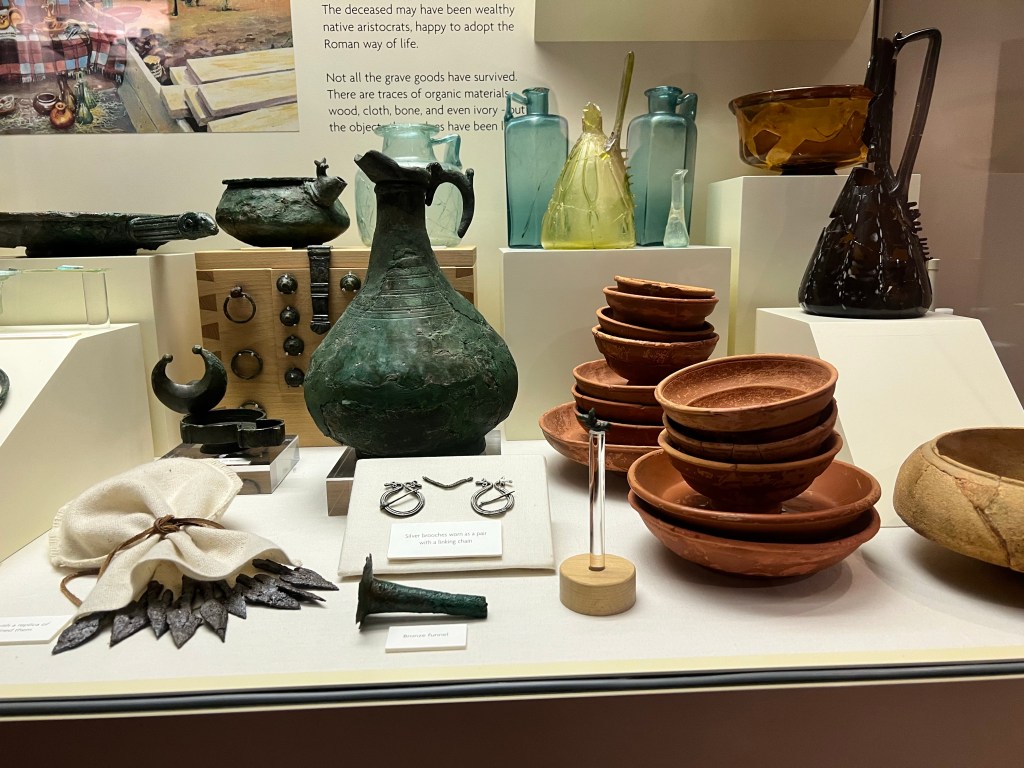
Near the museum were ruins of a Roman wall and Roman theatre. When the Romans abandoned Verulamium around 500 CE, the locals scavenged the ruins for brick building material for houses and for building the Cathedral.
- Search “Verulamium” for a complete description of the Roman settlement and the museum.
After several hours in the museum, we walked out the back entrance past St. Michaels, a small beautiful church and village, then through an upscale residential community on our walk uphill on Fishpool Street.
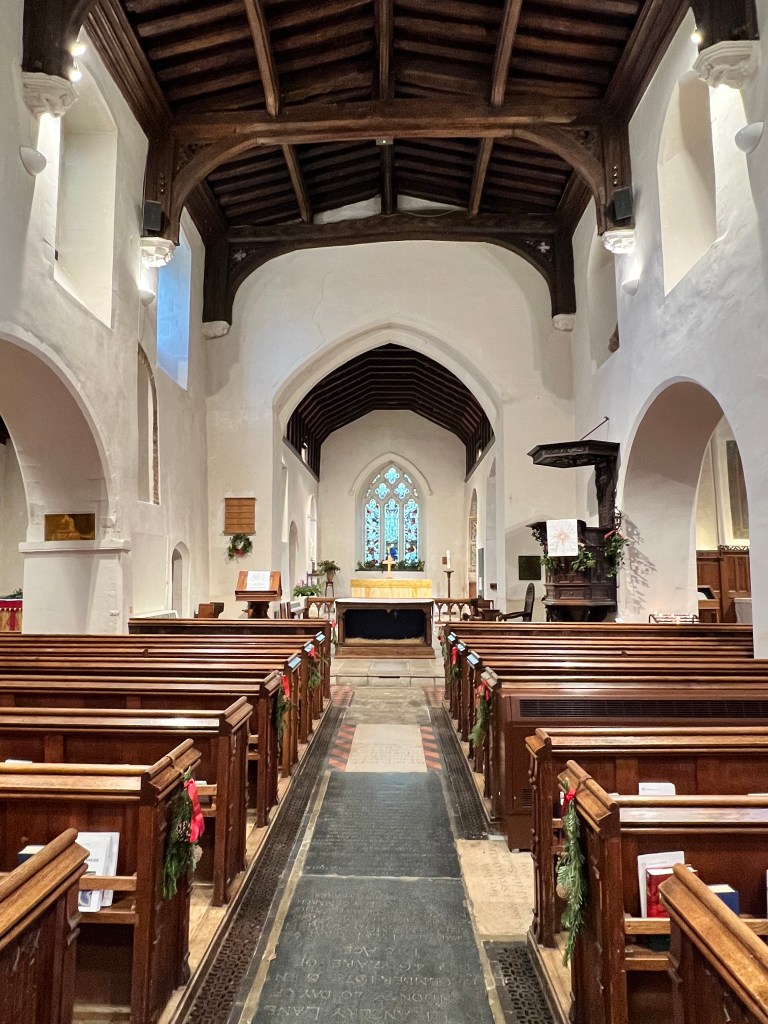
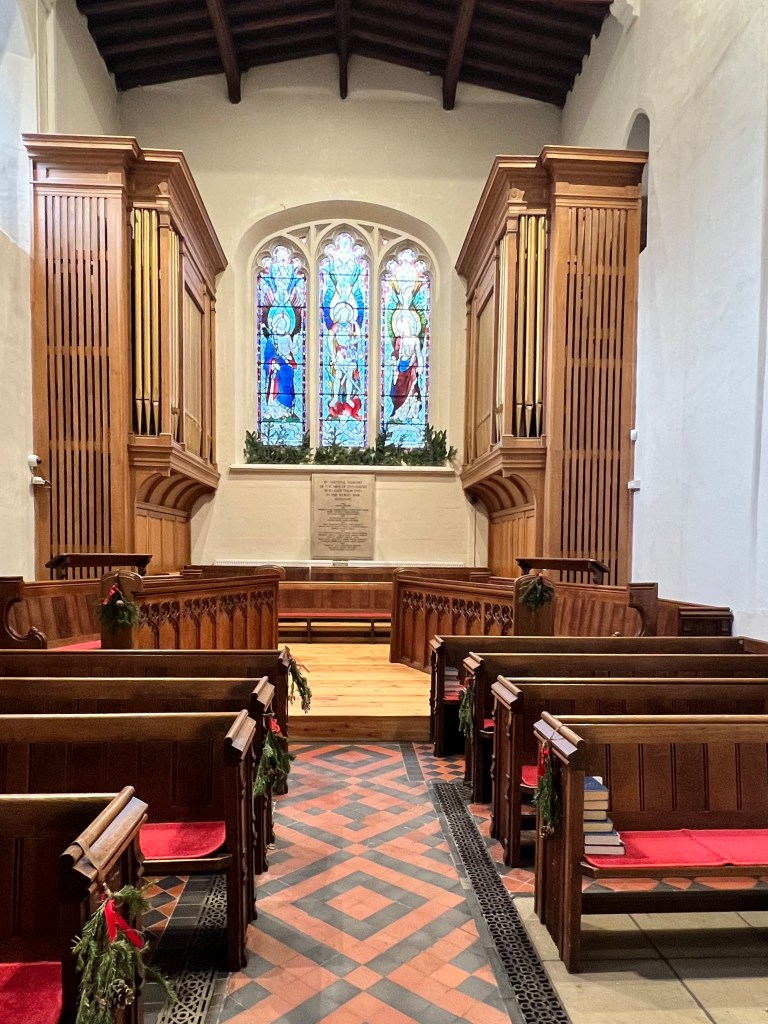
St. Michael’s Main Aisle and side Chapel. A beautiful gem.
At the moment we were flagging, a street sign for the Lower Red Lion pub proclaimed “dog friendly and child free.
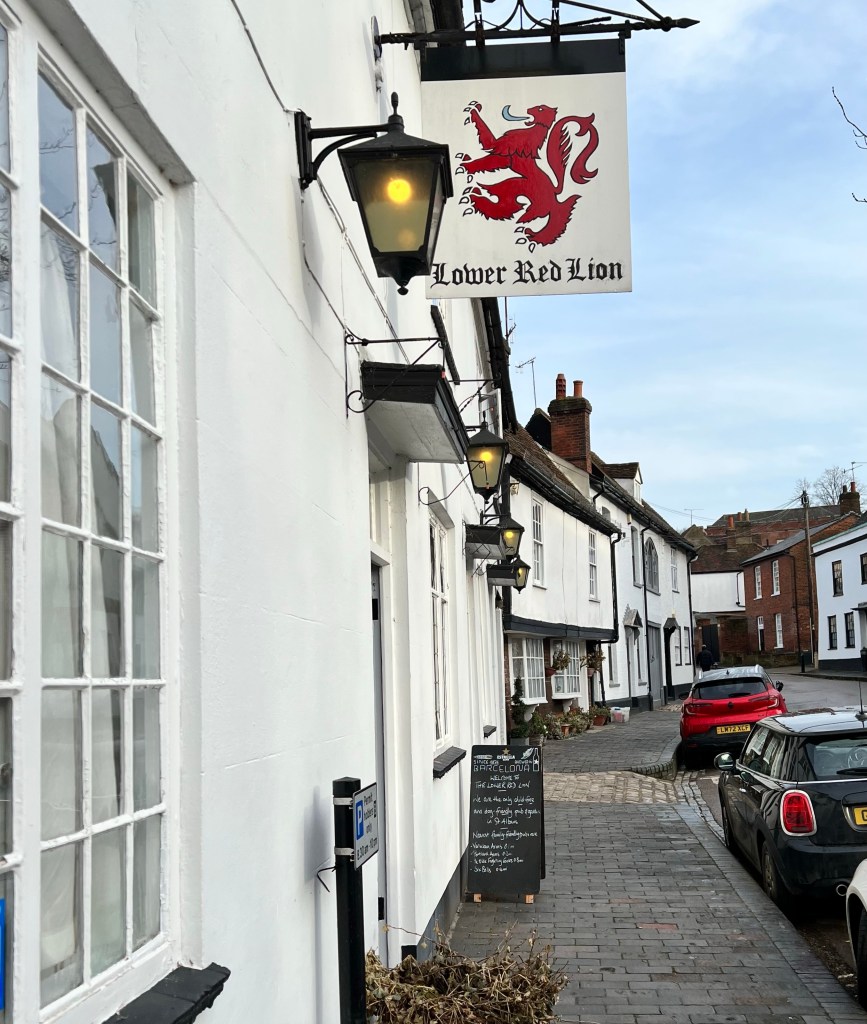

Lower Red Lion Inn and Sidewalk Sign
The sign added a list of nearby “family friendly” pubs. A great pub lunch of fish and chips and hot soup restored us, and the ancient three-legged pub dog Sammie visited for a rub. Closing the loop back to the hotel, I took the low road through the Cathedral grounds, while Becky stopped at the Hammersmith Bishop’s Cave shop for emergency cheese and crackers.
The Cathedral held Evensong on Christmas Eve, featuring youthful singing in the Quire. The service was lovely. On Christmas morning, we went back for a 9:30 family-oriented service. Choirs and worshippers sang both liturgical and traditional Christmas music. Singing in the huge Cathedral was an amazing vocal and emotional experience as the reverberating sound envelopes everyone.
Children were invited to view the huge crèche where the baby Jesus had appeared over night. Families walked down the central aisle of the longest nave in England (disputed by Winchester Cathedral). Later, as the service progressed, several children broke loose and followed personal pilgrimages through the Cathedral with parents in calm pursuit.
Christmas afternoon, we strolled around city center again, now almost empty except for a few restaurants with reserved seating. The only places open for walk-in were the Michelin one-star restaurant or the White Hart Inn Christmas Day dinner—each was available for 95 pounds per person (about $120 plus VAT and service charge). Instead we returned to the hotel for a pizza and cheese plate in the room and an evening of “Midsomer Mystery” and “Vera.”
On our last morning in St. Albans, we visited the Cathedral again for a more focused look at the building. A tour-guide told us of a scheduled 11:30 tour, then graciously spent 20 minutes showing us some of his favorite parts of the Cathedral. The scheduled tour was cancelled because the docents could not get the microphone to work, so we got another 20 minutes of personal guidance.
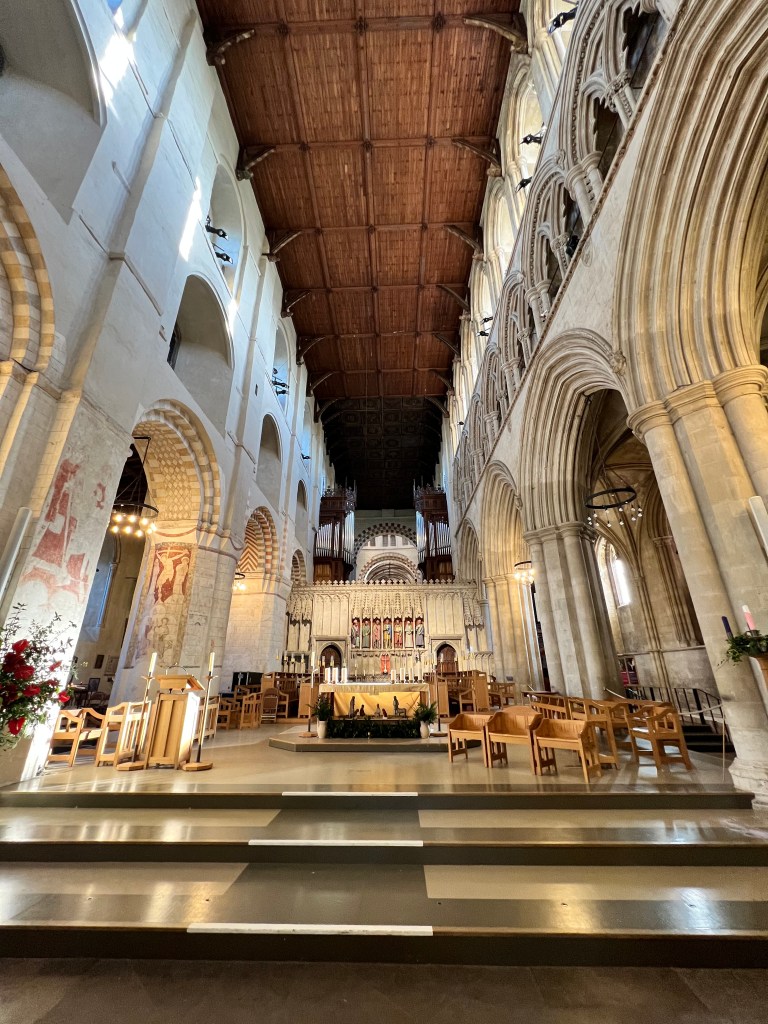
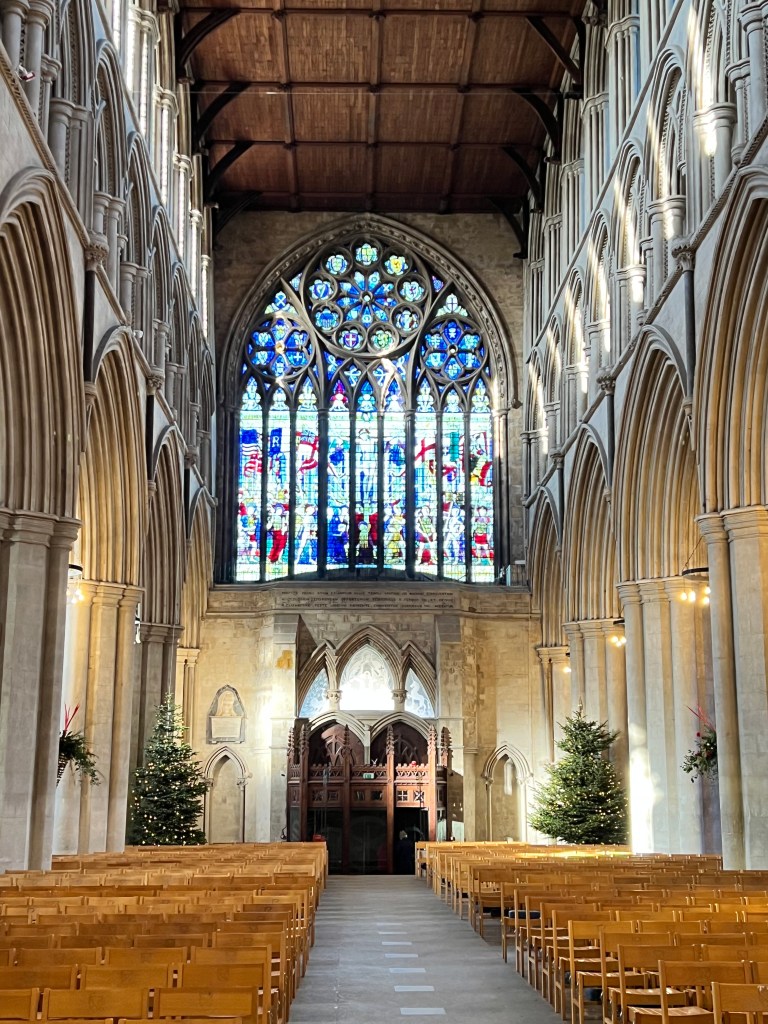
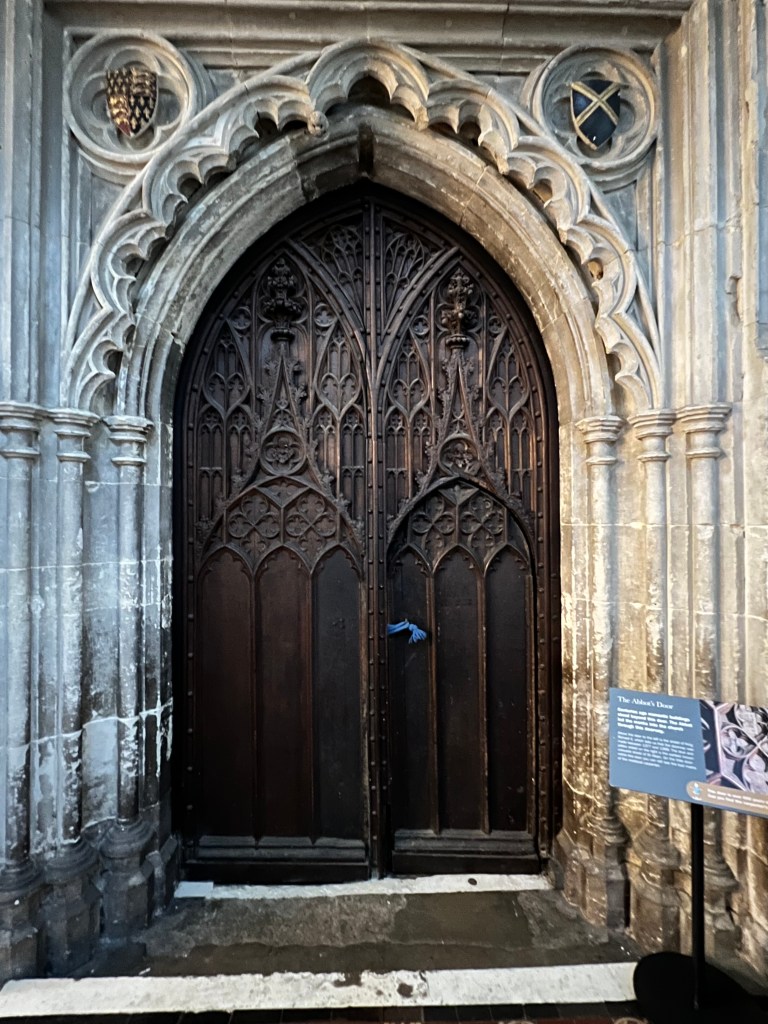
Interior spaces in Cathedral. Compare right and left walls in first picture. Rose Window, and Bishop’s Door Tap on Photos to Enlarge.
We also had the Cathedral guide book and a virtual tour online. We continued studying evidence of the Cathedral’s repeated building, damage and renovation over its 1000 year history of Norman, English, and Gothic architecture. Cathedrals tend make their own weather, generally chilly and breezy. On the tour, we passed a family with a 4-year old girl who was bundled up in hat, coat, leggings and scarf. Her repeated utterance was “C-C-cold, cha cha cha cha.”
- Travelers may say that once you have seen one Cathedral you have seen them all, and certainly they have similarities. But St. Albans Cathedral is like no others due to its history, architecture, and tradition. Ely Cathedral and Winchester Cathedral are other unique examples worth seeking out.
- The Cathedral website has a 3D virtual tour you might enjoy. stalbanscathedral.org
A mezze lunch at a Turkish restaurant completed the morning as we headed back to the hotel for a 2:30 taxi ride to Heathrow.
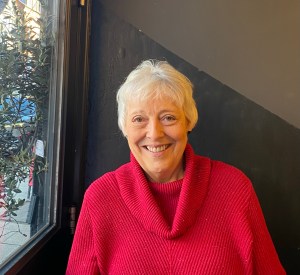
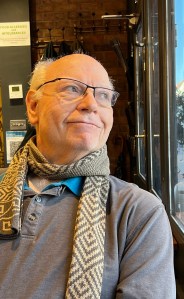
Our original plan was to stay at Samuel Ryder through Monday night and travel to Heathrow on the morning of the 27th, but reality and avoidance of panic dictated an alternate plan.
The M-pass was good for 8 days in December. We used two days coming and going to Dover and thought we could explore nearby villages. However, trains were not running consistently during the holidays due to scheduled track repairs and work stoppages (labor action). The train trip would have been an hour and half through downtown London even if they happened to be running that day.
The 10:20 flight on December 27th came with a strong caution to arrive 2-3 hours early for security. Getting to the airport by 7:20 seemed problematic. As a result, we arranged for taxi on Monday afternoon and spent the night at Hilton Garden Inn in the Heathrow Central Transport hub—only a 15 minute walk to Terminal 3. Although the hotel is 30 miles from Heathrow, the actual ride lasted over an hour including the stop-and-go traffic jam entering the airport. Being in a traffic jam on Monday afternoon instead of being anxious on Tuesday morning was a wise change.
In searching the Heathrow website, I read about an Indian bistro on Level 4 in Terminal 5 outside security. A week in England without Indian food would be incomplete. An hour of walking through tunnels, riding a train, and taking elevators or escalators from level to level brought us to Kanishka Kitchen. The lamb and eggplant wraps were small, light, and just spicy enough; we would definitely eat there again or maybe in their larger London restaurant someday.
Sunset Over Heathrow Airport
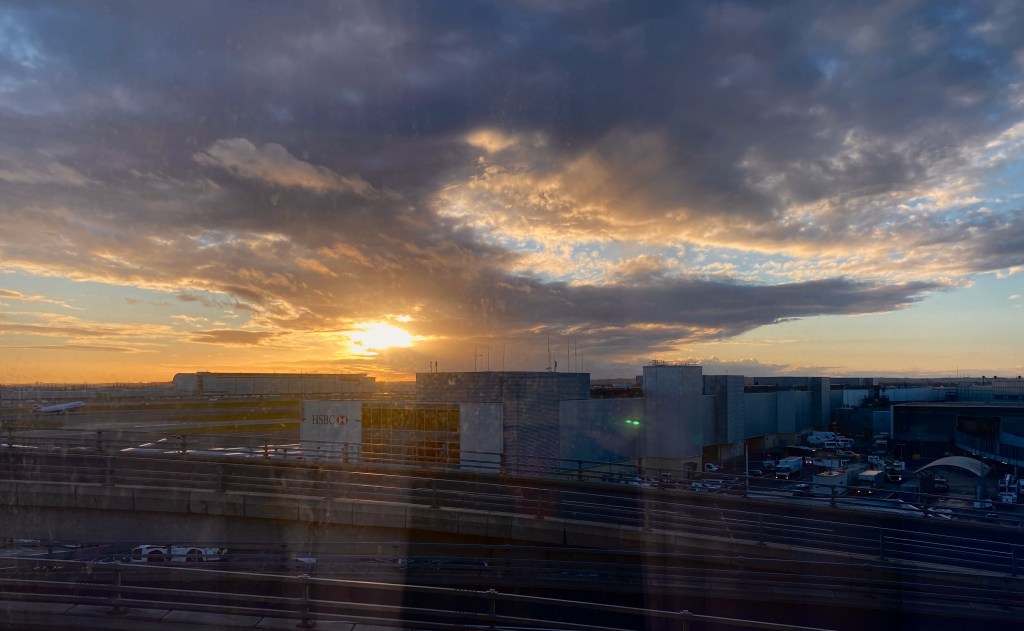
The next morning we were through security by 8:00, at our gate by 8:45, and boarding at 9:25 on a Boeing 787 to Philadelphia. After a long day, we arrived in Asheville around 5:30 pm without luggage. In Philadelphia, after we carried luggage through custom check, the airport had an alternative luggage drop-off for already checked-in bags. Becky correctly observed, “We are not going to get our luggage. This is a mess.” She was right. We imagined our luggage marooned somewhere with the thousands of lost suitcases from hundreds of cancelled flights.
After almost an hour waiting for no-show luggage and filing paper work, David took us home. We were too exhausted to be too upset about bags. We appreciated how Eric kept the house safe by turning off the water and draining the pipes during the hard freeze we missed in North Carolina. Wanda watched out for packages and the neighbors were alert to our absence. We had warm house, bed, and water but no food. A quick trip to Hot Dog World solved that problem and made us feel home again. We fell into our own bed with our travel refrain, “Good to go, good to get back.”
The next day, American reported that our 4 bags would arrive on the 5:30 flight from Philadelphia. We drove out and picked them up only one day late.
Thank you for traveling with us. We hope you found something interesting and informative from our travelogues. This is my first attempt at using WordPress for the travelogue. It was a learning experience not yet complete. The smaller photographs may be enlarged by tapping on them.
 Tipps for Travel