“Travel is fatal to prejudice, bigotry, and narrow-mindedness, and many of our people need it sorely on these accounts. Broad, wholesome, charitable views of men and things cannot be acquired by vegetating in one little corner of the earth all one’s lifetime.”
Mark Twain, The Innocents Abroad / Roughing It A quote from the first Hurtigruten presentation.
Each day/night after leaving the Arctic Circle involved anchoring in a fjord or docking where we could walk off the boat. We docked in Narvik on Otorfjorden, anchored in Bindalsfjorden for an adventure day, then docked at Andalsnes, Bergen in Byfjorden, and Egersund before crossing the North Sea channel (which Norwegians call the Norwegian Sea) to Dover. Each day brought new opportunities to participate in a variety of activities–both off the ship and within the ship.
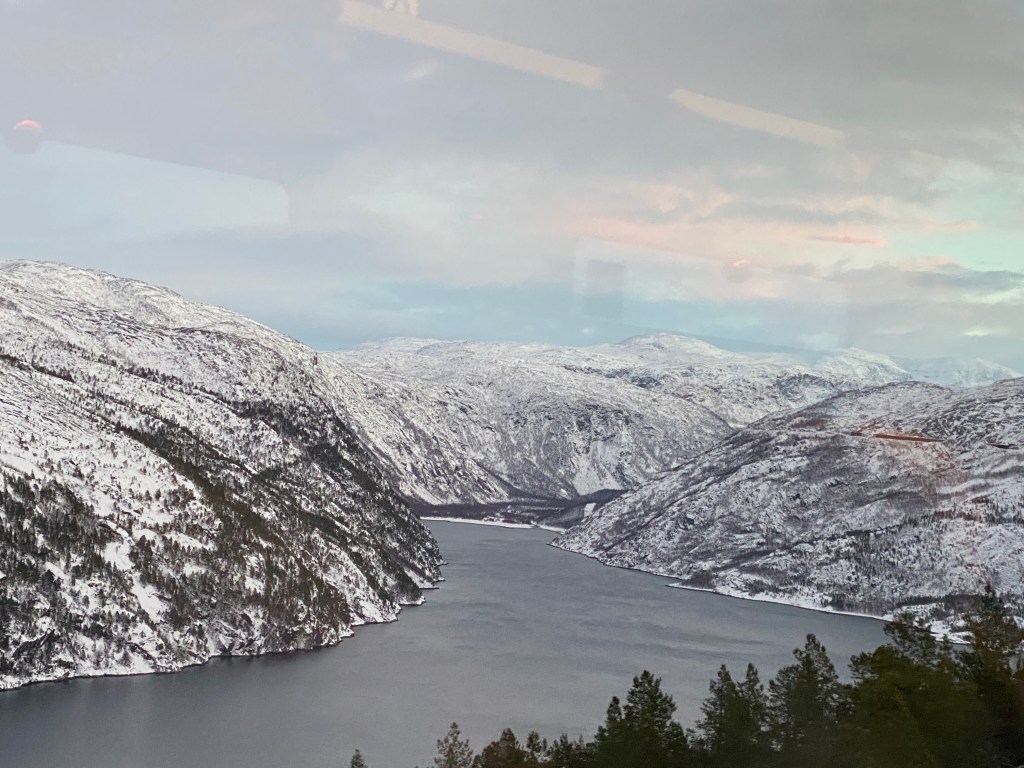
Southward. Norway, despite its efforts of neutrality, was invaded and occupied by Germans in World War II.
Narvik and Otofjorden witnessed ongoing sea and land battles between Norwegians and the Allies versus the Germans and some Norwegian quislings. A steep railroad built in the early 1900s was an engineering marvel hanging on the edge of the fjord mountain and connecting two of the largest iron mines in the world to a port that did not freeze over like those in Sweden.
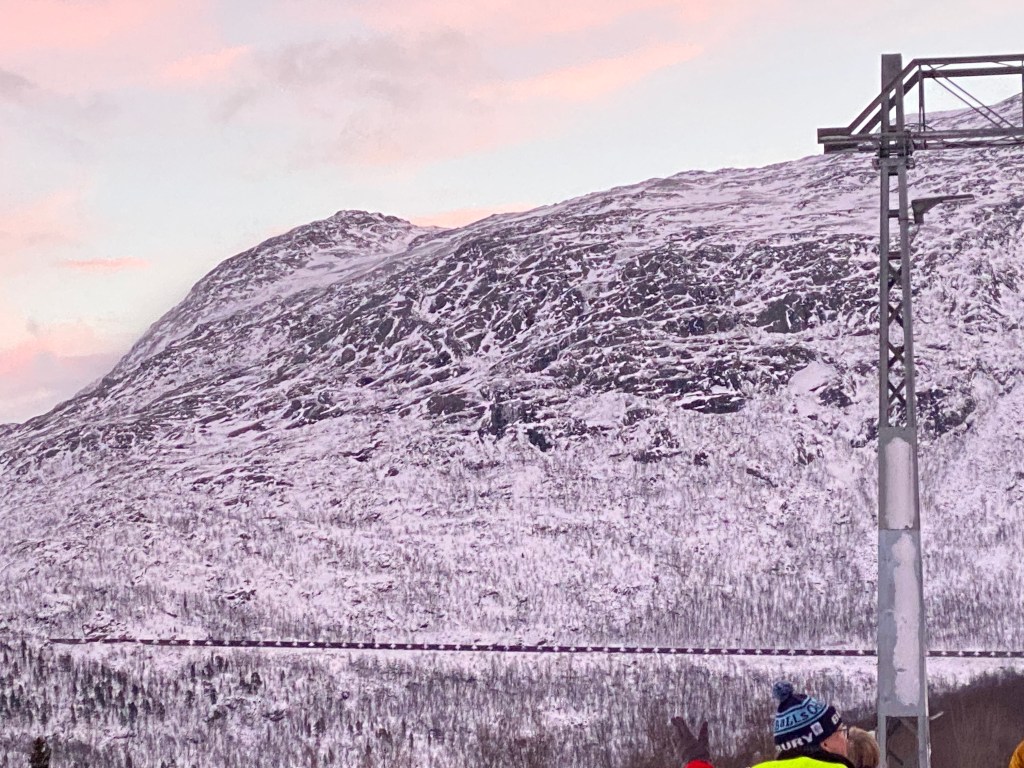
Can you see the rail cars on the side of the fjord? I counted 178 cars on the iron ore train.
Capturing the railroad, port, and iron ore was important to German war plans, and their ships arrived en masse without warning in 1940. A garrison of Norwegian soldiers fled into the surrounding mountains using the railroad and engaged in guerilla-type warfare until the British and later the Allies eventually were able to connect and coordinate efforts.
German and British ships of every description were bombed in battle and scuttled in the wide fjord. The bow of one German battleship is still visible in the fjord, but hard to see. One heroic story involved the British battleship that lost its bow but managed to get all the way back to England. We did not see much at first because we were sitting on the wrong side of the train next to the sheer side of the mountain. After the first stop, we moved to the starboardside looking out over the fjord at the rugged black and white mountain-scape. The railroad took us almost to the Swedish border then back with photo ops at four stations along the route.
This day we had time for only one excursion. Choosing between the train trip and the Narvik War Museum was hard; we were mildly disappointed at not having time to see both. Our lovely new friend Ann (we nicknamed her Dame Ann) kindly brought us brochures from the museum. For WWII buffs, Wikipedia has an excellent description of the battles. Dame Ann recommended 1965 movie “Heroes of Telemark” starring Richard Widmark and a surfeit of famous British actors which dramatizes one operation in the protracted war, rather like “Guns of Navarone” only in Norway.
The next day MS Maud dropped anchor in Bindalsfjorden for an expedition day, meaning that activities would be more physically demanding. The rubber boats would ferry adventurers to an island landing site for activities such as hiking, kayaking, and a polar plunge at zero Celsius. Steve immediately declared a day of leisure. Becky was planning to go ashore until the expedition team announced a long boat ride, a wet landing which involved getting out of the rubber rafts “near” shore, walking up a steep muddy incline, and wearing snowshoes on the hike.
Many passengers analyzed the situation as we did and were happy for the younger, hardier, and more agile to go ashore. Our buddy Andy took the challenge and reported that he was totally “knackered” from the snowshoe climb but that the expedition team had done an excellent job preparing the way and the hike was beautiful.
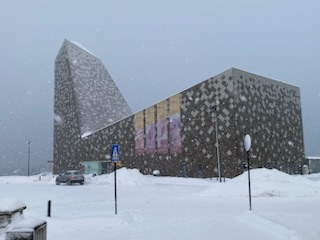
Andalsnes, the next stop, is a picturesque town built into the mountains on all sides. Some of the surrounding mountains are 750 meters high and the fjord is 750 meters deep, approximately 2 miles from the top to the bottom. A gondola ride to the top of the mountain was available, but we skipped it because the day began with a blinding snow storm and fog that obliterated the view. A sunny afternoon was perfect for a stroll in the snow. Andalsnes is the home of the Troll mountain range—a favorite of BASE jumpers, folk who parachute from buildings and mountains and float to the ground. We saw a film about the man who “invented” the sport and his eventual jumping demise. Yet another EXTREME sport I would not try.
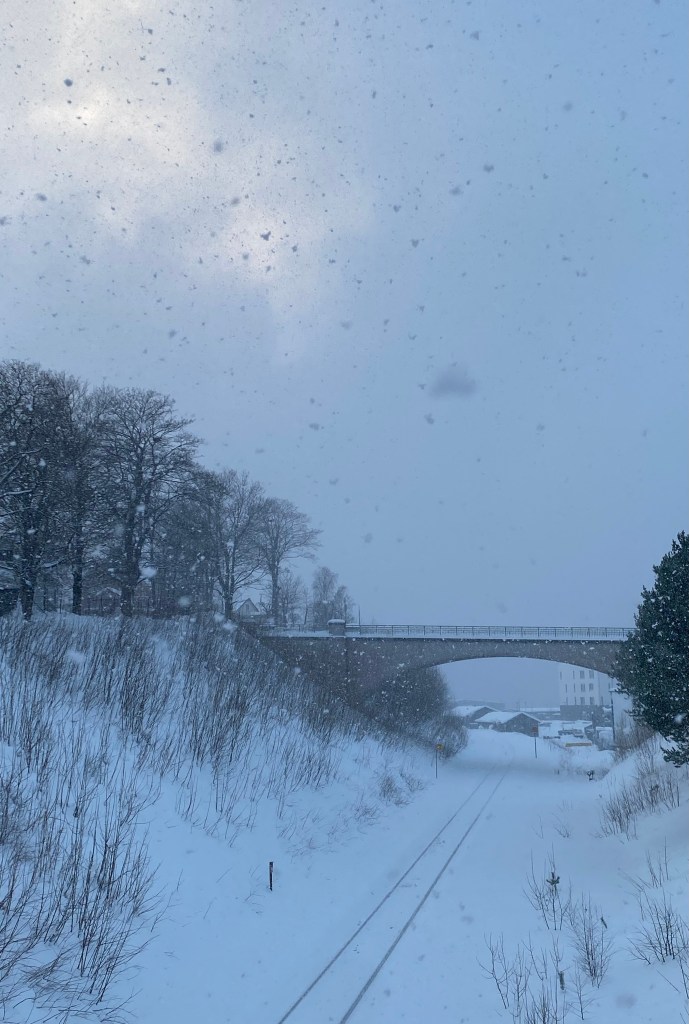
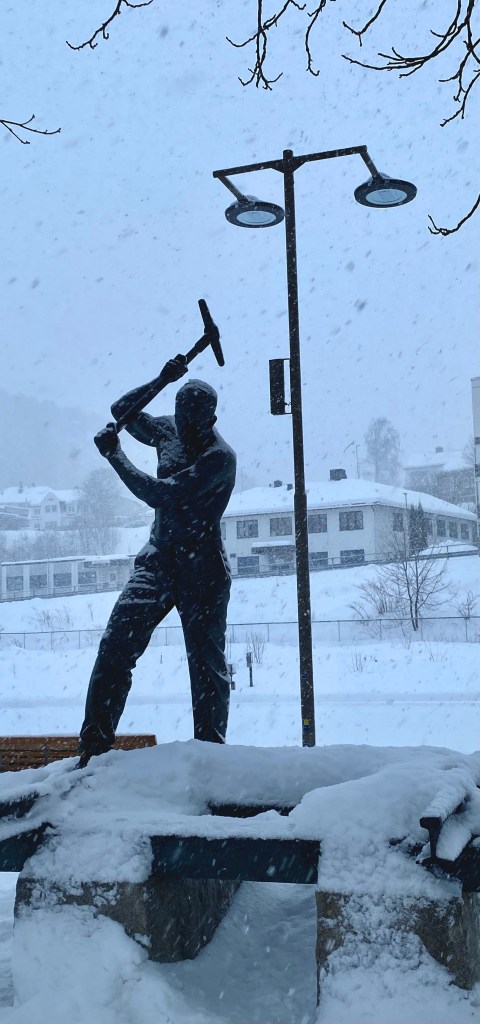
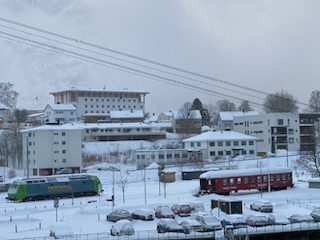
Everyone was looking forward to our stop in Bergen with the promise of Christmas Market and shopping in the second largest city in Norway. We docked just outside the city center and climbed aboard a bus with a local guide who pointed out the architectural and historic features of Bergen and the original settlement Bryggen. A few neighborhoods of crowded century-old wooden houses still exist; repeated fires plus WWII bombings plus an explosion of a German ship carrying tons of armaments destroyed most of the original houses, but some enclaves survived against all odds. Downtown Bergen was largely rebuilt after the war in modern, sleek Scandinavian style.

When Oslo became the capital, Bergen went into decline until North Sea oil and gas were discovered in the 1960s and 70s. Now Bergen is the most prosperous city as it is the largest supplier of oil for Europe during the current Ukraine war. It also has become the zero-carbon leader for Europe through hydroelectric power generation—rather ironic.
The tour bus stopped near the Christmas Market, but our images of glorious, craft-filled markets were disappointed;food vendors occupied most stalls with only one shop holding Christmas crafts. For lunch, Dame Ann recommended brats cooked on a open fire which were delicious. We hoped to spend some time in the KODE art museums downtown, but they are closed on Mondays.
As we were wearing our Hurtigruten orange/red coats, two women stopped us to chat. They are from South Africa and had flown to Bergen to begin a different Hurtigruten tour to go far into the arctic to Kirkenes, near Russia. Unfortunately, the airline lost one woman’s luggage with all her warm clothing. They were still hoping for luggage recovery. We walked about a mile back to the ship past a number of small, interesting shops through Bryggen. Having little space to pack anything, we were more lookers than shoppers.
Our final morning in Norway was spent in Egersund, a small village of 1500-2000. Archaeological findings show settlements that go back 4000 years. Since Viking times, Egersund (Oakland) has been a fishing village, and that tradition remains strong. Huge modern structures off load and process tons of krill, herring, and mackerel for distribution around the world.
A guide walked and talked us through the charming narrow, cobbled streets lit with thousands of twinkle lights— a Christmas wonderland with many local shops open for business. Highly recommended were the chocolate shop andlocally made gin distillery but we mostly followed our look-not-buy idea, Becky found a quilt store and bought onemeter of Norwegian-made fabric. Local clay has been used for pottery since the 1750s which we would like to see, but the pottery museum was closed on Tuesdays.
Winding Down, Wrapping Up. The lectures and workshops on various topics continued on the southbound route including the last day and a half at sea. A specialist from ORCA.com was on-board guest Cetacean expert and gave several lectures on these animals-whales, dolphins, and porpoises. We learned about their evolution and differentiation, feeding patterns and routes, habits and social behavior, environmental impact, and sound making and hearing abilities. Based on her guidance, Lauren challenged us to identify various cetacean songs, clicks, whistles, and moans by species.
Tim and Tomi continued to give science workshops and lectures about the ocean. The discovery boat passengers collected plankton 4 times along the route. Tim had a huge electronic microscope for identification and analysis of the different phytoplankton and zooplankton in the samples. Both are fascinating and important to the health of oceans and therefore everything.
Katrina amazed us with her knowledge as historian and culture specialist. She took us on a tour of the beautiful art that Hurtigruten displayed on MS Maud including photography, sculpture, design, painting, prints. All were labeledas a museum would. She sponsored several art workshops—on runes, Sami symbols, and paper weaving.
She also gave more information about the history and culture of the Vikings and Sami peoples. Fjords may look like tiny streams and inlets from the ocean on maps when in fact they are miles and miles of wide and winding water. In fact, “vik” means water and “Viking” means people who live/work on the water. Most Vikings were farmers who lived communally in “long houses” and engaged in storytelling and singing about customs and folklore. Their religion included many different deities who ruled various natural phenomenon and were hierarchically organized.
Since land was passed to the eldest son, the rest of the boys in the family had to figure out how to live. Some of those were the explorers and adventurers renowned in legend and fact as marauders who terrorized peaceful and unsuspecting Celts and Jutes and Franks and Danes, etc. However after the pillaging, Viking settlers moved in and set up trade. You can believe all the gory images of the Vikings portrayed in movies (recently “Norsemen”), and they may be accurate, but they portray only a small part of the culture.
The last days at sea were for wrapping up, celebrating, reviewing, and saying good bye. The three top executives on board—Captain, Chief Engineer, and Hotel Manager—held a Q&A about their jobs. The Captain told us that our route was approximately 3500 nautical miles and talked about their navigation process. The Engineer described how Hurtigruten uses low pollutant oil and is actively looking toward new fuel sources. The Hotel manager has worked for Hurtigruten for two years. Her job responsibilities include overseeing food service, cabin assignment and comfort, and cleaning which goes on constantly. We had “green” days on which we skipped cabin cleaning and that cost became a donation to the Hurtigruten Foundation for the environment.
Other activities were a band night featuring members of the crew, a variety farewell show put on by passengers, and a champagne toast with passengers, officers, expedition team and specialists, and the crew. On this cruise, there were about 250 passengers and 140 personnel. The MS Maud could accommodate about 500 passengers, but everybody was glad that we had lots of room to roam and enjoy.
Geraldine, our professional photographer, documented our journey and presented a slideshow of her photographs on the last day. She has such an amazing eye. We look forward to getting her photographs for our memory book. She was particularly helpful to Becky with the camera and they became friends.
Daniel, the chef, was always watching food service and Shez served as maitre’d. Becky became friends with both of them. Daniel gave Becky his hot-and-sour soup recipe scaled for 100 servings but metric measurements will make it easy to use. The food continued to be interesting and tasty and mostly very healthy—except for the scrumptious breads and beautiful desserts. Morning and night we were treated to croissants, millefeuille, financiers, hot cross buns, puddings, sauces, miniature pies, napoleons of various kinds, cakes, and assorted ice cream and gelatos. We suspected contestants from the Great British Baking Show were working in the galley.
Saying good-bye to new friends and trading contact information were happy/sad events. We had dinner with Pete and Anne on Tuesday and with Andy and Judith on Wednesday. Both nights we talked until we were the only ones in the AUNE restaurant. Tonya sat with us for a few minutes on the last morning. We even met some folk from Ohio while waiting to leave the ship. As far as we could tell, only about 15-20 travellers were from the USA.
Our luggage was due outside the cabin by 10:00 on Wednesday night so that Thursday morning we could roll out of bed, dress, eat breakfast, and wait for the notification for leaving ship. Our point of embarkation was now our point of departure. We got a taxi to the Dover train station and were on our way to St. Albans for Christmas.
Hi, I’m Linda Antin,
an independent designer and filmmaker
who loves nature.


 Tipps for Travel